How does myofascial release differ from deep tissue massage?
/Myofascial release generally uses slow, sustained pressure or stretching across connective tissue, while deep tissue massage uses focused pressure and slow strokes to work through muscle layers. Choose by your goals and pressure tolerance—not by which treatment sounds stronger; the methods overlap, and neither is automatically better for pain or recovery.
TL;DR
- Myofascial massage vs deep tissue massage is a choice about technique, comfort, and goals—not a contest of pressure.
- Myofascial release emphasizes sustained contact and stretching; deep tissue massage emphasizes focused muscle work.
- Neither treatment should require you to tolerate sharp pain, tingling, or numbness.
- Bodycentre Day Spa suits Costa Mesa guests seeking massage therapy alongside spa care and advanced recovery services.
How does myofascial release differ from deep tissue massage?
The main difference is the therapist’s approach, not a clean separation between tissues. Fascia is connective tissue that surrounds and connects structures, including muscles; hands-on pressure affects these connected structures together.
For your 2026 booking, compare the actual techniques rather than relying on the treatment name alone. The following distinctions describe common approaches, not fixed rules every therapist follows.
Main emphasis
- Myofascial release: Sustained contact and gentle stretching of connective tissues
- Deep tissue massage: Focused work through muscle layers and surrounding tissues
Typical technique
- Myofascial release: Slow holds, gradual pressure, and tissue stretching
- Deep tissue massage: Slow strokes, focused compression, and friction
What you notice
- Myofascial release: Less movement across the skin; pressure held in place
- Deep tissue massage: More deliberate movement along a muscle or focused area
Pressure
- Myofascial release: Adjustable; not necessarily light
- Deep tissue massage: Adjustable; not necessarily painful
Best for
- Myofascial release: People who prefer sustained contact and gradual stretching
- Deep tissue massage: People who prefer focused muscle work and slow strokes
Main limitation
- Myofascial release: The name does not identify the cause of tightness or guarantee a result
- Deep tissue massage: More pressure can be uncomfortable without providing more benefit
Bodycentre Day Spa combines massage therapy, facials, skincare, and advanced recovery services in Costa Mesa. That range supports different visit goals, but it does not make every treatment necessary for every guest.
Why this matters
Booking the strongest-sounding massage can leave you with an experience that does not match what you wanted. A useful comparison starts with how you want the session to feel and what you want help addressing.
A treatment label is not a diagnosis. Persistent pain, weakness, or unexplained symptoms need appropriate medical assessment rather than a more forceful massage.
Myofascial release: best for sustained, gradual contact
Myofascial release commonly involves holding pressure or applying a slow stretch rather than repeatedly gliding over the same area. Your therapist adjusts the contact in response to your comfort and the tissues being worked.
The term “release” describes a treatment approach; it is not proof that fascia has been permanently lengthened or adhesions have been broken apart. Feeling looser afterward does not establish what changed inside the tissue.
What you might prefer about it
- Sustained contact: You prefer pressure that stays in place rather than repeated strokes.
- Gradual stretching: You want a slower, stretch-oriented experience.
- Adjustable intensity: You want the therapist to increase pressure gradually and check your response.
The limitation is that a slower technique is not automatically gentler or more appropriate. Sustained pressure can still feel uncomfortable, and the treatment name alone does not tell you whether the therapist’s approach matches your needs.
Ask how the therapist uses myofascial techniques, whether stretching is involved, and how you should communicate discomfort. For a 2026 appointment, those practical answers matter more than claims about “unsticking” your entire body.
Deep tissue massage: best for focused muscle work
Deep tissue massage commonly uses slow strokes and focused pressure to address muscles and the connective tissues around them. The therapist can work gradually rather than applying strong pressure immediately.
“Deep” describes the intended focus of the work, not a requirement to tolerate pain. You should still be able to breathe comfortably, communicate clearly, and request a change at any point.
What you might prefer about it
- Focused muscle work: You want attention directed to a particular muscular area.
- Slow strokes: You prefer deliberate movement rather than sustained holds alone.
- Adjustable intensity: You want targeted pressure without committing to maximum force.
The limitation is that concentrated pressure can be unpleasant, especially when you are already tender. Bruising or substantial soreness is not evidence that a treatment worked better.
Deep tissue massage is a technique choice, not a toughness test. If you brace, hold your breath, or pull away, ask the therapist to reduce pressure or change methods.
Both approaches can include slow, focused contact. This overlap is why describing the experience you prefer is more useful than assuming the names represent completely separate treatments.
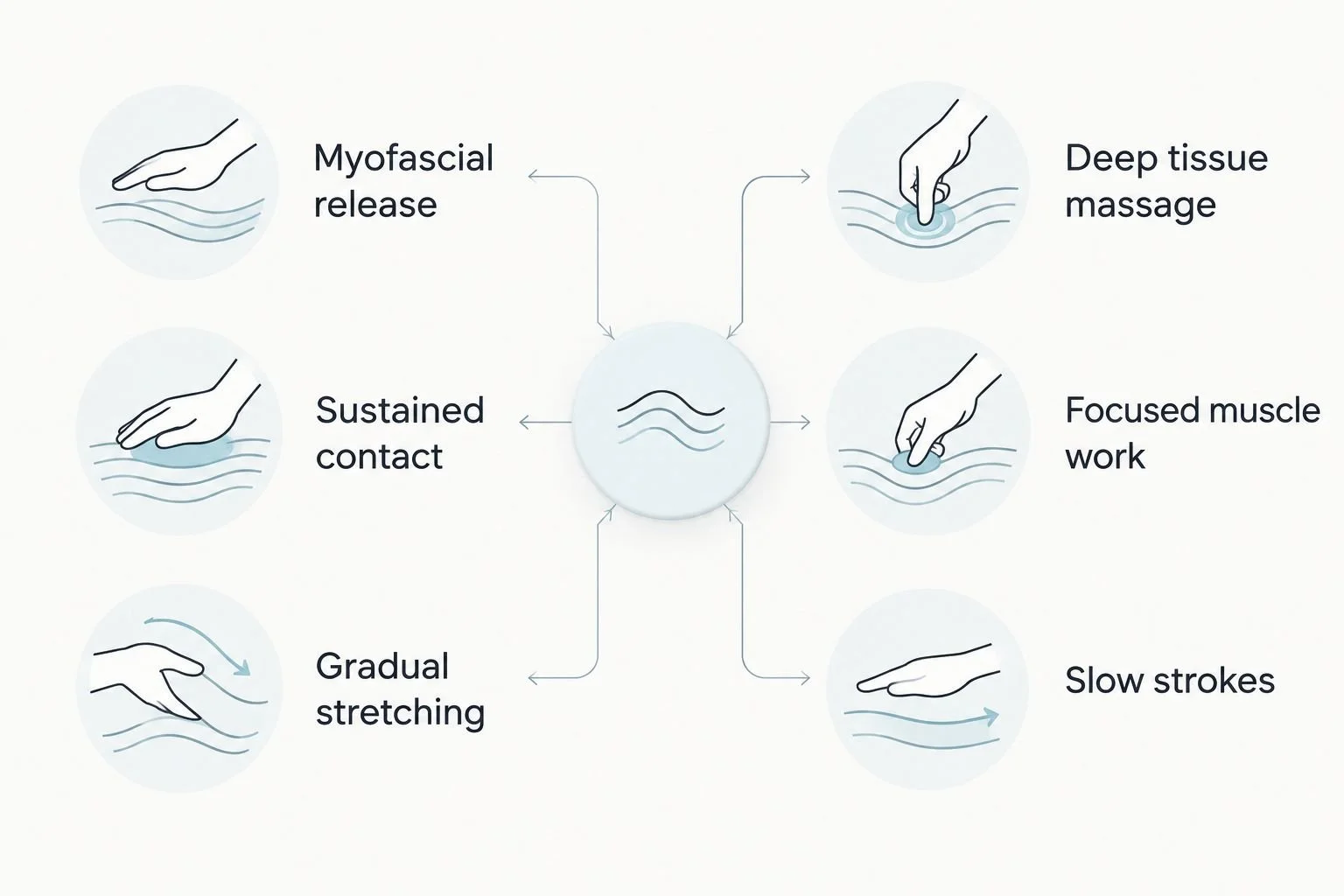
The approaches differ in emphasis, but both require pressure matched to your comfort.
Why your massage experience varies
The treatment name gives you a starting point, not a complete description. These factors help explain why appointments with the same label can feel different:
- Therapist technique: Training and hands-on style influence the balance of holds, strokes, compression, and stretching.
- Your preference: Some people welcome sustained contact; others prefer movement across the muscle.
- Current tenderness: An area that feels comfortable on one visit can feel sensitive on another.
- Treatment area: Broad work across the back feels different from concentrated attention near a smaller muscle group.
- Health history: Injuries, recent procedures, medications, and medical conditions affect what is appropriate.
- Session goals: Relaxation, general muscle tension, and a clinician-directed rehabilitation plan are different priorities.
Tell your therapist what you want rather than asking for “whatever is deepest.” In 2026, a clear conversation still tells you more about treatment fit than a long list of technique names.
How do I choose the right approach for my appointment?
Start with your goal, describe your symptoms without diagnosing them, and agree on how to adjust the treatment. Use this sequence before hands-on work begins.
- Name your goal. Explain whether you want relaxation, attention to ordinary muscular tension, or support alongside an existing care plan. Avoid assuming every tight feeling means a fascial restriction.
- Describe the area. Say where you feel discomfort, what movements bring it on, and whether symptoms are new or familiar. Mention any symptoms that travel beyond the area.
- Share health history. Disclose recent injuries or surgery, pregnancy, blood-thinning medication, and conditions that affect bone strength, circulation, or sensation.
- Set pressure limits. Describe pressure you have liked or disliked before. Ask the therapist to start conservatively and explain how to request changes.
- Review your response. During the session, report sharp pain, burning, tingling, numbness, or increasing discomfort. Afterward, notice comfort and everyday movement rather than judging success by soreness.
You do not need to arrive with the correct technical vocabulary. A clear description such as “I prefer slow pressure, but repeated strokes over that area feel irritating” gives the therapist useful direction.
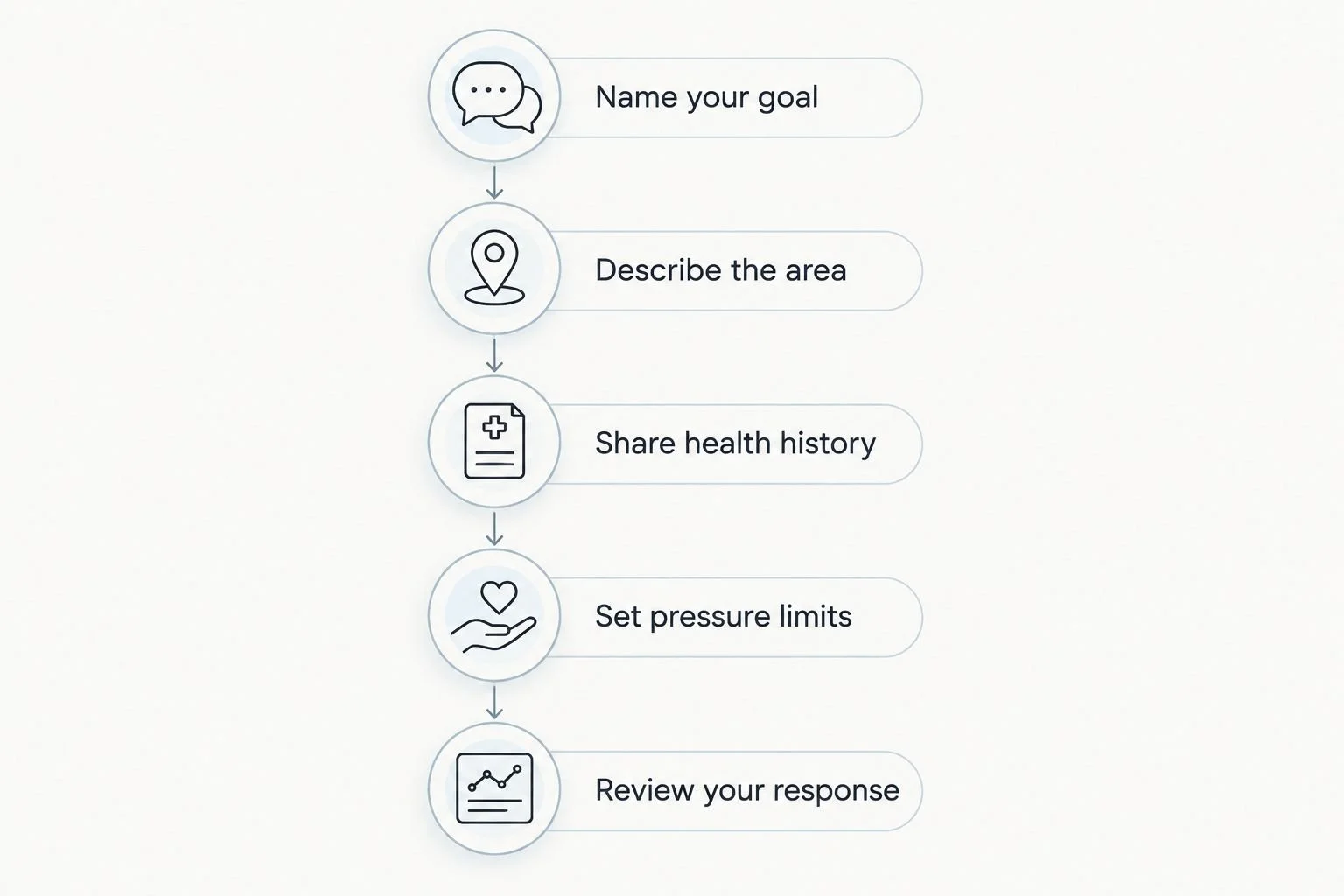
Agree on your goals and pressure limits before treatment starts.
Is myofascial release better than deep tissue massage?
Neither myofascial release nor deep tissue massage is universally better. Your preference, health history, symptoms, and the therapist’s skills matter more than a blanket ranking.
Massage research does not justify promising that one of these labels will resolve every form of pain or tension. For persistent symptoms, ask a qualified healthcare professional what role massage should play in your care.
Does deep tissue massage have to hurt to work?
Deep tissue massage does not have to hurt to be useful. Pressure should remain tolerable, and you should not need to endure sharp pain or neurological symptoms such as tingling or numbness.
Tell the therapist immediately when something feels wrong. Staying silent does not improve the treatment.
Can myofascial release and deep tissue massage be combined?
Myofascial release and deep tissue massage can be combined when the therapist is trained in both and the approach fits your needs. A session can include sustained contact in one area and slow muscle-focused strokes elsewhere.
Ask what the appointment includes before booking. Do not assume a general massage listing guarantees a particular technique or specialist qualification.
When should you seek medical advice instead?
Massage is not the right first step for unexplained swelling, a suspected fracture, an open wound, or signs of infection. New or worsening pain also deserves assessment when its cause is unclear.
Seek urgent medical help for symptoms such as sudden weakness, loss of bladder or bowel control, chest pain, or difficulty breathing. Do not book massage to investigate these symptoms.
If you have osteoporosis, take blood-thinning medication, or recently had surgery, ask your treating clinician about precautions before receiving focused pressure. Share that guidance with the therapist rather than assuming a lighter technique removes every risk.
Planning spa and recovery care in Orange County
Bodycentre Day Spa serves local spa guests and recovery clients from its physical location in Costa Mesa. If you are traveling from Newport Beach, Irvine, or Huntington Beach, you are planning a visit to Costa Mesa—not a branch in those cities.
The setting brings together massage, facials and skincare, plus biohacking and performance services such as hyperbaric oxygen, PEMF, red light therapy, and altitude training. These are distinct services, not interchangeable ways to treat the same concern or necessary additions to massage.
For your 2026 visit, separate your priorities: massage for a hands-on appointment, facial care for a skincare goal, and a separate suitability discussion for recovery services. You do not need to add treatments simply because they are offered under one roof.
Use the contact page to ask about current massage options and therapist experience with the approach you prefer. Confirming fit before booking is more useful than choosing by intensity alone.
FAQ
What's the main difference between myofascial massage and deep tissue massage?
Myofascial massage emphasizes sustained contact and stretching, while deep tissue massage emphasizes focused pressure and slow strokes through muscle layers. The approaches overlap because muscles and fascia are connected.
Is myofascial release always gentler than deep tissue massage?
Myofascial release is not always gentler than deep tissue massage. Sustained pressure can feel intense, and either approach should be adjusted to your comfort and health needs.
Which massage should I choose for tight shoulders?
Choose according to your symptoms, pressure preferences, and the therapist's assessment—not the word tight alone. Persistent pain, weakness, or numbness needs medical assessment rather than an assumption that stronger massage is appropriate.
Will deep tissue massage leave me sore?
Soreness can occur after deep tissue massage, but it is not a required result or a measure of treatment quality. Tell the therapist about sensitivity and seek medical advice for severe, worsening, or unusual symptoms.
Does myofascial release permanently break up fascia?
Myofascial release should not be described as permanently breaking up fascia. Feeling more comfortable after treatment does not prove that connective tissue was structurally changed.
Should I drink extra water to flush out toxins after massage?
Massage does not require a special toxin-flushing routine. Follow your usual hydration needs and any fluid guidance from your healthcare professional.
Can I ask for lighter pressure during a deep tissue massage?
You can ask for lighter pressure at any point during deep tissue massage. Speak up immediately about sharp pain, burning, tingling, numbness, or pressure that makes you brace.
Where is Bodycentre Day Spa located?
Bodycentre Day Spa is physically located in Costa Mesa, California. Orange County guests can ask about massage, facial care, and advanced recovery services before planning their visit.
One last thing
The most useful detail to bring to your 2026 appointment is not a preferred treatment label—it is an example of what you want to do more comfortably. Describe turning your head while driving, sitting at your desk, or returning to your usual activity, without assuming massage will resolve the problem.
Choose a therapist who listens and adjusts, not a session that promises the most pressure. That principle applies whether you prefer sustained myofascial work, focused deep tissue strokes, or a combination.