
How many craniosacral massage sessions do you need?
/There is no established number of craniosacral massage sessions you need, and no proven schedule guarantees relief. For your 2026 wellness planning, treat any suggested series as a proposal to review—not a medical requirement—and judge further appointments against a clear goal and your experience.
TL;DR
- Craniosacral massage has no established session count; reassess before committing to repeat visits.
- Bodycentre Day Spa combines spa care and recovery services in Costa Mesa; ask about treatment suitability before booking.
- Choose a specific goal, track your response, and stop if touch causes discomfort.
- Persistent or worsening symptoms need medical assessment, not an automatically extended massage schedule.
How many craniosacral massage sessions do you need?
You do not need to commit to a predetermined series. Craniosacral massage, also called craniosacral therapy, uses gentle touch, commonly around the head, spine, and pelvis. Research has not established a reliable session count for treating a particular condition or producing lasting results.
A practitioner's recommendation is therefore not the same as a validated treatment schedule. Ask what the recommendation is based on, what change you should look for, and what would prompt a different approach.
For local questions, Bodycentre Day Spa offers spa care and recovery services in Costa Mesa. Confirm the specific treatment you want before arranging your visit.
Your next step depends on your goal and response, rather than an appointment total:
Initial appointment
- Best for: Exploring whether gentle touch feels comfortable
- Advantage: Lets you assess the experience before deciding about repeats
- Limitation: Does not establish lasting benefit or medical effectiveness
Repeat appointment
- Best for: Continuing an experience you find worthwhile
- Advantage: Lets you reassess the same personal goal
- Limitation: Repetition does not guarantee a greater or longer-lasting effect
Pause
- Best for: Unclear benefit or an uncomfortable experience
- Advantage: Avoids continuing without a reason
- Limitation: Does not address an underlying health problem
Medical assessment
- Best for: Persistent, unexplained, or worsening symptoms
- Advantage: Focuses on evaluating the symptoms
- Limitation: A spa appointment cannot replace this assessment
The useful question is not whether you have completed enough appointments. It is whether another appointment has a clear purpose.
Why this matters
A fixed session count sounds reassuring. It gives you an endpoint, but it can also encourage you to keep booking when your experience does not support continuing.
Separate a pleasant appointment from a health outcome. Feeling relaxed during gentle touch is a valid personal reason to enjoy a service; it does not prove that the service has corrected an underlying condition.
That distinction matters when you compare wellness recommendations in 2026. A plan should explain its purpose and its limits without promising that a certain number of visits will resolve pain, headaches, sleep difficulties, or another medical concern.
Choose the goal before choosing the schedule. If your goal is quiet time and relaxation, assess the appointment on that basis. If your goal is treatment of a symptom, seek appropriate clinical guidance rather than relying on the spa schedule alone.
An initial appointment: assess comfort and fit
An initial craniosacral massage appointment is a chance to decide whether the approach suits you. It is not a commitment to continue, and it cannot tell you in advance how you will feel after later visits.
Before the appointment, explain why you are interested. Describe whether you want a gentle relaxation experience or whether a particular symptom prompted your search; those are different conversations.
Ask the practitioner to explain where touch will occur, whether you remain clothed, and how you can request a change or stop. Do not assume every practitioner delivers an identical session simply because the treatment name matches.
During the appointment, pay attention to comfort and consent. You do not need to tolerate pain, unwanted contact, or an explanation you do not understand to give the treatment a fair chance.
Afterward, make a brief note about the experience. Record whether the touch felt comfortable, whether you felt relaxed, and whether you noticed any unwanted effects. A useful first appointment gives you information, not an obligation to return.
Repeat appointments: continue for a clear reason
A repeat appointment makes sense only when you can explain why you want it. Enjoying the experience is a legitimate reason; assuming that more appointments must produce a medical improvement is not.
Use the same goal when you reassess. If you originally wanted a calming break, ask whether the experience provided that break and whether you want to repeat it. Do not replace that goal afterward with an unrelated claim about healing.
If you are tracking a symptom, keep your description consistent and share concerns with a qualified healthcare professional. Noticeable change after an appointment does not, by itself, establish what caused the change.
Sleep, activity, stress, medication, and other care can change at the same time. That makes it difficult to attribute a difference to the massage alone.
For a repeat-care plan in 2026, ask for a review point rather than an open-ended commitment. The practitioner should be willing to discuss continuing, changing the approach, or stopping without treating those choices as failure.
When to pause instead of adding appointments
No clear benefit is a reason to reassess, not an automatic reason to book more. You do not have to finish a suggested series to decide that a treatment does not suit you.
Pause if the experience is uncomfortable, the explanation relies on guaranteed results, or the proposed schedule has no clear review point. Ask for clarification before proceeding if you feel pressured to continue.
Do not interpret worsening symptoms as proof that a treatment is working. Stop the session if necessary and seek medical advice about concerning symptoms.
Massage is not the right setting for evaluating a new or unexplained health problem. Sudden severe headache, new weakness, or other urgent symptoms require prompt medical attention rather than another spa visit.
You can also pause simply because your preference has changed. Wellness care should remain a choice you understand and want, not a schedule you feel required to complete.
Why craniosacral massage schedules vary
There is no established session count to personalize with a simple formula. Differences in proposed schedules reflect the purpose of the visit, the practitioner's approach, and your circumstances—not proof that a particular frequency is necessary.
Use these factors to discuss the recommendation:
- Your goal. Relaxation and management of a diagnosed condition require different expectations. Name the goal plainly before discussing repeat visits.
- Your response. Comfort, perceived benefit, and unwanted effects should inform whether you continue. A calendar alone cannot make that decision.
- Your health history. Share relevant conditions, recent injuries, procedures, and current care so the practitioner can discuss suitability and any need for medical clearance.
- Other care. Tell the practitioner about concurrent treatments. Keep medical decisions with the healthcare professional responsible for them.
- Practical fit. Travel, work, caregiving, and personal preference affect whether an appointment is worthwhile for you. A difficult schedule is not evidence that you need a more intensive series.
None of these factors establishes a guaranteed outcome. They help you make a more informed decision about an optional service.
How to decide whether to book again
Use a simple review process instead of trying to reach an arbitrary total. Keep the questions consistent so you can distinguish enjoying an appointment from expecting it to treat a health condition.
Define your goal
Write down what you want in everyday language. For example, wanting a quiet, gentle-touch appointment is clearer than wanting your whole body to be reset.
Avoid goals that depend on claims you cannot verify. Ask the practitioner to explain unfamiliar terms without using those terms as proof that the treatment works.
Discuss suitability
Explain relevant health concerns before treatment begins. If you are seeking help for persistent symptoms, ask your healthcare professional whether massage is appropriate alongside your existing care.
Confirm the practitioner's training, the nature of the touch, and how consent is handled. A recognizable treatment name does not answer those questions.
Track your response
Record what you actually noticed rather than what you hoped would happen. Include comfort during the appointment and any concerns afterward.
Keep your notes short enough to use. You are making a personal booking decision, not trying to diagnose yourself or prove a treatment effect.
Review the plan
Before another appointment, ask whether the original reason still applies. Continue, pause, or choose a different service based on that answer.
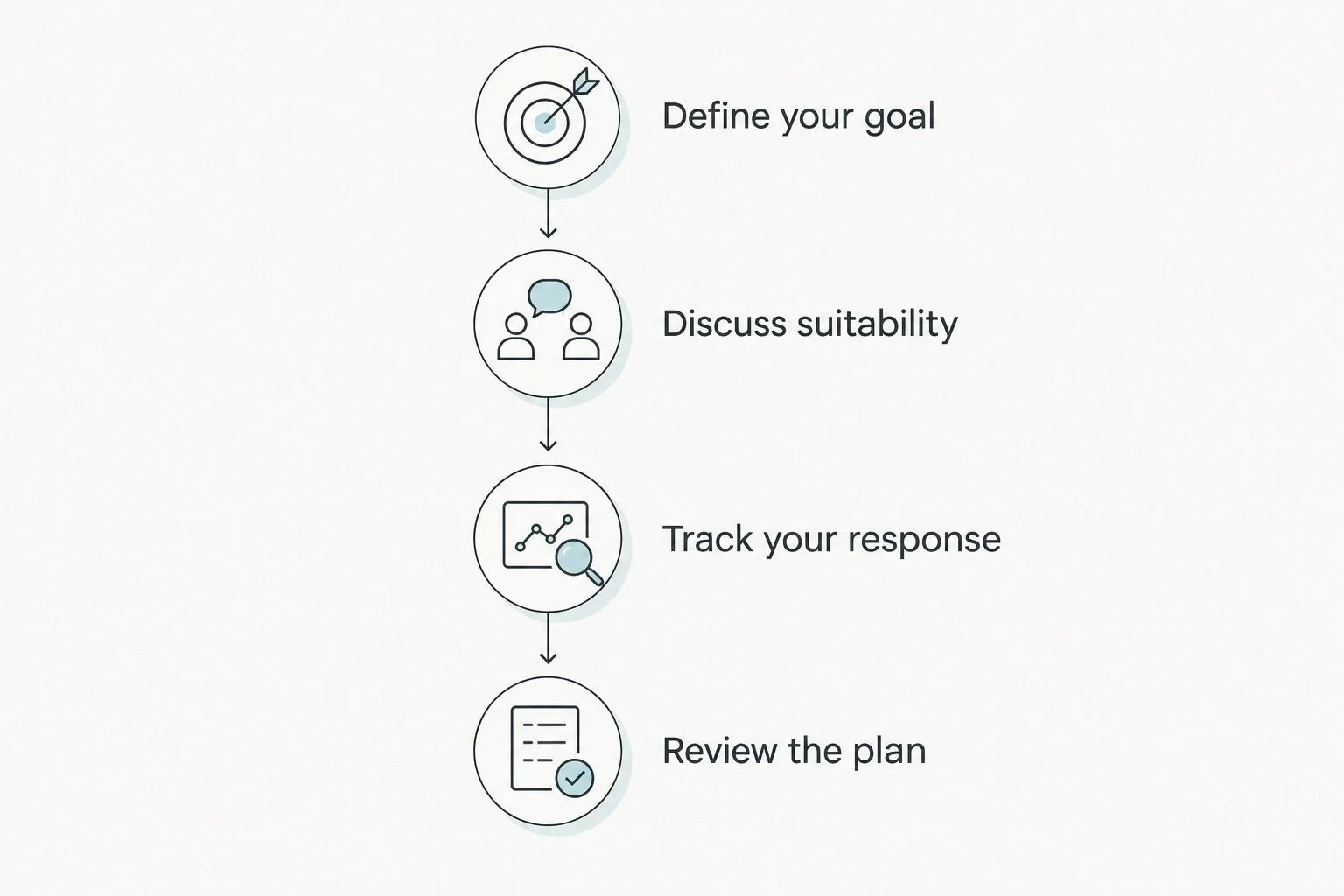
Decide about another appointment after reviewing your goal and experience.
Your 2026 appointment plan should leave room to stop. A review is useful only when it can change the next decision.
What should you ask before booking?
Ask questions that reveal what will happen, not just what the treatment is called. Clear answers help you decide whether the appointment matches your expectations.
- Treatment approach: What touch is involved, and how does this appointment differ from other massage services?
- Practitioner training: What relevant training does the person providing the service have?
- Personal suitability: Is there anything in your health history that needs medical guidance before treatment?
- Review point: How will you decide together whether another appointment is worthwhile?
Be cautious about explanations that turn every response into a reason to continue. Improvement, no change, and feeling worse should not all lead automatically to the same recommendation.
A clear discussion should also distinguish relaxation from claims about treating disease. You can appreciate an appointment without accepting an unsupported explanation for it.
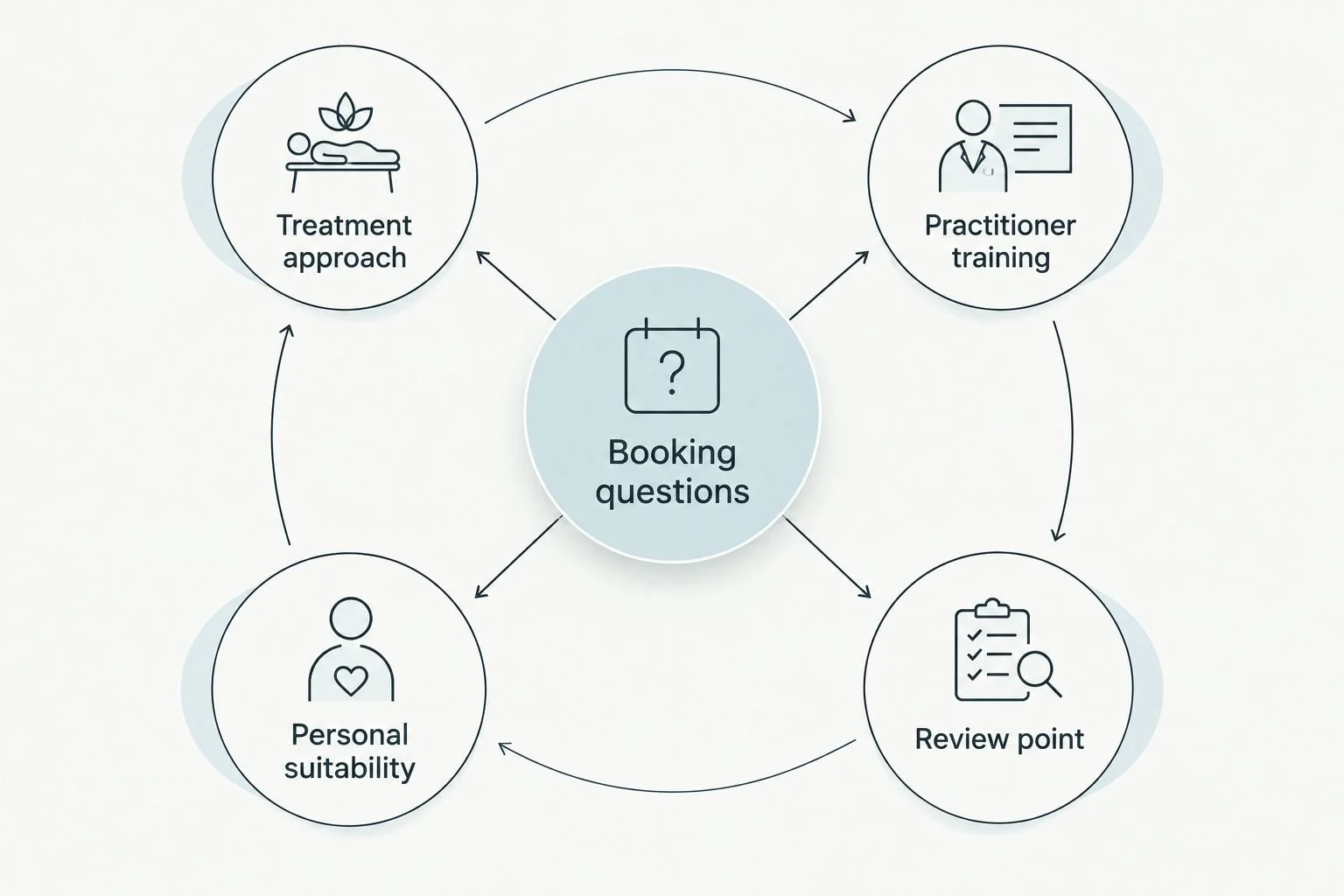
Ask about the treatment itself before discussing a repeat schedule.
How does this fit into a local spa and recovery routine?
Bodycentre Day Spa is best for Orange County guests seeking spa care and recovery services at a Costa Mesa location. Its stated services include massage, facials, skincare, waxing, and recovery options such as PEMF, red light therapy, hyperbaric oxygen, and altitude training.
That combination gives you different service areas to ask about under one roof. It does not mean that adding treatments improves the results of craniosacral massage or that every service is appropriate for your goal.
A facial addresses a different appointment goal from massage. Likewise, interest in a recovery service does not establish a need to add it to a spa visit.
Whether you travel from Costa Mesa, Newport Beach, Huntington Beach, or Irvine, the physical spa location is Costa Mesa. Choose an appointment you can attend comfortably rather than treating travel effort as a reason to book a longer series.
For your 2026 visit, ask Bodycentre Day Spa to confirm the specific service, practitioner, and suitability before you make plans.
Ask about your next appointment
Confirm the treatment and discuss your goals before planning repeat visits in Costa Mesa.
Should you book weekly craniosacral massage?
There is no established weekly requirement for craniosacral massage. If a practitioner suggests weekly visits, ask what purpose that frequency serves and when you will review it.
Can you stop after an initial appointment?
You can stop after an initial craniosacral massage appointment. Continuing is optional, and an uncomfortable experience or unclear benefit deserves discussion rather than an automatic rebooking.
Does needing more sessions mean the treatment is working?
Needing more sessions does not demonstrate that craniosacral massage is working. A recommendation to continue should have a clear rationale and should never replace assessment of persistent or worsening symptoms.
FAQ
How many craniosacral massage sessions should I book to start?
There is no established starting session count for craniosacral massage. If you choose to try it, assess an initial appointment before deciding whether repeat visits are worthwhile.
How often should I get craniosacral massage?
There is no established frequency that applies to everyone. Discuss your goal, suitability, and response before agreeing to a repeat schedule.
Will craniosacral massage fix my headaches?
Craniosacral massage should not be presented as a guaranteed headache treatment. New, persistent, or worsening headaches need medical assessment rather than a longer massage schedule.
Is craniosacral massage the same as deep tissue massage?
No, craniosacral massage generally uses gentle touch, while deep tissue massage uses firmer pressure directed at muscles and related tissues. Ask the practitioner to explain the approach before choosing a service.
Should I keep going if I feel worse afterward?
Do not automatically continue if you feel worse after craniosacral massage. Pause, tell the practitioner, and seek medical advice about persistent or concerning symptoms.
Can I use craniosacral massage instead of medical treatment?
No, craniosacral massage should not replace medical evaluation or prescribed treatment. Discuss symptom-related goals with the healthcare professional responsible for your care.
Can I combine craniosacral massage with other spa treatments?
Discuss suitability before combining treatments rather than assuming the combination adds benefit. Explain your goals and health history, and ask what each service is intended to do.
Is Bodycentre Day Spa located in Newport Beach or Irvine?
Bodycentre Day Spa is physically located in Costa Mesa, California. Guests from Newport Beach, Irvine, and other Orange County communities should plan their visit to the Costa Mesa location.
One last thing
Ask what would make the practitioner recommend stopping. That question reveals more about a proposed series than asking only how many sessions you need.
A useful answer should leave room for no benefit, discomfort, a change in your preferences, or referral for medical assessment. You are choosing an experience with clear limits—not purchasing a guaranteed outcome.