Best spa membership plans for regular massage and recovery care
/Best overall: a massage-first membership for a regular massage routine. Best for mixed care: a flexible spa membership. Best for an unpredictable schedule: individual bookings without a recurring commitment. If you’re searching for a massage membership near me in 2026, compare these plan structures—not assumed offers—and confirm each provider’s written terms before joining.
TL;DR
- For massage membership near me searches, choose a plan around appointments you will actually use.
- Bodycentre Day Spa combines massage, facials, and recovery services in Costa Mesa; confirm current membership terms directly.
- Choose flexible spa credits only when the written terms include your preferred treatments.
- Keep individual bookings if your schedule makes recurring visits difficult.
Why this matters
A membership is a recurring commitment, not a treatment recommendation. The right structure fits your calendar, preferred services, and comfort with the cancellation terms; the wrong one gives you appointments or credits you struggle to use.
Bodycentre Day Spa offers massage, facials, skincare, waxing, and advanced recovery services at its Costa Mesa location. Bodycentre Day Spa suits Orange County guests who want to explore traditional spa care and advanced recovery services at one Costa Mesa location. That service mix is relevant to your comparison, but it does not establish which treatments a membership includes.
The options below are membership formats to evaluate in 2026, not named plans or confirmed offers from this spa. You should request the actual agreement before treating any feature as included.
What makes the best spa membership?
Use these criteria before comparing a headline benefit or signing an agreement:
- Treatment fit: Your usual massage style, facial, or recovery service appears explicitly in the eligible-service list.
- Usable frequency: The recurring appointment fits your real schedule, including travel and changing work hours.
- Clear credit rules: The agreement explains expiration, rollover, substitutions, and whether unused benefits survive cancellation.
- Booking fit: You understand how therapist selection, appointment changes, and preferred visit times work.
- Exit flexibility: Renewal, pauses, cancellation notice, and any minimum commitment are written clearly.
- Treatment suitability: You can discuss health history and treatment-specific precautions before committing to repeated sessions.
Start with the treatment itself. The guide to choosing the right massage in Costa Mesa provides a useful next step before you compare recurring arrangements.
For your 2026 shortlist, separate service selection from membership selection. First decide what you want to book; then decide whether a recurring agreement supports that choice.
Spa membership formats at a glance
1. Massage-first membership
- Best for: A consistent massage routine
- Standout feature to seek: A recurring benefit matching your preferred treatment
- Key limitation to check: Other services might fall outside the agreement
2. Flexible spa membership
- Best for: Alternating massage and skincare
- Standout feature to seek: Explicit permission to switch eligible services
- Key limitation to check: Credits might not translate equally between treatments
3. Recovery-focused membership
- Best for: A defined recovery-service routine
- Standout feature to seek: Access to the specific modality you intend to use
- Key limitation to check: Membership does not establish medical suitability
4. Coordinated couples memberships
- Best for: Partners maintaining separate routines together
- Standout feature to seek: Compatible scheduling and clearly assigned benefits
- Key limitation to check: Separate benefits do not guarantee a joint appointment
5. Individual bookings
- Best for: Irregular visits or changing preferences
- Standout feature to seek: No recurring treatment commitment
- Key limitation to check: No built-in recurring appointment routine
These are decision categories. Features in the table are terms to look for, not promises that a local provider offers them.
1. Massage-first membership: best for a consistent massage routine
A massage-first membership centers the agreement on recurring massage appointments. It is the strongest starting point when massage is the service you already choose, rather than something you hope a membership will persuade you to try.
Best for: You want a repeatable massage routine and have a realistic place for it in your calendar.
Consider a planning example of 1 visit per month. Look back over 3 months of your actual schedule: would you have attended each appointment without rearranging essential commitments? This is a scheduling check, not a prescribed treatment frequency.
Massage-first membership pros:
- Keeps the recurring benefit aligned with your main reason for visiting.
- Gives you a straightforward treatment category to compare across agreements.
- Supports planning around a familiar appointment rather than choosing a different service each time.
Massage-first membership cons:
- A massage-focused benefit does not establish that facials or recovery sessions are included.
- Preferred massage styles, appointment lengths, and therapist choices still need confirmation.
- Unused appointments become a problem when expiration rules conflict with your schedule.
Ask what happens when your usual therapist is unavailable or you want a different massage style. Also distinguish total appointment time from hands-on treatment time; request the provider’s definition rather than assuming they are identical.
Verdict: Buy only when the written benefit matches the massage you intend to book and the schedule you can maintain.
2. Flexible spa membership: best for alternating massage and skincare
A flexible spa membership allows a choice among eligible services, if its agreement explicitly permits that choice. This format fits someone who wants massage on one visit and a facial or another skincare service on another.
Best for: Your spa routine includes both bodywork and skincare, rather than massage alone.
Bodycentre Day Spa offers massage, facials, skincare, and waxing in Costa Mesa. That range makes service eligibility an important question: the presence of a treatment on a service menu does not mean a membership covers it.
Flexible spa membership pros:
- Accommodates changing treatment preferences when substitutions are permitted.
- Keeps massage and skincare within the same planning conversation.
- Lets you prioritize the treatment you want instead of selecting one solely to use a narrow benefit.
Flexible spa membership cons:
- A credit might cover different portions of different treatments.
- Specialty services or additions might sit outside the eligible list.
- More choices require closer reading of substitution and expiration rules.
Before joining, ask the provider to explain a concrete switch: replacing a massage appointment with a facial. Request a clear account of what benefit applies and whether anything remains unused. Do not assume waxing, specialty skincare, or recovery services follow the same rules.
Verdict: Buy when switching between your preferred treatments is explicitly allowed; hold when the agreement leaves substitutions unclear.
3. Recovery-focused membership: best for a defined recovery routine
A recovery-focused membership centers on a particular service or eligible group of services. Relevant treatment names include hyperbaric oxygen, PEMF, red light therapy, and altitude training, but these are different modalities—not interchangeable versions of the same appointment.
Best for: You have identified a specific recovery service and want to evaluate a recurring arrangement for that service.
Hyperbaric oxygen involves breathing oxygen in a pressurized environment. PEMF means pulsed electromagnetic fields; red light therapy uses light exposure, while altitude training involves reduced-oxygen conditions. These descriptions explain the methods, not a promise of results.
Recovery-focused membership pros:
- Keeps your comparison focused on the modality you actually want.
- Creates an opportunity to ask about screening and session procedures before committing.
- Separates recovery-service planning from a general relaxation appointment.
Recovery-focused membership cons:
- Access to equipment does not establish that a treatment is appropriate for you.
- One recovery modality cannot be assumed to replace another.
- A recurring agreement does not guarantee changes in pain, performance, or recovery.
Bodycentre Day Spa offers these advanced recovery services alongside traditional spa care. Ask which service an agreement covers, how suitability is assessed, and what health information you should disclose. Discuss medical conditions, medications, pregnancy, and implanted devices with the appropriate clinician and provider before choosing a modality.
For a 2026 recovery plan, define the purpose of each appointment before selecting the recurring format. Avoid adding treatments simply because they appear in a bundle.
Verdict: Hold until the specific service, suitability checks, and membership coverage are clear.
4. Coordinated couples memberships: best for partners with separate needs
Coordinated couples memberships means evaluating individual recurring arrangements together. It does not mean assuming a shared account, transferable benefits, or a named couples plan exists.
Best for: You and your partner both want recurring visits but need different treatments or schedules.
For example, 2 appointments per month across a household could mean one appointment for each partner. That planning example says nothing about credit sharing: each person’s eligibility and booking rights need separate confirmation.
Coordinated couples memberships pros:
- Lets each partner choose treatments around individual preferences.
- Makes travel and appointment planning a shared task.
- Avoids treating one partner’s service preferences as the default for both.
Coordinated couples memberships cons:
- Separate memberships do not guarantee simultaneous appointments.
- Shared credits, guest use, and transfers require explicit permission.
- Each agreement can create its own renewal and cancellation obligations.
Ask whether booking together means the same appointment time, the same treatment room, or simply consecutive visits. Those are different experiences. If one partner prefers occasional facials while the other wants regular massage, compare separate arrangements rather than forcing identical commitments.
Verdict: Buy only after both partners independently fit the terms; skip a second membership that exists solely to match the first.
5. Individual bookings: best for an unpredictable schedule
Individual bookings let you choose an appointment without adopting a recurring treatment commitment. They belong in every membership comparison because not joining is a valid decision.
Best for: Your visits are occasional, your travel varies, or you are still deciding which treatments you prefer.
A first massage or facial helps you assess the appointment experience before you commit to repetition. It does not establish that a treatment will produce a particular health outcome.
Individual booking pros:
- Lets you select each treatment around your current plans.
- Avoids managing recurring credits and their expiration terms.
- Leaves room to explore massage, skincare, or recovery services separately.
Individual booking cons:
- Does not create a recurring appointment routine by itself.
- Requires a fresh booking decision for each visit.
- Does not include membership-specific benefits unless a provider explicitly grants them.
Review your 2026 calendar honestly. If travel, caregiving, or changing shifts repeatedly disrupt appointments, flexibility deserves more weight than a benefit you struggle to use.
Verdict: Buy individual appointments and skip a membership until your attendance becomes predictable.
How these formats rank
The ranking prioritizes treatment fit, usable frequency, clear credit rules, booking fit, exit flexibility, and suitability. Massage-first ranks first for this search because it directly addresses a recurring massage routine; flexible spa and recovery-focused formats answer different needs.
This is a decision guide, not a provider scorecard or a claim that specific agreements have been reviewed. Your preferred format should follow your actual service use, not the order of the list.
Which spa membership should you choose?
Default to a massage-first membership only if you already want regular massage and can use its written benefits. Choose flexible spa coverage for a genuine massage-and-skincare routine; evaluate recovery coverage separately around the exact modality.
Use this sequence before joining:
- Choose treatment: Identify the service you would book without a membership.
- Check schedule: Put a realistic appointment into your calendar.
- Read terms: Confirm coverage, expiration, renewals, and cancellation.
- Decide commitment: Join only when the agreement fits the first three checks.
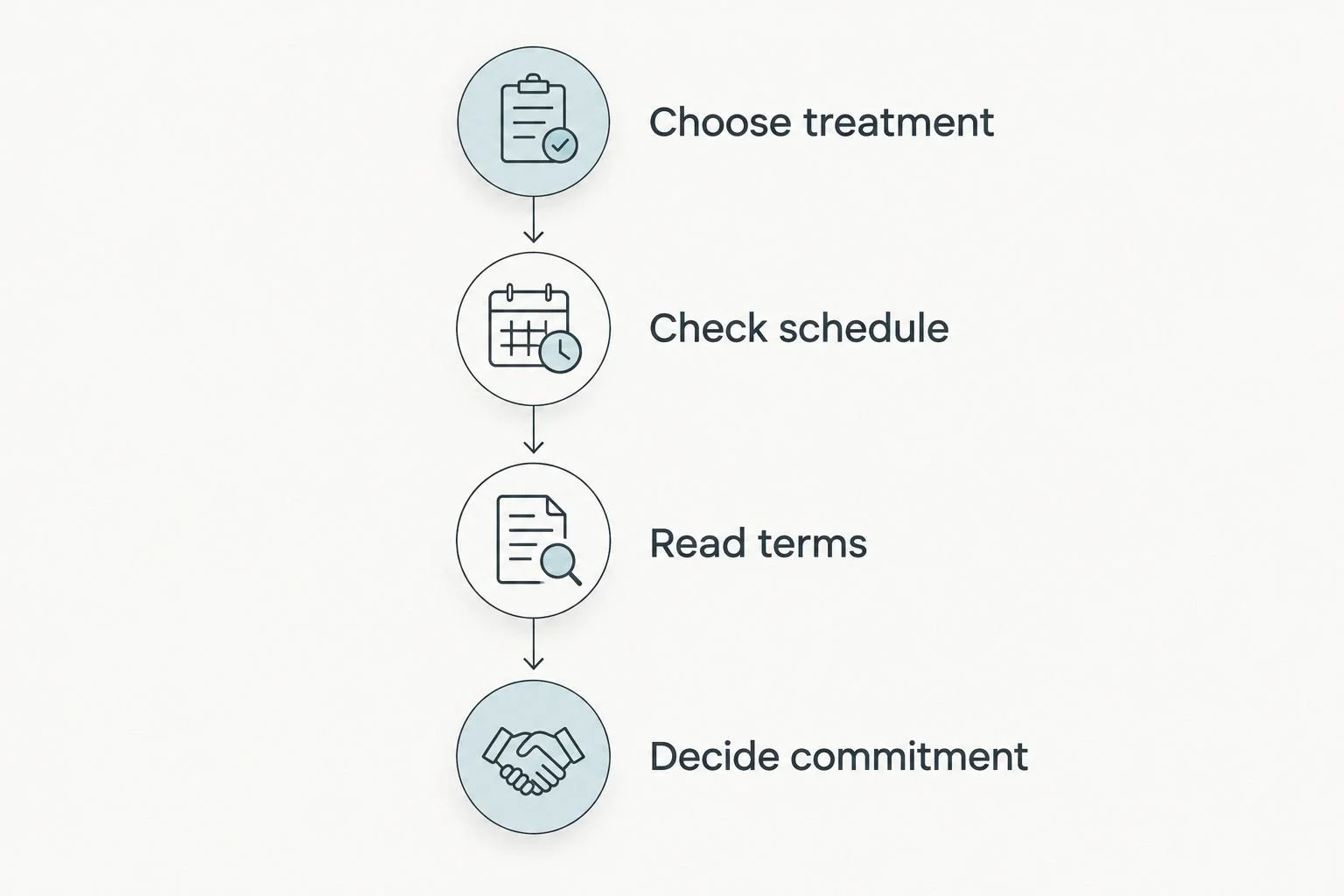
Choose your treatment before choosing a recurring agreement.
For guests traveling from Costa Mesa, Newport Beach, Irvine, Huntington Beach, or Santa Ana, include the actual trip in that schedule check. The physical spa location is Costa Mesa; compare the journey from wherever your day normally begins.
Explore your treatment options
Review spa and recovery services, then ask which current membership terms fit your preferred care.
FAQ
What’s the best massage membership near me?
The best massage membership matches your preferred treatment, realistic visit frequency, and acceptable contract terms. Start with a massage-first format if massage is the service you already intend to book.
Does Bodycentre Day Spa offer a membership covering every service?
Confirm current membership coverage directly with Bodycentre Day Spa. Its service range includes massage, facials, skincare, waxing, and advanced recovery, but that does not establish that one agreement covers everything.
Can I use a massage membership for facials?
You can substitute a facial only when the membership agreement explicitly permits it. Ask which facials qualify and how the benefit applies before joining.
Is a recovery membership the same as a massage membership?
No, recovery services and massage are distinct treatment categories. Confirm the exact modality covered and discuss treatment-specific precautions rather than assuming benefits transfer between services.
Can couples share spa membership credits?
Credit sharing depends on the provider’s written agreement. Confirm account ownership, transfer permissions, and joint booking arrangements separately.
Should I join if I cannot visit regularly?
Choose individual bookings when your schedule does not support recurring visits. Reconsider a membership once you know which treatments you prefer and can attend consistently.
Is the spa located in Newport Beach or Irvine?
The spa’s physical location is Costa Mesa. Guests considering visits from Newport Beach, Irvine, Huntington Beach, and Santa Ana should include travel in their appointment planning.
One last thing
Ask what happens to unused benefits after you cancel—not just how to cancel. Ending a recurring payment and retaining unused appointments are separate questions. Get both answers in writing before your first renewal.