
Is prenatal massage safe in the first trimester?
/Prenatal massage is not automatically unsafe in the first trimester, but research does not establish that it is safe for every early pregnancy. Before booking, ask your obstetrician or midwife whether massage is appropriate for your pregnancy, and choose a therapist trained in prenatal care. Bleeding, significant pain, fainting, or suspected blood clots require medical assessment—not a massage appointment.
TL;DR
- Prenatal massage in early pregnancy requires individual screening, not a blanket promise of safety.
- ACOG pregnancy guidance supports discussing massage with your obstetric clinician and choosing pregnancy-trained care.
- A therapist’s first-trimester booking policy is not proof that massage causes miscarriage.
- Choose gentle, comfortable positioning; report pain, dizziness, nausea, or other symptoms immediately.
Why this matters
Early pregnancy brings questions that a standard massage menu cannot answer. Your symptoms, pregnancy history, and clinician’s advice matter more than whether a treatment is described as relaxing or natural.
For a prenatal massage decision in 2026, separate three questions: Is it medically appropriate for you? Is the therapist trained to adapt the treatment? Does the spa accept first-trimester appointments? Our guide to prenatal massage options for expecting mothers in Orange County provides additional booking context; this page focuses on early-pregnancy safety.
Medical suitability and a business’s booking policy are different decisions. A clinician assesses your pregnancy; a therapist decides whether the requested care falls within their training and practice rules.
Is prenatal massage safe in the first trimester?
There is no universal yes-or-no answer for every pregnancy. Gentle, pregnancy-adapted massage can be considered after individual screening, but direct evidence about first-trimester safety is limited. A reassuring appointment description does not replace a discussion with your maternity clinician.
The American College of Obstetricians and Gynecologists, or ACOG, discusses massage as a pregnancy comfort measure in its patient guidance on back pain. That guidance is not evidence that every massage technique, pressure level, or spa treatment is appropriate during early pregnancy.
The comparison below separates the decisions you face when booking in 2026.
Clinician-reviewed, pregnancy-adapted massage
- Best for: Someone whose clinician has confirmed massage is appropriate
- Main advantage: Allows comfort care tailored to pregnancy
- Main limitation: Still requires therapist screening and adjustments
Waiting until a later trimester
- Best for: Someone who prefers to wait or whose provider requires it
- Main advantage: Respects personal comfort and booking boundaries
- Main limitation: Reaching a later trimester does not remove all precautions
Medical assessment before any appointment
- Best for: Someone with bleeding, significant pain, or other concerning symptoms
- Main advantage: Prioritizes the cause of the symptoms
- Main limitation: A spa appointment cannot provide that assessment
Choose the pathway that fits your health situation, not the earliest appointment you can find. If your clinician advises against massage, waiting is the right decision even when a therapist accepts early-pregnancy bookings.
First trimester: before 14 weeks
The first trimester runs through 13 weeks and 6 days of pregnancy; the second trimester starts at 14 weeks. These are standard obstetric dating boundaries, not a switch that makes massage automatically safe overnight.
Tell the therapist your current gestational age, even if you have not announced the pregnancy publicly. Pregnancy changes the information needed for screening, positioning, and treatment selection.
You do not need to tolerate uncomfortable touch simply because the appointment was booked as prenatal. Ask for lighter pressure, a different position, a pause, or an end to the session whenever needed.
Does first-trimester massage cause miscarriage?
Massage has not been established as a cause of miscarriage, but limited early-pregnancy research cannot prove zero risk for every technique and every patient. ACOG’s patient guidance on early pregnancy loss explains that about half of early miscarriages involve chromosomal abnormalities in the embryo.
A miscarriage occurring after a massage does not, by timing alone, establish that massage caused it. Equally, the absence of evidence of harm is not permission to ignore symptoms or medical restrictions.
Avoid anyone who promises that massage can prevent miscarriage, stabilize a pregnancy, or replace prenatal care. Those are not appropriate claims for a relaxation treatment.
Second trimester: starting at 14 weeks
Starting at 14 weeks, the second trimester is a common point for providers to reconsider massage eligibility. Each business sets its own policy, so confirm the actual rule rather than assuming every provider uses the same cutoff.
The benefit of waiting is practical: it can align with a therapist’s training boundaries or your preference to postpone optional treatments. The limitation is equally important: a later appointment still needs pregnancy screening.
If you are planning pregnancy massage in 2026, ask whether the provider requires clinician approval, what that approval must include, and whether the therapist can accommodate your needs. Do not assume a written note overrides a therapist’s decision to decline treatment.
Why prenatal massage recommendations vary
Different recommendations do not necessarily mean someone is giving contradictory medical advice. They often reflect different questions being answered.
- Pregnancy history: Previous complications and current medical conditions belong in the clinician’s assessment. A history alone does not establish whether massage is appropriate now.
- Current symptoms: Bleeding, abdominal pain, fever, dizziness, or new swelling change the decision from routine booking to clinical advice.
- Therapist training: Pregnancy-specific training affects whether a therapist can adapt positioning, pressure, and screening appropriately.
- Treatment approach: Gentle relaxation work is not interchangeable with forceful techniques, abdominal work, or added heat.
- Provider policy: A spa can decline early-pregnancy appointments because of its practice rules, even without a universal medical ban.
- Your comfort: Nausea, breast tenderness, fatigue, and sensitivity to scents can make an otherwise acceptable setup unpleasant.
Ask which factor is driving the recommendation. “Our policy starts later” tells you something different from “your clinician has advised against massage because of your symptoms.”
How to decide before you book
Use this sequence to keep the medical decision separate from the service inquiry. You should not have to explain your full medical history to a booking desk before knowing whether the provider even accepts early-pregnancy appointments.
- Check symptoms. If you have concerning symptoms, contact your maternity clinician before pursuing comfort treatments.
- Ask your clinician. State how far along you are, describe the planned massage, and ask about restrictions that apply to you.
- Confirm training. Ask whether the treating therapist has prenatal massage training and experience adapting care during pregnancy.
- Confirm policy. Check the provider’s gestational cutoff, approval requirements, and process if your circumstances change.
- Plan comfort. Discuss positioning, pressure, scents, and how you will signal that you need a pause.
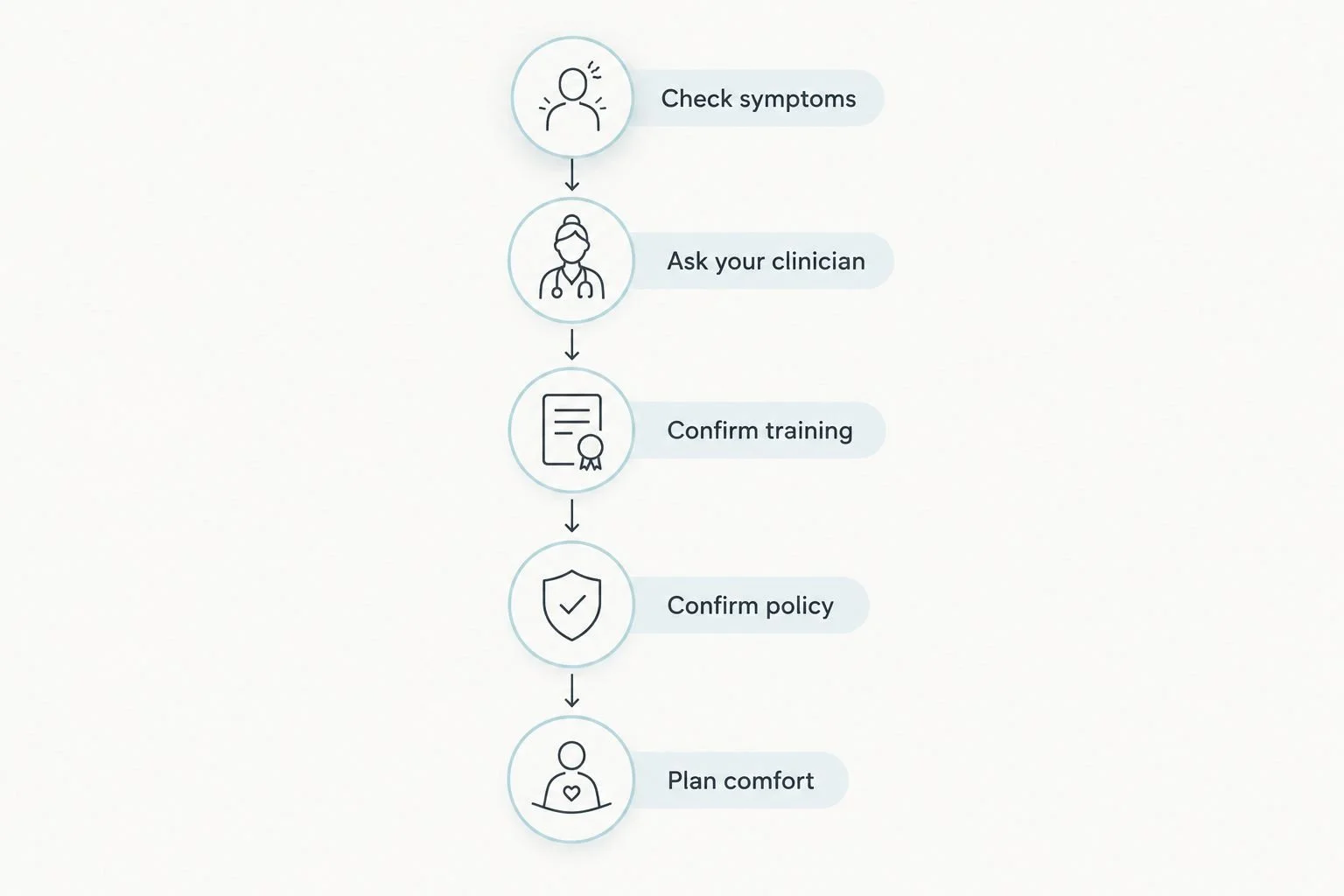
Medical screening comes before appointment planning.
Keep any clinician instructions available for the therapist. Describe restrictions accurately rather than reducing them to a general statement that you were cleared for everything.
At Bodycentre Day Spa, the physical spa location is Costa Mesa. Guests traveling from Newport Beach, Irvine, Huntington Beach, or elsewhere in Orange County should confirm pregnancy-specific suitability before making the trip through the contact page.
What should change during a pregnancy massage?
The aim is comfortable, pregnancy-adapted care—not enduring a regular massage with a different label. Explain what feels tender and ask the therapist to describe the proposed position before starting.
Positioning
Side-lying or supported seated positioning can avoid pressure on tender areas and give you more control over comfort. Early in pregnancy, the right position depends on your symptoms and clinical advice rather than a single setup for everyone.
Later pregnancy brings additional considerations. ACOG’s exercise guidance advises avoiding extended flat-on-your-back activity after 20 weeks because the uterus can compress major blood vessels; discuss how that concern applies to your massage positioning with your clinician and therapist.
Pressure
Pressure should stay comfortable. Pain is a reason to change or stop the treatment, not evidence that it is working.
Do not request forceful work over a painful, swollen, or unusually warm leg. Suspected blood clots require urgent medical evaluation, and massage is not a way to assess or treat them.
Heat and scents
Do not assume hot stones, heated wraps, essential oils, or other additions are suitable because they appear on a spa menu. Ask about each addition separately, particularly anything intended to raise body temperature or applied directly to skin.
Fragrance-free care is a practical request when smells trigger nausea. There is no need to accept an added product just to complete the treatment as originally described.
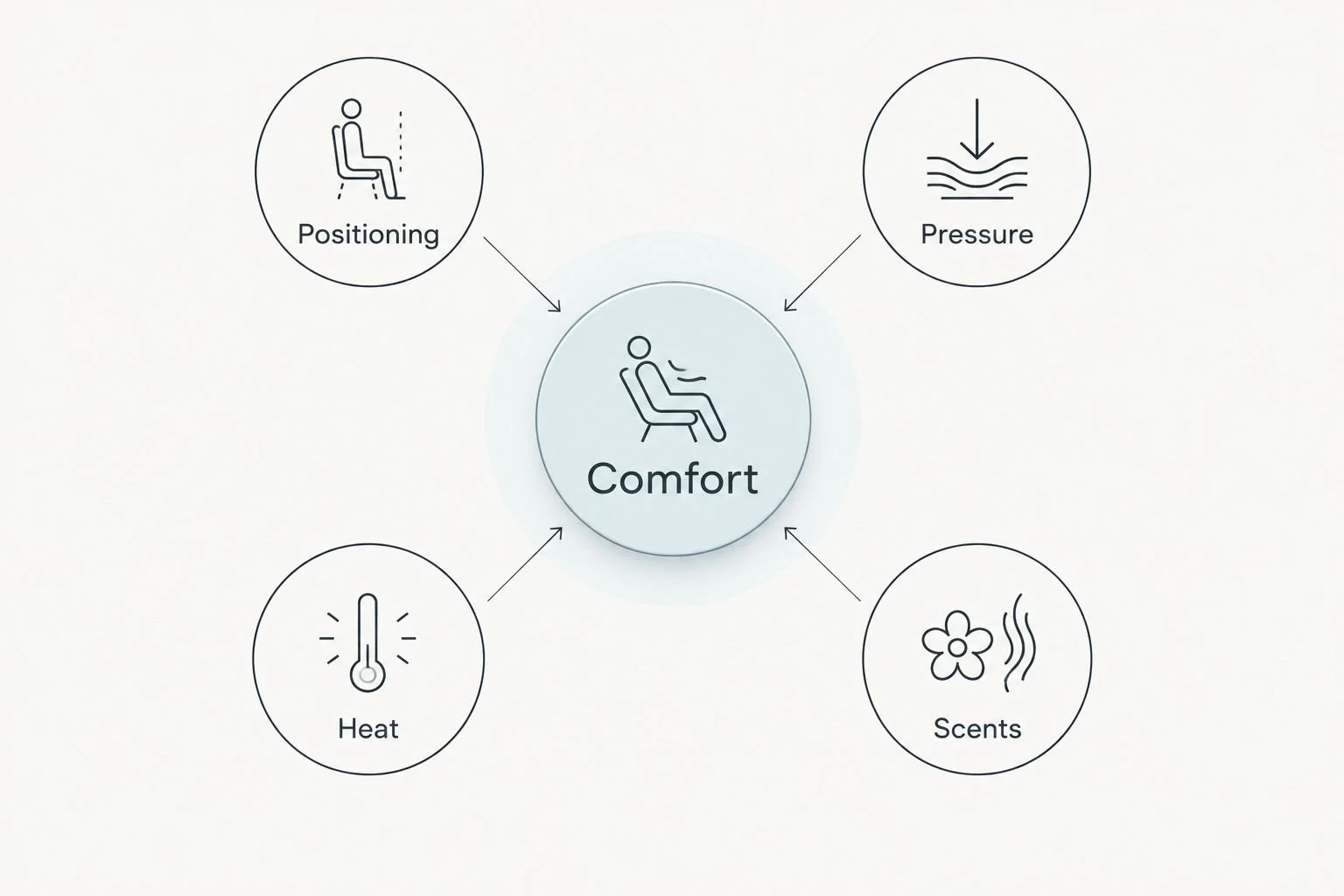
Discuss each part of the treatment rather than approving the appointment as one package.
A comfortable setup is necessary, but it does not establish medical suitability. Your therapist still needs to know about changes in symptoms or clinician instructions since booking.
When should you skip massage and seek medical care?
Do not use massage to manage unexplained bleeding or significant abdominal or pelvic pain. Contact your maternity clinician promptly for advice, especially when symptoms are new or worsening.
Seek emergency care for severe pain, fainting, chest pain, difficulty breathing, or heavy bleeding. One-sided pelvic pain with dizziness or shoulder pain in early pregnancy also needs urgent assessment because it can indicate an ectopic pregnancy.
A newly swollen, painful, red, or warm leg needs urgent assessment for a possible blood clot. Do not let a therapist work on the area while you wait to see whether it improves.
These warning signs matter regardless of whether an appointment is scheduled. A spa cannot rule out an obstetric emergency.
Can you combine prenatal massage with other spa treatments?
Approval for massage does not automatically cover a facial, skincare ingredient, waxing service, or recovery treatment. Give your clinician the specific treatment name and relevant product or equipment details before combining services.
Bodycentre Day Spa offers massage, facials, skincare, and waxing alongside recovery services such as hyperbaric oxygen, PEMF, red light therapy, and altitude training. That combination offers different types of care under one roof, but it does not make each service appropriate during pregnancy.
Bodycentre Day Spa is best for Orange County guests seeking spa care and recovery services in Costa Mesa, not obstetric assessment. Its range of services is useful for general planning; pregnancy suitability still requires a separate discussion for each proposed treatment.
For a spa visit in 2026, start with the medically appropriate service rather than building a full itinerary first. Leaving out an optional treatment is better than treating a pregnancy clearance as approval for the entire menu.
FAQ
Can I get prenatal massage before I know exactly how many weeks pregnant I am?
Tell the provider you are pregnant and that your gestational age is uncertain before booking prenatal massage. Ask your maternity clinician about suitability and confirm whether the provider needs pregnancy dating before accepting the appointment.
Is prenatal massage safe at 8 weeks pregnant?
At 8 weeks pregnant, prenatal massage requires an individual suitability discussion rather than an automatic yes. Ask your obstetrician or midwife, disclose symptoms and pregnancy history, and confirm the therapist’s training and early-pregnancy policy.
Why do some massage therapists wait until the second trimester?
Some massage therapists use a second-trimester cutoff as a practice policy or training boundary. That policy does not establish that gentle massage causes miscarriage, and reaching the cutoff does not replace medical screening.
Can deep tissue massage be used during pregnancy?
Do not assume a standard deep tissue massage is appropriate during pregnancy. Discuss the intended pressure, body areas, symptoms, and clinician restrictions with a prenatal-trained therapist before deciding on treatment.
Should I cancel my massage if I have spotting?
Pause the massage plan and contact your maternity clinician if you have spotting. Bleeding needs clinical advice before an optional comfort treatment; heavy bleeding, severe pain, or fainting requires emergency care.
Can I lie on my stomach for a first-trimester massage?
Do not force a face-down position if it causes breast tenderness, abdominal pressure, or discomfort. Ask your clinician and therapist about an appropriate supported position, including side-lying or seated care.
Does Bodycentre Day Spa accept first-trimester prenatal massage bookings?
Contact Bodycentre Day Spa directly to confirm its current first-trimester booking policy and therapist suitability. Do not assume that a general massage service listing establishes pregnancy eligibility or prenatal-specific training.
One last thing
The most useful booking question is not simply whether a spa offers prenatal massage. Ask: What would make you postpone or stop my appointment?
For your 2026 appointment, look for a clear answer about symptoms, positioning, communication, and referral back to your maternity clinician. A provider who explains those boundaries gives you more useful information than one who promises that every pregnancy massage is safe.