Postpartum recovery treatments for new mothers: complete 2026 guide
/New mothers’ postpartum massage is hands-on soft-tissue care aimed at easing muscle tension and supporting comfort after childbirth. Your 2026 plan needs to account for healing tissue, feeding positions, delivery complications, and medical follow-up—not just how tight your shoulders feel.
TL;DR
- Postpartum massage is comfort care, not treatment for birth complications, pelvic floor problems, or postpartum depression.
- ACOG recommends postpartum contact within 3 weeks and a complete visit by 12 weeks after birth.
- Choose pressure and positioning around your recovery, not a fixed calendar date.
- Keep massage, skincare, and biohacking separate from clinician-directed postpartum care.
Why postpartum massage matters for new mothers
Feeding, carrying your baby, and spending long periods in supported sitting positions can leave your neck, shoulders, and back uncomfortable. Massage gives you a way to address that muscle tension, but the appointment must fit your current recovery—not your pre-pregnancy preferences.
Childbirth also changes what a therapist needs to know. A cesarean incision, perineal injury, ongoing bleeding, blood-pressure complications, or medicines that affect bleeding all belong in the conversation before treatment. Your delivery date alone does not establish readiness.
Start with choosing the right massage in Costa Mesa, then add postpartum-specific questions about positioning, pressure, and medical restrictions. Someone who enjoys deep pressure before pregnancy should not automatically request the same session after birth.
For your 2026 recovery plan, make comfort the goal—not faster healing, weight loss, or a return-to-exercise deadline. Massage belongs alongside appropriate medical follow-up, practical support, and rest opportunities.
How to plan postpartum massage and recovery care
1. Check symptoms before scheduling treatment
Start with your maternity clinician’s instructions and a written symptom list. ACOG’s postpartum-care guidance recommends contact with a maternal care provider within 3 weeks after birth, followed by ongoing care and a complete postpartum visit no later than 12 weeks. Those milestones are not automatic permission for every spa treatment.
Urgent symptoms belong in medical care, not on a massage table. Seek immediate medical attention for chest pain, trouble breathing, a severe or persistent headache, vision changes, or new one-sided leg swelling or pain. A temperature of 100.4°F, or 38°C, also requires prompt medical attention after birth.
Do not let an appointment delay assessment of heavy bleeding, worsening abdominal pain, or an incision that looks infected. Thoughts of harming yourself or your baby require immediate help; call emergency services if there is immediate danger.
- Write down your delivery details and current symptoms.
- Follow restrictions from your maternity care team.
- Ask specifically about massage after complicated delivery or surgery.
- Tell the therapist about blood thinners and other relevant medicines.
- Postpone treatment when symptoms need medical assessment.
2. Choose one immediate comfort goal
Before booking anything, adjust the activity that seems to trigger discomfort. Bring your baby toward you during feeding rather than repeatedly bending your neck down. Support your arms and back, and ask someone to help with lifting or carrying when needed.
Then decide what you want from an appointment. A quieter hour and comfortable shoulder work are different goals from evaluating pelvic pain or treating a surgical scar. Naming the goal helps you choose an appropriate provider without buying a collection of unrelated treatments.
Use these three categories when sorting your needs: Comfort, Skin care, and Clinical care. They can coexist, but they are not interchangeable. A facial does not assess persistent pelvic symptoms, and massage does not replace care for a birth complication.
- Comfort: Identify the muscle tension you want addressed.
- Skin care: List irritation, sensitivity, or dryness to discuss.
- Clinical care: Take pelvic, incision, or systemic symptoms to a clinician.
- Describe the movements or positions that aggravate discomfort.
- Choose one priority rather than stacking several treatments immediately.
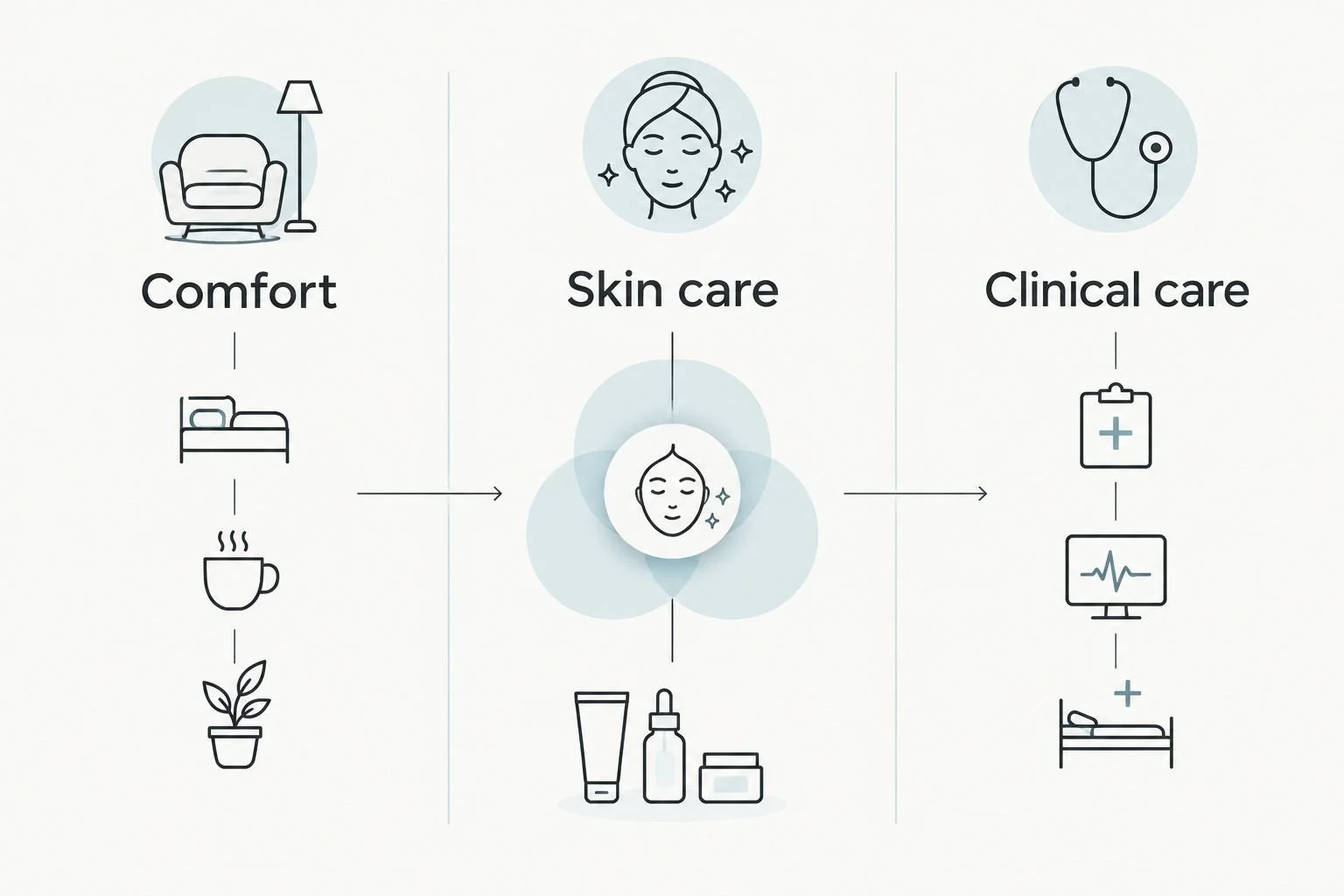
Choose the type of care that matches the problem you want addressed.
3. Match pressure and positioning to your recovery
Start with a supported resting position at home and note what feels uncomfortable. Share that information with the therapist before treatment begins. Side-lying or supported reclining can be alternatives when lying face down presses on tender breasts or your abdomen.
Bodycentre Day Spa is best for mothers seeking spa care and recovery services in Costa Mesa, not medical postpartum treatment. Its massage, facials, skincare, and advanced recovery services provide different options under one roof. That combination does not establish that every service is appropriate immediately after childbirth.
When contacting Bodycentre Day Spa, explain that you recently gave birth and ask whether the therapist can accommodate your restrictions. Confirm postpartum experience rather than assuming a general massage appointment includes specialized care. For a 2026 visit, discuss current symptoms even if you completed an intake form previously.
- Request comfortable pressure rather than the deepest available pressure.
- Ask about side-lying and supported reclining before arriving.
- Keep pressure away from unhealed incisions and injured tissue.
- Explain breast tenderness and positioning preferences.
- Stop or change the treatment if pressure causes pain.
4. Arrange feeding, transport, and aftercare
Make the visit manageable before adding another service. Arrange childcare, prepare whatever feeding supplies your family uses, and leave room for travel without rushing. If you are breastfeeding or pumping, planning around your usual routine can reduce discomfort from breast fullness during the appointment.
Tell the therapist about breast tenderness. You do not need to tolerate an uncomfortable face-down position to complete a massage, and breastfeeding alone is not a reason to assume massage is off limits.
The physical spa is in Costa Mesa. Mothers traveling from Newport Beach, Huntington Beach, or Irvine should plan the same essentials as Costa Mesa residents: transportation, feeding arrangements, and help with carrying if needed. Do not drive while impaired by medication or against your clinician’s instructions.
- Arrange a caregiver and a way to reach them.
- Bring feeding or pumping supplies if needed.
- Tell the therapist when a position compresses tender breasts.
- Choose clothing that does not rub healing areas.
- Leave space afterward for food, fluids, and an unhurried return home.
5. Separate spa care from recovery technology
Keep the basic routine simple first: follow discharge instructions, eat regularly, drink according to thirst, and use the movement your clinician permits. Technology should not become a prerequisite for feeling that you are recovering correctly.
Bodycentre Day Spa offers massage and skincare alongside services such as PEMF, red light therapy, hyperbaric oxygen, and altitude training. These are different interventions, not interchangeable versions of postpartum massage. PEMF uses pulsed electromagnetic fields; red light therapy exposes tissue to selected light wavelengths; hyperbaric oxygen involves oxygen in a pressurized setting; altitude training changes oxygen exposure during training.
A service’s presence on a recovery menu does not establish postpartum suitability. Ask your clinician about the exact intervention, especially after surgery, a pregnancy complication, or a change in medication. A facial can be a separate skincare choice, with ingredients and exfoliation adjusted to your circumstances.
- Ask what each proposed treatment is intended to address.
- Request screening for your medical history and current medicines.
- Discuss implants or medical devices before equipment-based services.
- Review facial ingredients if breastfeeding or using prescription skincare.
- Decline claims about hormone balancing, detoxing, or guaranteed healing.
6. Reassess before repeating or combining treatments
Before your next appointment, note what changed during and after the previous one. Record whether positioning was comfortable, whether the original tension changed, and whether you developed soreness or new symptoms. A simple written note is enough; you do not need a tracking subscription.
Repeat a service because it fits your needs, not because a recovery package sets the schedule. If discomfort persists, worsens, or interferes with ordinary movement, discuss it with your maternity clinician. Pelvic pressure, leakage, or pain with activity deserves a separate clinical assessment rather than progressively stronger massage.
Avoid making several changes at once. Adding massage, a new exercise routine, and multiple equipment-based treatments together makes it harder to identify what caused discomfort. Your 2026 plan should remain adjustable as healing, sleep, and caregiving demands change.
- Record the treatment area, pressure, and positioning used.
- Note soreness, irritation, dizziness, or other unwanted effects.
- Report new symptoms rather than treating them as normal recovery.
- Recheck restrictions when your medical circumstances change.
- Choose the next visit around a clear purpose.
Compare your postpartum recovery options
Choose care by the problem it addresses, not by how advanced the treatment sounds. Clinical assessment, massage, skincare, and equipment-based services have different roles; combining them does not remove their individual limitations.
Keep postpartum mood and nutrition in the same conversation as pain and mobility: tell your maternity clinician about appetite changes, persistent low mood, anxiety, or difficulty coping rather than expecting massage to address them. Relaxation time and mental-health treatment are not substitutes for each other.
Massage
- Best for: Mothers seeking muscle comfort and relaxation
- Main advantage: Pressure and positioning can be adjusted
- Key limitation: Does not assess or treat obstetric complications
Clinical care
- Best for: New, persistent, or worsening postpartum symptoms
- Main advantage: Evaluates causes and directs appropriate treatment
- Key limitation: A spa appointment cannot provide this assessment
Pelvic health physical therapy
- Best for: Mothers referred for pelvic floor or movement concerns
- Main advantage: Provides individualized rehabilitation assessment
- Key limitation: Requires a qualified clinical provider; not general spa massage
Facials
- Best for: Mothers seeking skincare and personal-care time
- Main advantage: Focuses directly on skin concerns
- Key limitation: Ingredients and exfoliation need individual review
Recovery technology
- Best for: Mothers considering a specific, medically reviewed intervention
- Main advantage: Offers a different treatment format from hands-on care
- Key limitation: Red light, PEMF, and hyperbaric oxygen are not interchangeable or automatically postpartum-appropriate
Altitude training
- Best for: People considering a return-to-training plan
- Main advantage: Has a performance-training purpose
- Key limitation: Is not a substitute for postpartum assessment or rehabilitation
Bodycentre Day Spa’s massage and recovery services belong in the wellness portion of this comparison. Confirm the proposed treatment, practitioner experience, and screening process before deciding whether a visit fits your circumstances.
Common mistakes new mothers make
Treating a calendar milestone as blanket clearance
Reaching a postpartum visit does not mean every pressure level, body position, or device-based treatment is suitable. Ask about the activity you actually want to try, particularly after surgery or complications.
Requesting deep pressure to speed recovery
Stronger pressure is not evidence of a better postpartum appointment. Start with tolerable work, protect tender areas, and communicate throughout the session; pain is a reason to adjust, not a requirement to endure.
Booking lymphatic work for unexplained swelling
Do not book massage to investigate new or worsening swelling. One-sided leg swelling or pain needs urgent medical assessment, and other persistent swelling should be discussed with your clinician before treatment.
Keeping mental-health concerns outside the recovery plan
A spa visit can provide personal time, but it does not diagnose or treat postpartum depression or anxiety. Tell a healthcare professional about persistent distress or difficulty functioning, even when physical recovery appears to be progressing.
FAQ
When can I get a postpartum massage?
There is no single start date that fits every birth and recovery. Follow your maternity clinician’s guidance, especially after surgery or complications, and confirm that the therapist can adapt pressure and positioning.
Can I get postpartum massage after a C-section?
Massage after a C-section needs to respect surgical healing and your clinician’s restrictions. Avoid pressure on an unhealed incision, and do not assume a general spa session includes appropriate scar treatment.
Is postpartum massage safe while breastfeeding?
Breastfeeding alone does not automatically rule out massage. Tell the therapist about breast tenderness, choose comfortable positioning, and discuss any additional medical concerns before treatment.
Is deep tissue massage better for postpartum back pain?
Deep tissue massage is not automatically better for postpartum back pain. Choose tolerable pressure, and seek clinical assessment for severe, persistent, or worsening pain rather than repeatedly increasing intensity.
Can postpartum massage fix pelvic floor problems?
General postpartum massage does not replace pelvic floor assessment or rehabilitation. Discuss leakage, pelvic pressure, and pelvic pain with your clinician, who can advise whether pelvic health physical therapy is appropriate.
Should I add red light therapy or PEMF after childbirth?
Do not add red light therapy or PEMF solely because it appears on a recovery menu. Ask your clinician about the exact treatment and have the provider screen your medical history, medicines, and any implanted devices.
Does Bodycentre Day Spa provide medical postpartum care?
Bodycentre Day Spa is a day spa and fitness studio in Costa Mesa offering spa and recovery services, not a replacement for maternity care. Confirm postpartum accommodations directly, and keep medical symptoms with your healthcare team.
One last thing
The most useful booking question is: how will you adapt this appointment to my recovery? A clear answer about pressure, positioning, sensitive areas, and reasons to postpone tells you more than a treatment name. For 2026, build your plan around that conversation—not a promise to get your body back.