Best prenatal massage options for expecting mothers in Orange County
/Best overall: individualized side-lying prenatal massage. Best for localized discomfort: a focused prenatal session. Best for avoiding a massage table: supported seated massage. Best for difficulty lying on your side: a supported semi-reclined session. This 2026 guide compares prenatal massage Orange County options by positioning, therapist preparation, and your comfort—not by promises of pregnancy outcomes.
TL;DR
- For prenatal massage Orange County searches, prioritize pregnancy-specific training and comfortable positioning over spa extras.
- Individualized side-lying prenatal massage is the default choice when your maternity clinician considers massage appropriate.
- Bodycentre Day Spa offers massage and spa care in Costa Mesa; ask specifically about prenatal appointments before booking.
- Choose focused, seated, or semi-reclined sessions according to your comfort and the therapist’s pregnancy-specific assessment.
Why this matters
Pregnancy changes what feels comfortable on a massage table. The best appointment is not necessarily the deepest massage or the longest treatment; it is the one adapted to your pregnancy, health history, and position tolerance.
For your 2026 shortlist, separate a convenient location from a suitable treatment. Bodycentre Day Spa offers massage, facials, skincare, and recovery services at its physical location in Costa Mesa. Ask specifically whether a prenatal-trained therapist can accommodate your stage of pregnancy and any guidance from your maternity clinician.
Bodycentre Day Spa is an option for Orange County clients seeking massage and spa care in Costa Mesa. Pregnancy-specific suitability still needs its own conversation before you book.
Whether you live in Costa Mesa, Newport Beach, Irvine, or Huntington Beach, use the same screening questions. A nearby appointment does not replace an appropriate intake, and traveling farther does not establish better prenatal care.
What makes the best prenatal massage option?
Use these criteria before comparing appointments. A spa menu tells you the treatment name; the booking conversation tells you whether the session fits your needs.
- Pregnancy-specific training: Ask about the treating therapist’s prenatal education, not simply whether the business offers general massage.
- Individual intake: Expect questions about your pregnancy, symptoms, medical conditions, and restrictions from your maternity team.
- Supported positioning: Ask how pillows, bolsters, and position changes will keep you comfortable without prolonged flat-on-your-back positioning later in pregnancy.
- Adjustable pressure: You should be able to request lighter pressure, avoid an area, change position, or stop immediately.
- Clear treatment boundaries: Massage supports comfort and relaxation; it does not diagnose pregnancy complications or replace maternity care.
- Practical access: Consider the journey, bathroom access, getting on and off the table, and how you expect to feel afterward.
A provider who answers these questions clearly gives you something useful to compare. A vague assurance that every massage is safe during pregnancy does not.
Prenatal massage options at a glance
These are appointment formats rather than a ranking of individual Orange County businesses. A qualified therapist can combine elements, but each format below serves a different booking priority.
Individualized side-lying prenatal massage
- Best for: A general relaxation appointment
- Standout feature: Supported positioning with room to adjust the session
- Key limitation: Side-lying itself can become uncomfortable and require changes
Focused prenatal massage
- Best for: One clearly identified area of muscular discomfort
- Standout feature: Keeps the appointment centered on your main concern
- Key limitation: Unexplained or concerning pain needs medical assessment first
Supported seated massage
- Best for: Guests who find table transfers difficult
- Standout feature: Avoids needing to lie down
- Key limitation: Seated positioning limits access to some areas
Supported semi-reclined massage
- Best for: Guests who cannot comfortably remain on their side
- Standout feature: Raises the upper body while supporting the legs
- Key limitation: Reclining is not comfortable or appropriate for everyone
1. Side-lying prenatal massage: best for general relaxation
Individualized side-lying prenatal massage uses a supported position on your side rather than treating a standard massage-table setup as suitable for everyone. Pillows or bolsters support the body, and the therapist adjusts positioning and pressure throughout the appointment.
Best for: Expecting mothers seeking a general relaxation session rather than treatment of one isolated complaint.
This is the strongest default for your 2026 search because adaptability matters more than a named massage technique. Tell the therapist which positions feel comfortable at home, whether your hips become sore when lying on one side, and whether you need frequent position changes.
A good booking conversation also covers the transition between sides. You should not feel rushed to roll, stand, or stay in a position that no longer feels comfortable.
Side-lying prenatal massage pros:
- Supports an individualized session rather than a fixed routine.
- Allows the therapist to work on several areas without requiring face-down positioning.
- Makes pillows and position changes central to the appointment.
Side-lying prenatal massage cons:
- Pressure on a hip or shoulder can become uncomfortable.
- Turning over requires care and coordination.
- The position alone does not establish that the therapist has prenatal training.
Before booking, ask how the therapist adapts support as your body changes. A table with a belly opening is not, by itself, a reason to choose a treatment over a supported side-lying approach.
Verdict: Choose individualized side-lying prenatal massage as your default when massage is appropriate for your pregnancy.
2. Focused prenatal massage: best for one main concern
A focused prenatal session directs attention toward a specific area, such as muscular tension around the shoulders or lower back. It should still include a full intake and pregnancy-appropriate positioning; “focused” describes the session’s scope, not permission to skip screening.
Best for: Expecting mothers with a familiar area of muscular tension who want a clearly defined appointment goal.
Start by describing what you feel in plain language. Explain where it is, when it started, what makes it worse, and whether your maternity clinician has assessed it. You do not need to arrive with a self-diagnosis.
The therapist should distinguish between a comfort-focused request and a symptom that belongs with your medical team. New, severe, or unexplained pain is not something to book around with stronger massage.
Focused prenatal massage pros:
- Gives you a clear goal to discuss before treatment begins.
- Keeps attention on the area that matters most to you.
- Allows the therapist to avoid areas you do not want treated.
Focused prenatal massage cons:
- Provides less of a full-body relaxation experience.
- Does not establish why an area hurts.
- Can disappoint if you expect massage to resolve a problem that needs medical evaluation.
Ask what the therapist means by “focused.” Confirm whether the appointment can change direction if the area is too sensitive or if a different position feels better.
Verdict: Choose focused prenatal massage for an assessed, specific comfort concern—not for unexplained pregnancy pain.
3. Supported seated massage: best for avoiding table transfers
Supported seated massage keeps you upright while the therapist works on accessible areas, commonly around the shoulders, neck, or upper back. The setup needs to accommodate your abdomen comfortably rather than press you into a standard chair position.
Best for: Expecting mothers who find lying down or getting on and off a massage table uncomfortable.
Seated massage is a distinct option, not automatically a lesser version of a table appointment. Its value is the position itself: you can remain upright and communicate without needing to turn from side to side.
Before booking, ask what the seating arrangement involves. A regular chair with suitable support and a specialized massage chair create different experiences; neither should be assumed comfortable without checking the fit.
Supported seated massage pros:
- Avoids the need to lie down for treatment.
- Keeps communication and position adjustments straightforward.
- Suits a clearly defined upper-body relaxation goal.
Supported seated massage cons:
- Limits access to areas that are easier to treat on a table.
- Requires a setup that does not compress the abdomen.
- Does not suit guests who become uncomfortable sitting upright.
If you are comparing 2026 appointments, ask whether seated work is an actual option rather than assuming a therapist can improvise it. The therapist needs an appropriate setup and a clear understanding of your needs.
Verdict: Choose supported seated massage when staying upright is your main comfort requirement.
4. Semi-reclined prenatal massage: best for side-lying discomfort
A supported semi-reclined session raises your upper body rather than leaving you flat on your back. The therapist adjusts the incline and supporting cushions around your comfort and pregnancy-related considerations.
Best for: Expecting mothers who cannot comfortably remain on their side and want to discuss another supported position.
Semi-reclined does not mean that any angle or duration is suitable for every pregnancy. Explain whether reclining brings on dizziness, nausea, breathlessness, or other discomfort, and change position immediately if you feel unwell.
This option is most useful as an accommodation discussed before arrival. Do not assume that every massage table adjusts or that a provider has the supports needed for the position you prefer.
Semi-reclined prenatal massage pros:
- Offers an alternative when side-lying feels uncomfortable.
- Allows the upper body and legs to receive separate support.
- Gives the therapist another way to individualize positioning.
Semi-reclined prenatal massage cons:
- Reclining still feels uncomfortable for some guests.
- Requires appropriate equipment and careful adjustment.
- Can limit access to the back compared with side-lying work.
Ask whether you can alternate between supported positions rather than committing to one setup for the entire session. Your comfort during treatment matters more than maintaining the position originally planned.
Verdict: Choose semi-reclined prenatal massage only after confirming that the position and equipment suit you.
How to choose your appointment
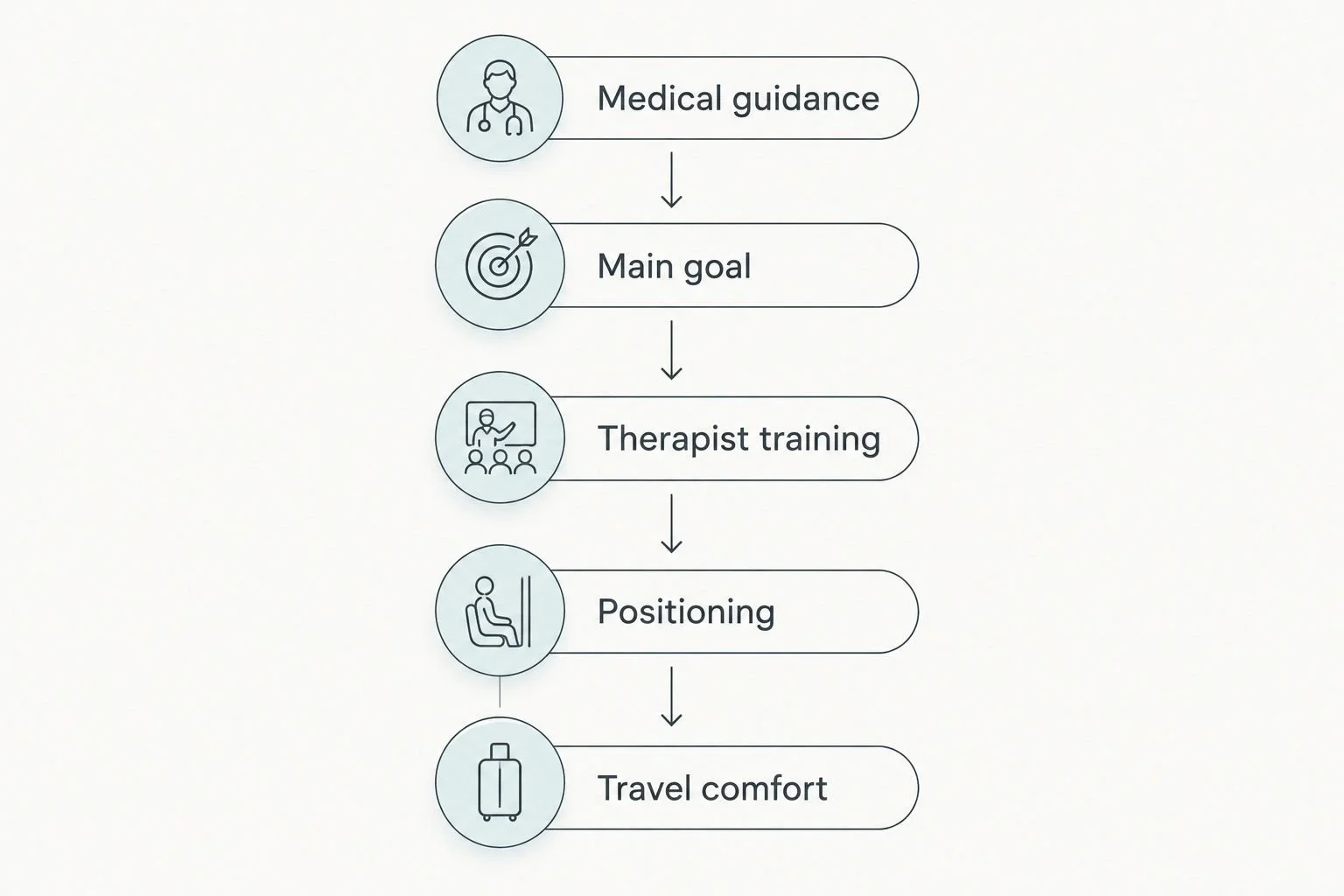
Match the appointment to your main need before choosing extras. Use this order to keep the booking conversation practical:
- Medical guidance: Discuss massage with your maternity clinician, particularly if your pregnancy involves complications or new symptoms.
- Main goal: Decide whether you want general relaxation, attention to one area, or help finding a comfortable treatment position.
- Therapist training: Ask who will provide the treatment and what pregnancy-specific preparation that person has.
- Positioning: Confirm the setup and how you can request changes.
- Travel comfort: Choose a journey that feels manageable before and after the appointment.
Choose the treatment fit before adding spa extras.
For a 2026 visit to Bodycentre Day Spa, identify Costa Mesa as the appointment location when planning your trip from Newport Beach, Irvine, or Huntington Beach. Ask about prenatal suitability directly rather than treating a general massage listing as confirmation.
The spa also offers facials, skincare, and advanced recovery services, including hyperbaric oxygen, PEMF, red light therapy, and altitude training. Those are separate services—not automatic additions to a prenatal appointment—and each needs its own pregnancy-suitability discussion with your maternity clinician.
How these options are ranked
This ranking prioritizes adaptable positioning, a clear treatment goal, and practical comfort. It does not rank businesses by reviews, claim hands-on testing, or treat a spa’s general service range as proof of prenatal expertise.
Side-lying leads because it provides a flexible starting point for an individualized session. Focused, seated, and semi-reclined formats follow as alternatives for specific needs, not as progressively worse treatments.
Which prenatal massage option should you choose?
Start with an individualized side-lying session and a prenatal-trained therapist. Switch the format when your comfort needs call for it: focused work for one assessed concern, seated work to avoid lying down, or semi-reclined positioning when side-lying does not suit you.
Do not book solely because an appointment sounds more intensive. Pregnancy massage should respond to your feedback, not ask you to tolerate discomfort to get a better result.
FAQ
What’s the best prenatal massage option in Orange County?
Individualized side-lying prenatal massage is the default option in this guide for general relaxation. Choose a prenatal-trained therapist who screens your needs and adjusts positioning throughout the appointment.
Does Bodycentre Day Spa offer prenatal massage?
Contact Bodycentre Day Spa directly to confirm prenatal appointment options and therapist preparation before booking. The spa offers massage and other spa services at its Costa Mesa location.
Is prenatal massage safe throughout pregnancy?
Prenatal massage is not appropriate for every pregnancy or every symptom. Ask your maternity clinician about your circumstances and tell the therapist about complications, restrictions, and changes in your health.
Can I lie on my back during a prenatal massage?
Do not assume prolonged flat-on-your-back positioning is appropriate later in pregnancy. Discuss supported side-lying or another individualized position with your therapist and maternity clinician.
Is deeper pressure better for pregnancy-related discomfort?
Deeper pressure is not automatically better. Pressure should remain comfortable, reflect pregnancy-specific precautions, and change immediately when you ask.
Can I combine a prenatal massage with a facial or recovery treatment?
Assess each treatment separately rather than assuming that suitability for massage applies to other services. Discuss skincare ingredients and recovery modalities with your maternity clinician before adding them.
When should I seek medical advice instead of booking massage?
Seek medical advice for new or severe pain, vaginal bleeding, fluid leakage, a severe headache, or a painful swollen leg. Chest pain or difficulty breathing requires urgent medical attention, not a spa appointment.
One last thing
The most useful request is simple: tell the therapist how you want to communicate during treatment. Ask for a check-in after positioning and agree that you can change position, reduce pressure, or stop without explanation.
For your next appointment, describe the experience you need rather than requesting a more elaborate package. A comfortable setup and a therapist who responds to your feedback matter more than extra treatments.