

How accurate is an InBody scan?
/An InBody scan is useful for tracking body-composition trends, but it is not an exact measurement of body fat or muscle. Its accuracy depends on the device, the person being measured, and testing conditions; hydration, meals, and recent exercise can change the result without reflecting actual fat loss or muscle gain.
TL;DR
- An InBody scan estimates body composition; use consistent testing conditions to make repeat results more meaningful.
- InBody results are not interchangeable with DXA results, and neither method directly measures every tissue.
- Judge body-fat and muscle estimates alongside strength, measurements, and longer-term weight trends.
- Repeat an unexpected InBody result under comparable conditions before changing your training or eating habits.
How accurate is an InBody scan?
There is no single accuracy percentage that applies to every InBody scan. Agreement with another body-composition method depends on the device model, the reference method, and the population being assessed. A figure from one study does not establish your individual margin of error.
InBody devices use bioelectrical impedance analysis, often shortened to BIA. They pass a small electrical current through the body, measure resistance to that current, and use those measurements to estimate body water and body composition. The electrical measurement is real; the tissue breakdown is an estimate.
The distinction matters when comparing an InBody result with a DXA scan, a bathroom scale, or an earlier appointment. The guide to body-composition tracking methods explains the wider choice of measurements.
InBody scan
- Best for: Following estimated body-composition trends under consistent conditions
- Main advantage: Estimates fat, lean tissue, and body water beyond scale weight alone
- Main limitation: Fluid changes influence the estimates
DXA scan
- Best for: Clinician-directed assessment of body composition and bone mineral
- Main advantage: Provides regional tissue estimates and bone information
- Main limitation: Uses low-dose X-rays, and results still depend on equipment and analysis
Body weight
- Best for: Following total weight trends
- Main advantage: Straightforward to repeat
- Main limitation: Does not distinguish fat, muscle, water, or digestive contents
No method wins every job. Choose the measurement that answers your question, rather than assuming a more detailed report is automatically more useful.
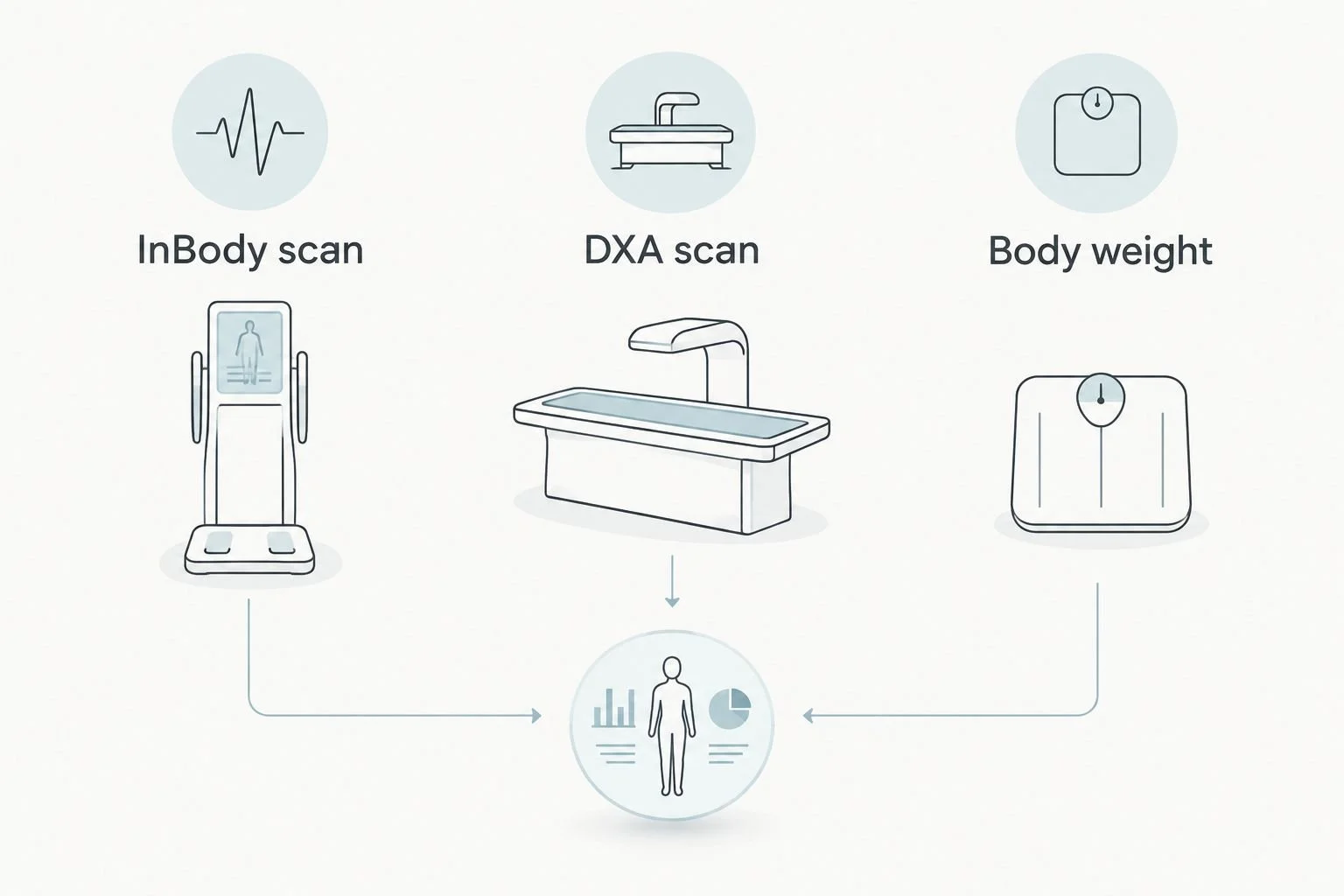
Different measurement methods answer different questions; their results are not interchangeable.
Why this matters
If you are tracking fitness progress in 2026, a detailed printout can feel more definitive than it is. A reported change in muscle or body fat does not automatically mean your body built or lost that tissue between appointments.
That misunderstanding can lead you to restrict food unnecessarily, add training when you need rest, or dismiss progress because a single result looks disappointing. Use the scan as supporting information. Your strength, energy, measurements, and longer-term patterns provide context that the printout cannot supply.
Accuracy and repeatability are different
Accuracy means closeness to the quantity being estimated. Repeatability means getting similar results when the same person is measured under similar conditions.
An InBody device can produce repeatable readings without matching another method exactly. Conversely, changing your preparation between appointments makes it harder to tell whether a difference reflects your body or your testing conditions.
Consistent preparation improves comparison; it does not turn an estimate into a direct measurement. That is the most useful distinction to remember when interpreting a body-composition report.
Why InBody scan results vary
These factors explain why apparently small changes deserve context rather than an immediate change to your routine:
- Hydration: BIA relies on electrical properties related to body water. Dehydration, fluid retention, and shifts in fluid distribution can affect estimated composition.
- Food and drink: Recent intake adds weight and changes the conditions under which you are measured. Follow the facility's preparation instructions instead of improvising a fasting routine.
- Recent exercise: Exercise changes circulation, temperature, and fluid distribution. A reading after training is not directly comparable with a rested measurement.
- Device and setup: Different models, software, electrode contact, and positioning can affect results. Keep the device and setup consistent when tracking progress.
- Health and physiology: Illness, swelling, menstrual-cycle-related fluid changes, and medicines that affect fluid balance can complicate interpretation. Do not change prescribed medication to influence a scan.
For your 2026 tracking record, write down relevant circumstances beside the result. A note about an unusually hard workout or recent illness is more useful than trying to explain every movement in body-fat percentage.
How do you prepare for a more useful InBody scan?
Follow the instructions for the specific device and facility, then repeat that preparation at later appointments. There is no benefit in forcing your body into an unusual state just to produce a preferred reading.
- Confirm instructions. Ask about meals, drinks, exercise, clothing, and any device-specific restrictions before your visit. Tell the operator about an implanted electronic medical device and follow the manufacturer's safety guidance and your clinician's advice.
- Match conditions. Use the same device when possible and arrange a similar time of day. Keep your normal hydration routine unless your clinician has given you different instructions.
- Record context. Note recent exercise, illness, unusual swelling, or other changes that affect fluid balance. Tell the operator if you could not follow the preparation instructions.
- Review trends. Compare the result with previous readings and other signs of progress. Do not treat an unexpected reading as a reason to change your diet immediately.
The goal is a comparable appointment, not a perfect-looking score. If you arrive straight from a workout, explain that before testing rather than treating the result as equivalent to a rested baseline.
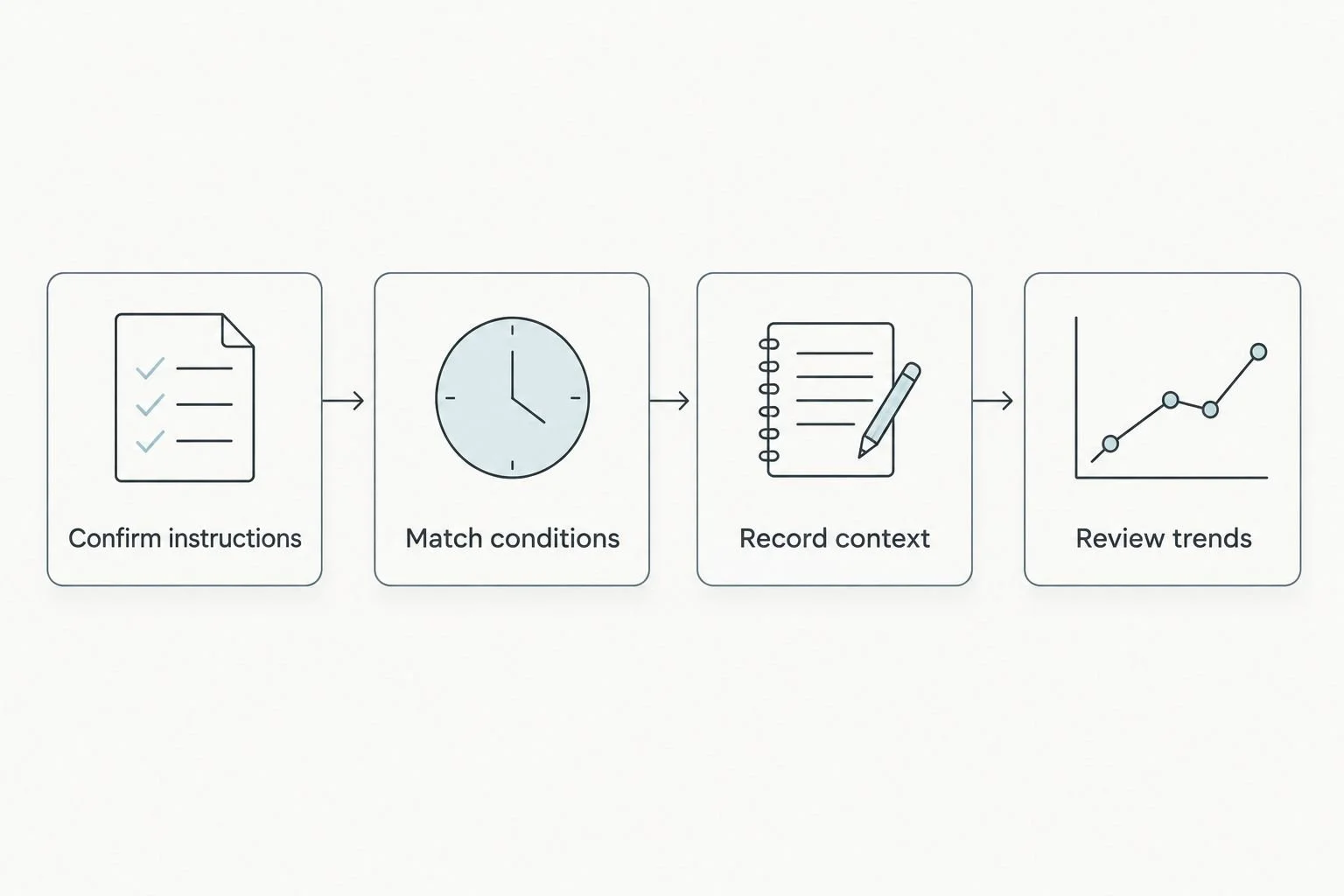
Repeat the preparation, not just the appointment, to make comparisons more useful.
Keep the preparation instructions with your report. That small habit makes it easier to reproduce the conditions later, particularly if different staff members handle your appointments.
Can an InBody scan mistake water changes for muscle changes?
An InBody scan can show a change in estimated muscle when fluid balance changes. Muscle contains water, and BIA uses electrical measurements related to body water to estimate tissue compartments.
A higher muscle estimate after a change in hydration does not establish new muscle growth. A lower estimate after sweating or illness does not establish that you lost muscle tissue.
Look for agreement across your records. If your strength and measurements are stable but the scan changes abruptly after an unusual day, review testing conditions before drawing a conclusion.
Is an InBody scan as accurate as a DXA scan?
An InBody scan and a DXA scan are different estimation methods, so their body-fat results are not interchangeable. DXA uses X-ray attenuation to estimate tissue composition; InBody uses electrical impedance.
DXA is used in clinical and research settings, but it is not an error-free picture of every tissue. Positioning, equipment, software, and hydration still matter when interpreting body-composition results.
If you switch methods in 2026, keep separate baselines. A difference between a DXA report and an InBody report does not, by itself, show that you gained or lost fat.
How often should you repeat an InBody scan?
Repeat an InBody scan when the result will inform a useful decision, not simply because another appointment is possible. Closely spaced readings can emphasize short-term fluid variation instead of meaningful tissue change.
Agree on a schedule with the professional helping you interpret the results. The schedule should reflect your training or health goals and give you enough time to assess a broader pattern.
For a 2026 training plan, decide in advance what you would do differently based on the findings. If no reasonable decision depends on another reading yet, continue recording your routine rather than chasing a new score.
How should you read the report without overreacting?
Start with the purpose of the appointment. A report intended to support strength training should not become a judgment about appearance or personal worth.
Body-fat percentage
Treat body-fat percentage as an estimate, not a precise inventory of fat tissue. Compare it under similar conditions and alongside other measurements rather than giving a small isolated change more meaning than it supports.
Muscle and lean tissue
Lean tissue is not synonymous with skeletal muscle. It includes water and other non-fat components, so check the report's labels before treating every increase in lean mass as muscle growth.
Regional results
Regional estimates describe different parts of the body, but they do not diagnose an injury or explain pain. Bring persistent weakness, swelling, or a major unexplained difference to a qualified healthcare professional rather than trying to correct it from the printout alone.
Your next decision
Before changing anything, ask whether the result agrees with your training record, weight pattern, and how you feel. An unexplained result deserves a better comparison before it deserves a major lifestyle change.
Where does body-composition tracking fit into spa and recovery care?
BodyCentre Day Spa is best for Orange County guests seeking spa care and advanced recovery services under one roof. The physical spa is in Costa Mesa, serving local guests and visitors from nearby communities such as Newport Beach, Irvine, and Huntington Beach.
BodyCentre Day Spa offers massage, facials, skincare, and waxing alongside recovery and performance services. Those options serve different purposes: massage appointments address hands-on care and relaxation, facials focus on skin care, and recovery-service choices need their own suitability discussion.
A body-composition report does not prescribe any of those treatments. It cannot establish that you need massage, red light therapy, PEMF, hyperbaric oxygen, or altitude training, and a changing scan result does not prove that a treatment worked.
For BodyCentre Day Spa guests planning visits in 2026, the useful next step is to explain your goal and ask what fits. Confirm current assessment options and preparation requirements through the contact page rather than assuming a particular device or assessment is offered.
The advantage of BodyCentre Day Spa's mix of spa and recovery care is choice. The limitation is equally important: having several services to choose from does not mean you need to combine them, and none replaces medical assessment of unexplained symptoms.
FAQ
Can I trust an InBody scan's body-fat percentage?
Treat an InBody scan's body-fat percentage as an estimate, not an exact measurement. Consistent testing conditions and agreement with other progress measures make the result more useful.
Why did my InBody scan say I lost muscle?
A lower muscle estimate can reflect fluid changes rather than actual muscle loss. Review hydration, recent exercise, illness, and testing conditions before changing your routine.
Should I drink extra water before an InBody scan?
Do not deliberately overdrink to influence an InBody scan. Follow the facility's preparation instructions and maintain your usual hydration routine unless your clinician advises otherwise.
Can I get an InBody scan after working out?
Recent exercise changes the conditions used to estimate body composition. Follow the facility's exercise guidance and avoid comparing a post-workout reading directly with a rested baseline.
Is an InBody scan better than weighing myself?
An InBody scan provides estimated composition information that body weight alone cannot provide. A scale remains useful for total-weight trends, while an InBody report requires more attention to hydration and preparation.
Can an InBody scan diagnose a health problem?
An InBody scan alone cannot diagnose the cause of symptoms or replace a medical evaluation. Discuss unexplained weight changes, swelling, weakness, or other concerns with a qualified healthcare professional.
Should I change my diet after one unexpected InBody result?
Do not make a major dietary change based only on one unexpected InBody result. Check the testing conditions and review the finding alongside your longer-term records and professional advice.
One last thing
Do not try to improve your next scan by changing how you prepare. A more flattering result achieved through different hydration or timing tells you less about your progress, not more.
Keep the conditions steady and let the longer-term pattern do the talking. The best report is the one that helps you make a sensible decision without making your day revolve around a percentage.