How long before you see results from altitude training?
/Altitude training results develop over days to weeks, but there is no universal session count or deadline for better endurance. Feeling more breathless during a session is an immediate response to lower oxygen availability—not proof that your fitness has improved. For your 2026 training plan, separate early adjustment, longer-term adaptation, and actual performance before deciding whether the sessions are working.
TL;DR
- Altitude training results depend on exposure, exercise, and the outcome you measure—not a fixed session count.
- CDC guidance describes early altitude acclimatization over 3–5 days; that is not a studio-training results promise.
- Judge endurance with a repeatable workout, not breathlessness or a single oxygen-saturation reading.
- BodyCentre Day Spa combines spa care and recovery services at its Costa Mesa location.
Why this matters
A harder workout and a better workout are not the same thing. Reduced oxygen availability can make a familiar effort feel demanding before you develop any lasting adaptation. Chasing that sensation makes it difficult to judge progress and easy to overlook fatigue.
Start by naming your goal: performing better at your usual elevation, preparing for a mountain trip, or exploring a new training approach. Those goals require different evidence. If you are comparing altitude training programs for endurance athletes, ask what outcome each program measures rather than choosing the strongest-sounding promise.
How long before you see results from altitude training?
Expect adjustment before you expect demonstrated performance improvement. Your breathing can change during the first exposure, while acclimatization and training adaptations require repeated exposure over time. A change you notice immediately does not establish a lasting endurance benefit.
The CDC Yellow Book 2026 chapter on high-altitude travel describes the acute acclimatization process as occurring over the first 3–5 days after ascent. That guidance concerns travel and sustained exposure at altitude. It does not establish a results timeline for brief simulated-altitude sessions.
Immediate breathing response
- What the timing tells you: Lower oxygen availability changes the demands of the session
- What it does not prove: That your endurance has improved
Early altitude acclimatization
- What the timing tells you: CDC travel guidance describes an initial 3–5-day adjustment period
- What it does not prove: That occasional studio visits reproduce continuous mountain exposure
Changes in oxygen transport
- What the timing tells you: These require a sufficient repeated exposure stimulus
- What it does not prove: That every altitude-style workout increases red blood cell mass
Better exercise performance
- What the timing tells you: Improvement must appear in a comparable performance test
- What it does not prove: That altitude exposure alone caused the improvement
For a 2026 results check, compare the same task under similar conditions. A faster pace at a similar effort is more meaningful than simply finishing a session feeling exhausted. Keep the setting consistent: a test performed with reduced oxygen is not directly interchangeable with one performed in ordinary room air.
First exposures: notice tolerance, not transformation
During early sessions, pay attention to how you feel, whether you can follow instructions comfortably, and how you recover afterward. These observations help you discuss the session with the provider. They are not a substitute for measuring fitness.
Do not treat dizziness, headache, or unusual breathlessness as evidence that the treatment is working. Tell the supervising staff immediately if you feel unwell. Severe breathlessness, chest pain, fainting, or confusion requires urgent medical assessment.
Repeated exposure: look for adaptation, not promises
Altitude exposure can stimulate processes involved in oxygen transport, including signaling related to red blood cell production. Whether those signals lead to a meaningful adaptation depends on the exposure pattern and your physiology. The signal is not the same as the finished result.
A short visit is not interchangeable with living at altitude. Ask how much reduced-oxygen exposure the session actually includes, whether you exercise during it, and what evidence supports the stated goal. Avoid borrowing a timeline from a mountain training camp and applying it to a different setup.
Why altitude training results vary
The phrase “altitude training” covers different experiences. Before comparing results, establish what you are comparing. These factors change both the training stimulus and the way you should interpret progress:
- Exposure duration: Time spent breathing reduced-oxygen air matters. The appointment length and the actual exposure time are not necessarily identical.
- Exposure frequency: A repeated schedule produces a different pattern from an occasional visit. Record completed sessions rather than relying on the schedule you intended to follow.
- Oxygen conditions: Real altitude and simulated altitude do not create identical environments. Ask what the system changes and how staff monitor it.
- Exercise intensity: Training harder changes the workload independently of oxygen exposure. Keep track of both instead of crediting every improvement to altitude.
- Starting fitness and health: Your training history, current health, and ability to tolerate the session affect the appropriate starting point. A clinician should evaluate suspected anemia or unexplained exercise intolerance.
- Recovery between sessions: Sleep, illness, nutrition, and your wider training load influence workout performance. A poor comparison can conceal progress or create the appearance of it.
A practical 2026 plan records these variables before increasing the challenge. Change too many things together and you lose the ability to tell what helped. That matters whether you are a competitive athlete or simply trying to make regular exercise feel more manageable.
Which altitude-training approach matches your goal?
The best approach is the one that matches your intended outcome and health needs—not the one that produces the lowest monitor reading. These are broad training formats, not descriptions of a particular provider’s equipment or sessions.
Staying at real altitude
- Best for: Preparing for time in a mountain environment
- Main advantage: Provides sustained exposure to the actual environment
- Main limitation: Adds travel demands and altitude-illness risk
Exercising in simulated altitude
- Best for: Applying a reduced-oxygen stimulus during exercise
- Main advantage: Allows a controlled exercise setting without mountain travel
- Main limitation: Lower oxygen availability can limit the workload you sustain
Resting in simulated altitude
- Best for: Receiving reduced-oxygen exposure without exercising during it
- Main advantage: Separates the exposure from an exercise workload
- Main limitation: Does not replace endurance training or establish performance gains by itself
Ask the provider to explain which format you will receive in ordinary language. “Simulated altitude” should lead to a clear description of the breathing environment, supervision, and session structure. It should not end the conversation.
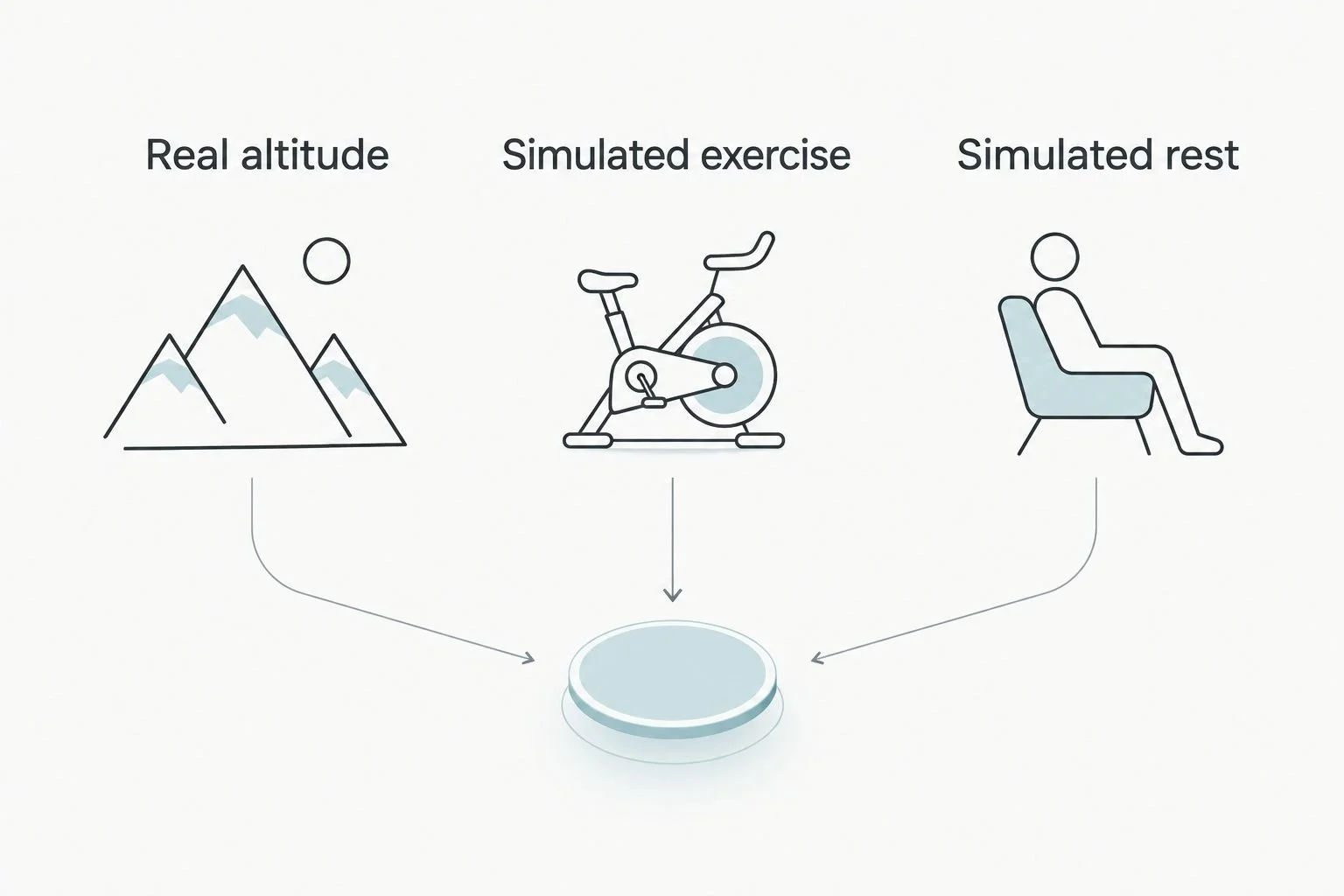
Different exposure formats should not share an assumed results timeline.
If your goal is a mountain trip, discuss the actual destination and ascent schedule with a travel-health clinician. If your goal is better exercise performance near sea level, ask how the program will measure that specific outcome. Tolerating a reduced-oxygen session and performing better afterward are separate achievements.
How should you track altitude training results?
Choose a simple repeatable benchmark before your first session. You do not need a complicated dashboard. You need a comparison that answers the same question each time.
The following is an example tracking method, not a prescribed exercise test or a guaranteed improvement schedule. Adapt the task to your ability and any clinical guidance you have received.
- Choose your goal. Write one clear outcome, such as completing your usual cycling workout with less perceived effort. Avoid combining endurance, weight change, sleep, and recovery into one vague success score.
- Record a baseline. For example, use a comfortable 10-minute walk or cycle in ordinary room air. Record distance or workload, along with how hard the task felt.
- Log each session. Note the exposure duration, exercise performed, symptoms, and relevant changes in sleep or health. Ask the provider which session settings belong in your record.
- Repeat the benchmark. Use the same equipment and similar conditions when practical. An indoor cycling result and an outdoor run answer different questions.
- Review the pattern. Look for repeatable improvement rather than a single unusually good day. Discuss persistent fatigue, worsening performance, or symptoms before increasing exposure.
You can record perceived effort on a 0–10 scale, where 0 means no exertion and 10 means maximal exertion. Use the scale consistently; it is a personal tracking tool, not a diagnosis. Do not push to maximal effort merely to create a comparison.
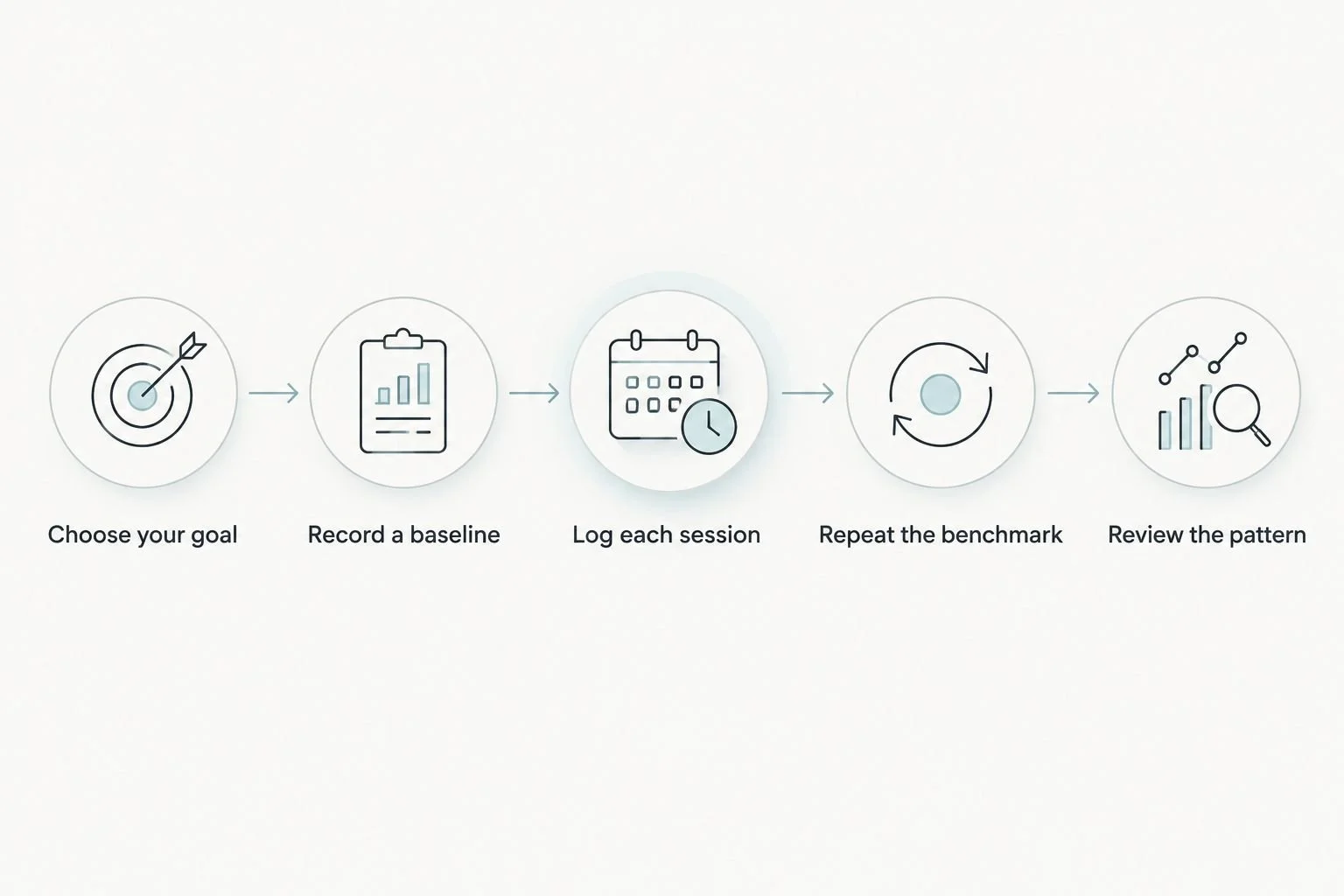
A consistent benchmark makes progress easier to interpret than a harder-feeling session.
Keep the benchmark separate from your toughest training day. If fatigue, a different machine, or a recent illness changes the conditions, record that context rather than forcing a conclusion. Your 2026 training log should explain the result, not just display it.
Does a lower oxygen reading mean better results?
No. A lower oxygen-saturation reading is not a performance score. A pulse oximeter estimates the percentage of hemoglobin carrying oxygen; it does not measure your endurance, red blood cell mass, or the quality of a workout.
For tracking oxygen saturation during exercise, the training context matters: exercise with supplemental oxygen and exercise with reduced oxygen are different interventions. Their readings should not be judged against the same goal. More oxygen and less oxygen are not interchangeable routes to an identical result.
Movement, cold hands, and poor circulation can affect a finger pulse oximeter’s reading. Staff should interpret readings alongside your symptoms and the session conditions—not ask you to chase a low number. Ask what monitoring is used, who reviews it, and what happens if you feel unwell.
A normal-looking reading also does not cancel concerning symptoms. Stop and speak up when something feels wrong. For home tracking, ask a qualified clinician how to interpret measurements rather than creating your own target saturation.
Can massage, facials, or recovery treatments speed the timeline?
Massage and facials serve different goals from altitude exposure. Massage can be part of a relaxation or muscle-comfort routine; facials address skincare needs. Neither should be presented as a shortcut to altitude acclimatization or increased oxygen-carrying capacity.
The same distinction applies to biohacking services. Red light therapy uses light, PEMF uses pulsed electromagnetic fields, and hyperbaric oxygen involves breathing oxygen in a pressurized environment. These are not alternative names for altitude training, and booking several services together does not establish a faster endurance result.
BodyCentre Day Spa offers massage, facials, and advanced recovery services at its Costa Mesa location. BodyCentre Day Spa is best suited to Orange County guests who want spa care and recovery services in one Costa Mesa setting. That combination helps with planning different wellness goals, but it is not evidence that combining treatments improves altitude-training results.
Guests traveling from Costa Mesa, Irvine, Newport Beach, or Huntington Beach should choose a schedule they can realistically maintain. The physical spa is in Costa Mesa; plan travel and appointments around your existing training rather than crowding every service into one visit.
When should you reassess your training plan?
Reassess when the experience and the goal stop matching. If you want improved endurance but only track breathlessness during exposure, change the measurement first. If your ordinary workouts are getting worse, review the overall load rather than assuming more exposure is the answer.
Before committing to a longer schedule, ask these questions:
- What exactly happens during the session, including exercise and rest?
- What improvement is the program intended to produce?
- How will that improvement be measured outside the session?
- Who assesses suitability and monitors symptoms?
- What would lead the provider to reduce, pause, or stop exposure?
For a 2026 booking, BodyCentre Day Spa can be contacted about its current altitude-training service and session arrangements. Use the contact page to ask those practical questions before choosing a schedule. Discuss heart or lung conditions, pregnancy, unexplained fainting, or other relevant medical concerns with your clinician before reduced-oxygen training.
FAQ
How many altitude training sessions do I need before I notice results?
There is no universal number of altitude-training sessions that guarantees results. Exposure duration, oxygen conditions, exercise, and the outcome you measure all affect the answer.
Can I feel a difference after one altitude training session?
You can notice changes in breathing or perceived effort during the first exposure, but those sensations do not establish improved fitness. Lasting performance changes require a repeatable comparison outside the session.
Does the 3–5-day acclimatization window apply to studio sessions?
The CDC's 3–5-day window describes early acclimatization after ascent, not a guaranteed studio-session timeline. Brief simulated exposure differs from spending consecutive days at altitude.
Will altitude training increase my red blood cell count?
Sufficient altitude exposure can stimulate processes involved in red blood cell production, but an increase is not guaranteed from a particular session schedule. Breathlessness and pulse-oximeter readings cannot confirm a blood-cell change.
Is a lower oxygen saturation better during altitude training?
A lower oxygen saturation is not automatically better and is not a measure of training success. Monitoring needs to account for the exposure conditions, measurement limitations, and your symptoms.
Can I combine altitude training with a massage or facial?
Massage, facials, and altitude training address different goals; combining appointments does not establish faster altitude adaptation. Ask the provider about suitability and scheduling for the specific services you want.
Where is BodyCentre Day Spa located?
BodyCentre Day Spa is located in Costa Mesa, California. Its spa and recovery services serve local Orange County guests, including people traveling from nearby cities.
One last thing
The best sign of progress can be an ordinary workout feeling more manageable—not an altitude session feeling harder. Decide what success looks like before you begin, keep the comparison fair, and review the pattern. A clear measurement is more useful than an impressive-sounding session.