
Using InBody scan results to guide your personal training plan
/Instead of rewriting your workouts after every weigh-in, build an InBody scan personal training plan that combines body-composition trends, strength records, and recovery notes. Use the scan to inform your next training decision—not to prescribe exercises or judge progress on its own.
TL;DR
- An InBody scan personal training plan works best when repeatable measurements support your strength goals.
- InBody estimates body composition; hydration and testing conditions affect comparisons.
- Keep workout performance and recovery notes alongside skeletal muscle mass and body-fat results.
- Bodycentre Day Spa combines spa care and recovery services for Orange County wellness clients.
Why this matters
An InBody scan uses bioelectrical impedance: a small electrical current helps estimate body water and body composition. The report is not a direct measurement of muscle tissue, and a change in estimated lean mass does not automatically mean you gained or lost muscle.
Your 2026 training plan needs a feedback loop, not another score to chase. A scan adds context, but your exercise history, symptoms, technique, and ability to recover determine what belongs in the gym.
Bodycentre Day Spa is best for local wellness clients seeking spa care and recovery services under one roof. Its physical location is Costa Mesa, serving guests from nearby Orange County communities, including Newport Beach, Irvine, and Huntington Beach. Confirm any scan or personal-training arrangements directly rather than assuming they are included in a spa visit.
For perspective on measurement choices, compare body-composition tracking methods before treating different devices as interchangeable.
Before you start
- Gather your materials: Have your InBody report, previous reports from the same device when available, a workout log, and a calendar. You do not need a new app; paper or a spreadsheet works.
- Confirm suitability: Follow the testing provider’s preparation instructions. Tell the provider about pregnancy, implanted electronic medical devices, or other relevant medical circumstances before testing; follow manufacturer restrictions and your clinician’s advice.
- Control the comparison: Food, fluids, recent exercise, and bathroom timing affect readings. Record testing conditions, and do not compare a post-workout scan with a rested baseline as though conditions were identical.
The easy-to-miss mistake is treating lean mass as muscle mass. Lean tissue includes water and other nonfat components. Keep the report’s exact measurement names instead of relabeling every lean-mass result as muscle.
Your baseline record
Start your 2026 baseline with a simple worksheet. The bold report labels below appear on common InBody result sheets, but report layouts vary by model; use the wording printed on your own report. The worksheet headings are yours, not software buttons.
Capture the report and its conditions
- Save the complete report with its test date and device information. Keep the original rather than copying only the score or colored bars.
- Copy Weight, Skeletal Muscle Mass, Body Fat Mass, and Percent Body Fat when those fields appear. Preserve the units exactly, including kilograms or pounds.
- Create a Testing conditions note. Record time of day, recent exercise, whether you followed the provider’s food and fluid instructions, and anything unusual about the visit.
- Add a Training goal sentence. Choose a practical outcome such as improving squat technique, rebuilding exercise consistency, or supporting strength while changing body composition.
- Add a Performance baseline using an exercise you already perform safely. Record the exercise, resistance, repetitions, and how difficult the set felt.
Expected result: You have a dated starting point with enough context to interpret the next scan. Another trainer can understand the record without guessing what a number means.
The sequence matters: capture the measurement, choose the goal, then record what you can actually do. Do not reverse it by picking a demanding workout merely because a report highlights one body region.
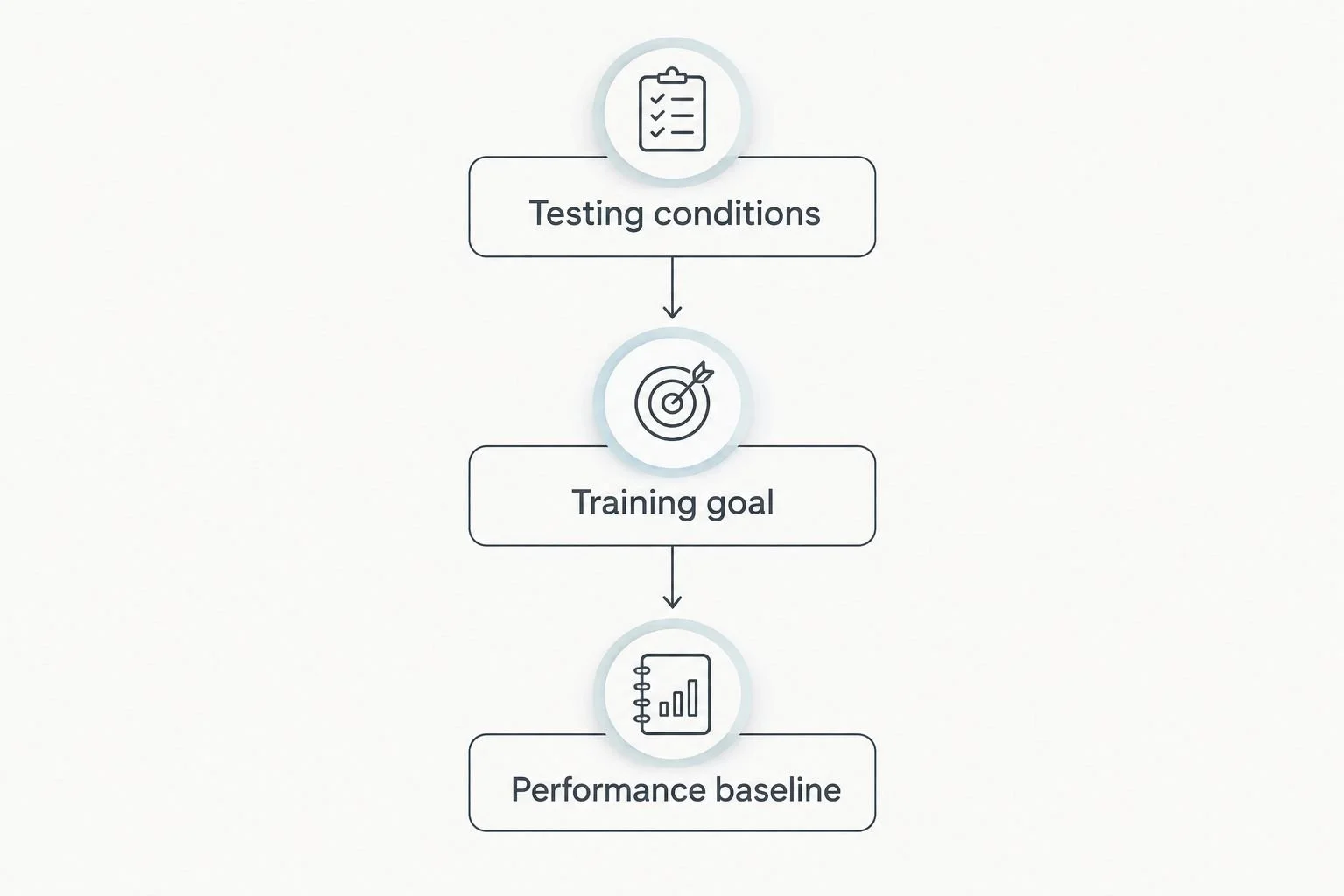
A useful baseline includes the circumstances of the scan and a real training goal.
Read regional results cautiously
If your report includes Segmental Lean Analysis, treat it as a prompt for discussion. It estimates lean tissue distribution; it does not diagnose an injury, establish exercise technique, or prove that one side needs heavier training.
Bring a persistent difference to a qualified trainer alongside your movement history. Pain, new weakness, swelling, or unexplained changes belong with a healthcare professional, not a self-designed correction based on a chart.
Your training priorities
Translate the baseline into a small number of decisions. Choose training from your goals and capabilities; use InBody results as supporting evidence.
Match each measurement to a decision
- Write down the main outcome you want from training. Keep body composition separate from performance so you can recognize progress in either area.
- Review your exercise history, current limitations, and weekly availability with a qualified trainer when you need exercise selection or technique support.
- Choose a repeatable schedule. For someone beginning resistance exercise, a discussion starting point is 2 sessions per week, adapted to health, experience, and recovery—not prescribed by a scan score.
- Record resistance, repetitions, technique notes, and effort after each session. Increase demands only when the exercise remains controlled and the progression fits your plan.
- Schedule 1 review per week to check attendance, performance, fatigue, and symptoms. This is a planning habit, not a requirement to repeat the scan weekly.
Expected result: Your calendar contains doable training sessions, and every tracked measure has a clear purpose. You are not changing exercises in response to every fluctuation.
Choose the right evidence for the question
No single tracking method answers every question. Use this comparison to decide what deserves attention before changing your routine.
InBody scan
- Best for: Estimated body-composition trends
- Main advantage: Separates estimated fat and lean components rather than showing weight alone
- Main limitation: Testing conditions affect results; it does not measure exercise ability
Workout log
- Best for: Strength and training consistency
- Main advantage: Shows what you performed and how it felt
- Main limitation: Better performance does not directly quantify fat or muscle changes
Scale weight
- Best for: Tracking total body-weight trends
- Main advantage: Simple to record consistently
- Main limitation: Does not distinguish fat, muscle, water, or digestive contents
Recovery notes
- Best for: Understanding training tolerance
- Main advantage: Captures sleep, soreness, and energy alongside workouts
- Main limitation: Subjective notes do not diagnose a medical problem
For example, improving exercise performance with little scale change is not a failed plan. Conversely, a lower body-fat estimate does not justify ignoring persistent fatigue or declining performance.
Your repeat-scan review
Make your 2026 follow-up a comparison of like with like. Consistent preparation is more useful than collecting frequent measurements under different conditions.
Compare before changing the plan
- Arrange follow-up testing with the provider and agree on preparation instructions. Use the same device when practical and reproduce the original conditions as closely as possible.
- Place the reports side by side. Compare the same fields and units rather than comparing a muscle-related field on one report with total lean mass on another.
- Review the workout log from the same period. Look for changes in performance, attendance, exercise difficulty, and recovery.
- Check for an explanation before interpreting a surprising shift. A different testing time, hard workout, illness, or altered hydration makes a clean comparison harder.
- Make one clear training decision: maintain the plan, adjust a manageable training variable, or seek professional assessment. Write down the reason so you can evaluate it later.
Expected result: Your next action has supporting evidence beyond a single report. You can explain both what changed and why the plan stays the same or changes.
The review should connect three records: scan results, workout performance, and recovery notes. Agreement between them strengthens your interpretation; disagreement is a reason to investigate, not automatically work harder.
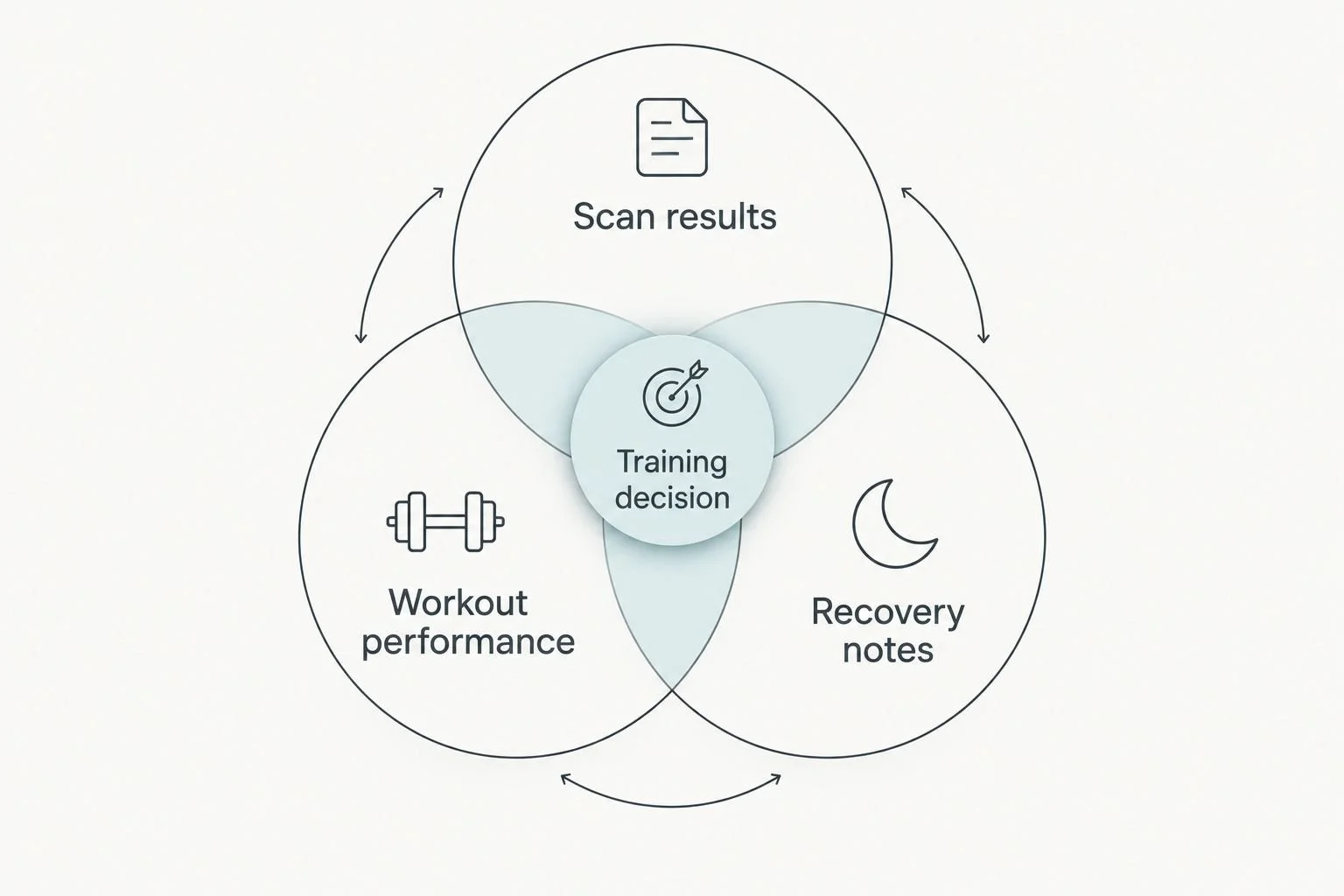
Interpret a scan alongside performance and recovery before changing training.
A repeat scan is a checkpoint, not a deadline for a visible transformation. Avoid setting a muscle-gain or fat-loss promise from a device estimate.
A second workflow: review training when performance changes
You do not need a new scan every time your workouts change. Use the same review process when performance stalls, your schedule shifts, or recovery becomes harder.
- Identify the specific change: missed sessions, reduced repetitions at a familiar resistance, unusual fatigue, or a new symptom.
- Check the circumstances first. Consider recent illness, sleep disruption, a changed exercise technique, or a workload increase before blaming body composition.
- Keep useful training elements stable. Discuss adjustments with your trainer rather than replacing the entire routine.
- Revisit scan trends at the next appropriately prepared appointment. Do not use an extra scan to settle a question about pain or exercise safety.
For your 2026 review notes, distinguish a performance question from a body-composition question. “Why does this movement hurt?” needs a different response from “Has estimated body fat changed under comparable testing conditions?”
This distinction also makes body composition tracking for strength training more useful: the measurements describe one part of progress, while the workout record shows whether the training task is improving. Neither record substitutes for an assessment of new pain or unexplained weakness.
Expected result: You can respond to a training problem without waiting for another scan—or overinterpreting one you already have.
Troubleshooting
Estimated muscle changes suddenly
Check preparation and recent circumstances before labeling the change as muscle gain or loss. Compare the original reports, preserve the testing notes, and ask the provider whether the readings are suitable for comparison.
Body weight stays the same
Review performance and the body-composition fields separately. Stable weight alone cannot tell you whether the plan is working; it also cannot prove that body recomposition occurred.
The report shows a left-right difference
Do not immediately add extra work to the lower-reading side. Ask a trainer to assess exercise execution and relevant history, and seek clinical assessment for pain, swelling, or new weakness.
Results disagree with how you feel
Give symptoms appropriate attention. A favorable scan does not cancel exhaustion, dizziness, or worsening pain; pause the relevant activity and seek qualified advice rather than using the report as clearance.
Tracking becomes stressful
Reduce the number of measures you monitor and discuss the approach with an appropriate professional. If weight or body-fat tracking worsens anxiety or disordered eating, prioritize support over collecting another measurement.
Customize your workflow
Keep your 2026 calendar realistic: training, rest, work, and personal care all need space. Reserve 10 minutes per weekly review as a practical planning choice, then stop checking the numbers until your next planned review.
Bodycentre Day Spa offers massage, facials, skincare, and recovery services such as PEMF, red light therapy, and hyperbaric oxygen. PEMF uses pulsed electromagnetic fields; hyperbaric oxygen involves breathing oxygen in a pressurized environment. Ask about suitability and limitations before choosing a treatment.
Spa care is optional support, not a substitute for training, sleep, nutrition, or medical care. Massage fits a relaxation goal; facials address skin-care goals. Neither a facial nor a recovery appointment proves a change in body composition.
For a visit to Bodycentre Day Spa in Costa Mesa, contact the team with your goals and questions about current services. Guests traveling from Newport Beach, Irvine, or Huntington Beach should plan around that same Costa Mesa location.
FAQ
How do I build an InBody scan personal training plan?
Combine a consistently prepared scan with a training goal, workout records, and recovery notes. Choose exercises from your abilities and needs, then use comparable scan trends as supporting evidence.
Can an InBody scan tell me which exercises to do?
No, an InBody scan does not prescribe exercises or assess movement technique. A qualified trainer can combine your goals, history, and exercise assessment to select appropriate movements.
Does higher lean mass always mean I gained muscle?
No, lean mass includes water and other nonfat tissue. Review the exact report field and testing conditions before interpreting an increase as muscle gain.
Should I work out before an InBody scan?
Follow the testing provider’s preparation instructions rather than adding a workout before testing. Recent exercise changes conditions that affect bioelectrical impedance measurements and makes comparisons harder.
How often should I repeat an InBody scan?
Agree on a repeat-testing schedule with the provider based on your goals and circumstances. Frequent scans under inconsistent conditions are less useful than comparable measurements reviewed alongside training records.
What if my scan improves but my workouts feel worse?
Investigate the decline in performance rather than treating the scan as proof that everything is fine. Review workload, sleep, illness, and symptoms, and seek professional advice when needed.
Can massage or recovery treatments replace strength training?
No, massage and recovery treatments do not replace the exercise stimulus used to develop strength. Choose spa services for their appropriate purpose and keep training decisions separate from treatment expectations.
One last thing
Write your review rule before seeing the next scan. Decide which performance records, preparation notes, and symptoms you will consider. That small step helps prevent a disappointing number—or an encouraging one—from making the decision for you.