Best facial treatments for every skin type in Costa Mesa
/Best overall: an assessment-led facial. Best for dry skin: a hydration-focused facial. Best for sensitive skin: a minimalist facial. This 2026 guide to facials Costa Mesa guests can compare ranks treatment approaches by skin needs—not by how many extras an appointment includes.
TL;DR
- For facials Costa Mesa guests can choose confidently, start with a skin assessment rather than the longest treatment description.
- Bodycentre Day Spa suits Costa Mesa guests seeking facial care, massage, and recovery services in one location.
- Choose hydration for dryness, a minimalist approach for sensitivity, and selective extractions for suitable clogged pores.
- Chemical peels need extra screening; inflamed acne, persistent redness, and changing spots belong with a dermatologist.
Why your skin needs more than a treatment name
A facial name tells you less than the steps inside it. Cleansing, exfoliation, extractions, masks, and massage serve different purposes, and your skin does not need every step at every visit.
Bodycentre Day Spa offers facials and skincare alongside massage, fitness, and advanced recovery services at its Costa Mesa location. Bodycentre Day Spa is best for facial guests who also want access to traditional spa care and advanced recovery services under one roof.
The rankings below describe treatment categories, not named packages or a confirmed booking menu. Use them to discuss your goals and choose an appropriate facial approach for your skin in 2026.
What makes the best facial treatment?
Judge a facial by whether its steps fit your skin today. A familiar skin-type label is useful, but current irritation, medication use, and recent procedures also belong in the conversation.
- Skin comfort: The plan respects burning, stinging, flaking, or tenderness instead of treating discomfort as proof of effectiveness.
- Main concern: Dryness, clogged pores, dullness, and uneven tone receive different treatment plans.
- Treatment intensity: Exfoliation and extractions have a clear purpose; neither is included automatically.
- Aftercare demands: You understand what to avoid afterward and whether visible irritation would disrupt your plans.
- Appointment purpose: Relaxation and targeted skincare are both valid goals, but they do not always require the same appointment.
A good consultation also leaves room to do less. If your skin is irritated, postponing exfoliation is a better decision than completing a predetermined sequence.
Facial treatments at a glance
This 2026 ranking prioritizes suitability and clear trade-offs. Read the limitation column before choosing: a treatment that fits one concern can be the wrong choice for another.
1. Assessment-led facial
- Best for: First visits and combination skin
- Standout feature: Steps selected around current skin needs
- Key limitation: Requires a detailed consultation
2. Hydration-focused facial
- Best for: Dry, tight-feeling skin
- Standout feature: Emphasis on moisture and comfortable skincare
- Key limitation: Does not resolve every cause of persistent dryness
3. Minimalist facial
- Best for: Sensitive or easily irritated skin
- Standout feature: Fewer products and optional steps
- Key limitation: Active irritation can require postponement
4. Congestion-focused facial
- Best for: Oily skin with suitable clogged pores
- Standout feature: Selective attention to blackheads and congestion
- Key limitation: Extractions can irritate; not appropriate for every blemish
5. Gentle exfoliating facial
- Best for: Dull-looking, nonreactive skin
- Standout feature: Surface exfoliation with an intensity discussion
- Key limitation: Over-exfoliation can worsen irritation
6. Superficial chemical peel
- Best for: Uneven tone requiring a targeted discussion
- Standout feature: Controlled chemical exfoliation
- Key limitation: Needs careful screening and aftercare
1. Assessment-led facial: best for first visits and combination skin
An assessment-led facial starts with your history and current concerns before choosing the treatment steps. For combination skin, that means acknowledging that a shiny forehead and dry cheeks do not necessarily need identical care.
This is the strongest default when you cannot tell whether your skin needs hydration, less irritation, or help with congestion. The value lies in the decision-making—not in adding every available technique.
Assessment-led facial pros:
- Gives you space to explain reactions and previous treatments.
- Allows different facial areas to receive different attention.
- Makes exfoliation and extractions decisions rather than assumptions.
Assessment-led facial cons:
- Depends on clear communication about products and medications.
- Does not replace diagnosis of a persistent skin condition.
Best for: First-time facial guests and people with mixed concerns.
Before booking, ask how the consultation changes the treatment. A useful answer explains which steps can be modified or omitted, rather than promising the same result for everyone.
Verdict: Buy—choose an assessment-led approach as your default, especially when your skin needs are unclear.
2. Hydration-focused facial: best for dry, tight-feeling skin
A hydration-focused facial emphasizes gentle cleansing, moisturizing products, and comfort. It is a sensible starting point when your main complaint is tightness or dry-looking skin rather than clogged pores.
Dryness and dehydration are not interchangeable diagnoses, and neither tells the whole story. Describe what you notice—flaking, tightness after washing, or sensitivity to products—rather than trying to diagnose the cause yourself.
Hydration-focused facial pros:
- Keeps the appointment centered on comfort and moisture.
- Offers a clear alternative to aggressive exfoliation.
- Fits guests whose main goal is a gentler skincare visit.
Hydration-focused facial cons:
- Fragranced or complex formulas can still trigger reactions.
- Persistent cracking, itching, or inflammation needs medical assessment.
Best for: Dry-feeling skin without active irritation or an unexplained rash.
Ask whether exfoliation is necessary rather than assuming dry skin needs scrubbing. Moisturizing and exfoliating are different actions; combining them is not automatically better.
Verdict: Buy—prioritize hydration when tightness and dryness are your main concerns.
3. Minimalist facial: best for sensitive or easily irritated skin
A minimalist facial reduces unnecessary products and treatment steps. The aim is a tolerable appointment, not a dramatic sensation or an elaborate sequence.
Tell the provider exactly what sensitivity means for you. A history of fragrance reactions, burning with skincare, or diagnosed rosacea changes the discussion more than the word sensitive alone.
Minimalist facial pros:
- Limits the number of products introduced during the visit.
- Makes it easier to discuss known triggers.
- Avoids treating strong sensations as a treatment goal.
Minimalist facial cons:
- A simpler treatment can still cause a reaction.
- Active flares can make postponement the appropriate choice.
Best for: Guests with a reaction history whose skin is currently calm.
Ask about fragrance, exfoliating ingredients, heat, and massage pressure. If even basic cleansing currently stings, seek advice about the irritation before planning a cosmetic treatment.
Verdict: Buy—choose restraint for reactive skin; wait if your skin is actively inflamed.
4. Congestion-focused facial: best for oily skin with clogged pores
A congestion-focused facial addresses suitable clogged pores through cleansing and, when appropriate, selective extractions. It should distinguish blackheads and other congestion from inflamed lesions that should not be squeezed.
Oily skin still needs comfortable, appropriate skincare. An appointment that leaves your face painfully tight is not a useful target simply because your skin produces oil.
Congestion-focused facial pros:
- Gives visible congestion a specific treatment focus.
- Creates an opportunity to discuss pore-clogging routines.
- Allows extractions to be limited to appropriate areas.
Congestion-focused facial cons:
- Extractions can cause redness and irritation.
- Recurrent or painful acne requires more than a spa appointment.
Best for: Oily or combination skin with noninflamed clogged pores suitable for professional attention.
Ask what the provider will leave alone as well as what they will treat. Do not request that every bump be extracted, and do not treat pain as evidence that a pore is being cleaned properly.
Verdict: Buy—for suitable congestion; skip aggressive extractions on inflamed blemishes.
5. Gentle exfoliating facial: best for dull-looking, nonreactive skin
An exfoliating facial removes surface dead skin cells using a physical or chemical method. An enzyme-based treatment is one possible approach, but the name alone does not establish how gentle the complete formula will be.
The important questions are what is being applied and whether your current routine already exfoliates. More exfoliation is not a shortcut to healthier skin.
Gentle exfoliating facial pros:
- Gives surface roughness and dullness a defined focus.
- Encourages a review of your existing exfoliating products.
- Can be planned without automatically adding extractions.
Gentle exfoliating facial cons:
- Excess exfoliation can irritate the skin barrier.
- Enzyme or botanical wording does not guarantee tolerability.
Best for: Nonreactive skin with surface dullness, after reviewing current products.
Disclose retinoids, exfoliating acids, and recent waxing or cosmetic procedures. Ask the provider for instructions specific to your treatment rather than following a generic online pause schedule.
Verdict: Buy—only when your skin is comfortable and your existing routine supports exfoliation.
6. Superficial chemical peel: best for a targeted uneven-tone discussion
A superficial chemical peel uses an exfoliating solution to affect the outer skin layers. Peel type, concentration, technique, and your skin history all influence suitability; the word superficial does not mean risk-free.
For uneven tone, first establish what you are trying to address. A changing spot or unexplained patch needs medical evaluation, not a stronger cosmetic treatment chosen from a menu.
Superficial chemical peel pros:
- Provides a focused option for discussing certain texture and tone concerns.
- Makes treatment intensity and aftercare explicit planning topics.
- Encourages attention to sun protection and recent skincare use.
Superficial chemical peel cons:
- Can cause irritation and unwanted pigment changes.
- Requires more screening than a basic cleansing appointment.
Best for: Guests with a defined cosmetic concern who have been assessed as suitable.
Discuss your history of dark marks after irritation, previous peel reactions, and medication use. Do not schedule an unfamiliar peel immediately before an important event.
Verdict: Hold—choose a peel only after a qualified provider confirms suitability and explains aftercare.
How these facial approaches are ranked
The 2026 order favors flexibility first, then specific concerns, with higher-screening treatments last. It is a suitability ranking—not a claim that a hydrating facial outperforms a chemical peel for the same condition.
The criteria are skin comfort, main concern, treatment intensity, aftercare demands, and appointment purpose. A lower-ranked option becomes the better choice when it matches your assessed needs; no treatment earns its place by sounding more technical.
Choose your appointment before choosing your extras
Use these 3 questions to prepare for a facial consultation in 2026. Write down your answers alongside your current skincare products so the conversation starts with useful details.
- Your goal: Are you seeking relaxation, help with dryness, attention to congestion, or guidance about uneven tone?
- Skin history: Which products, medications, conditions, and previous reactions should the provider know about?
- Aftercare plan: Can you follow the treatment-specific instructions without conflicting procedures or an important event?
The same questions work whether you live in Costa Mesa, Newport Beach, Irvine, or Huntington Beach. Bodycentre Day Spa's physical location is Costa Mesa; plan your travel and appointment around that location.
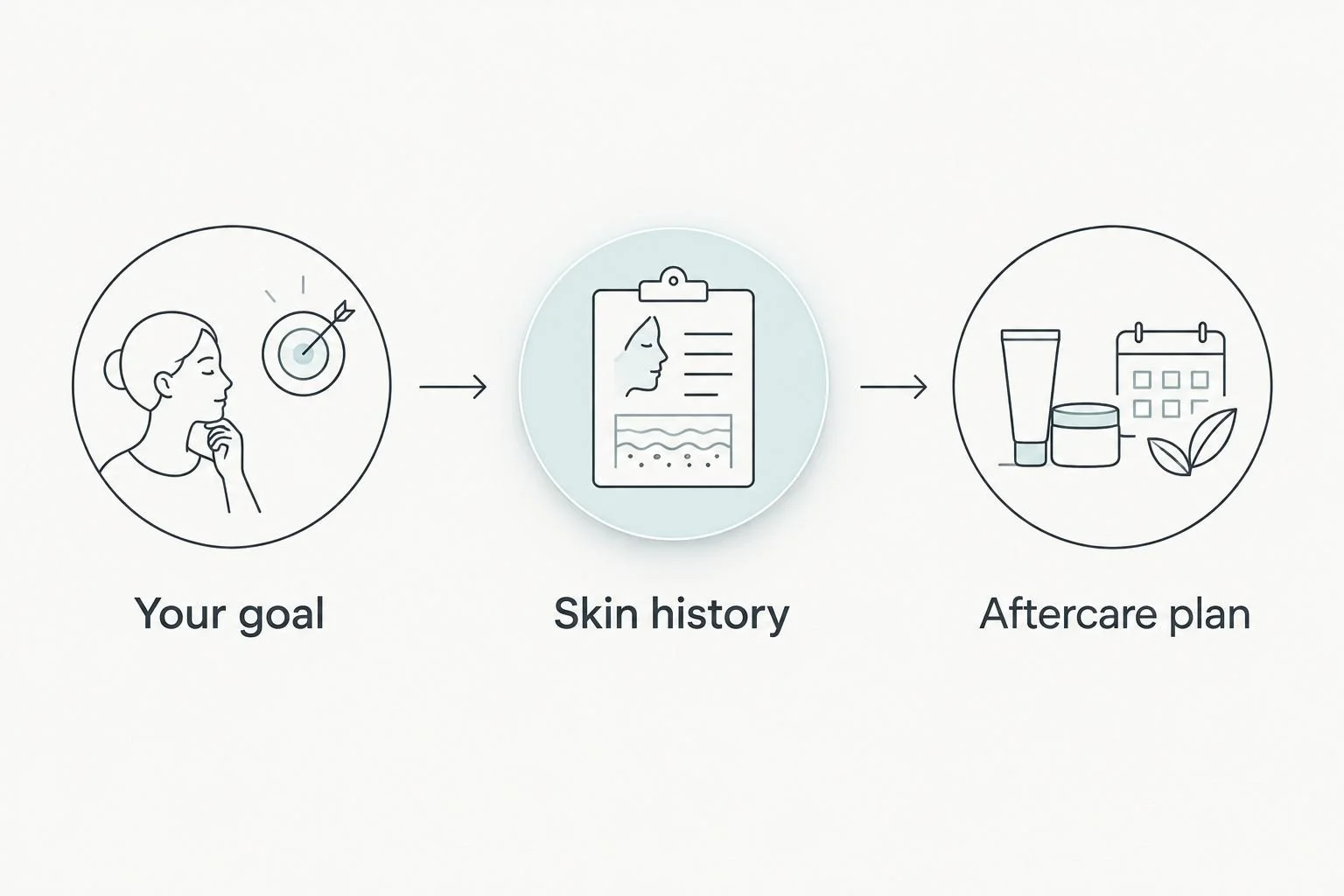
Choose the treatment around your goal, skin history, and aftercare—not its name alone.
Keep spa care and recovery goals distinct
Bodycentre Day Spa combines facials and skincare with massage, waxing, fitness, and recovery services, including red light therapy, PEMF, hyperbaric oxygen, and altitude training. That breadth gives you different appointment options, but the services are not interchangeable.
Massage centers on hands-on bodywork; facials center on skincare. PEMF uses pulsed electromagnetic fields, hyperbaric oxygen involves oxygen in a pressurized setting, and altitude training uses reduced-oxygen conditions. None should be added to a facial simply because the terminology sounds advanced.
Ask what each proposed service is intended to address and whether combining appointments is appropriate. For everyday skin protection, the American Academy of Dermatology recommends broad-spectrum, water-resistant sunscreen with SPF 30 or higher, reapplied every 2 hours outdoors and after swimming or sweating.
Which facial should you choose?
For an undecided guest, choose an assessment-led facial and keep the first appointment focused. Choose hydration for dryness, a minimalist approach for sensitivity, and congestion-focused care only when the pores are suitable for extractions.
For your 2026 booking, explain your main concern before asking for add-ons. If persistent inflammation, painful acne, or a changing lesion is driving the search, start with a dermatologist rather than a spa treatment.
FAQ
What's the best facial for a first visit in Costa Mesa?
An assessment-led facial is the best starting approach when you are unsure what your skin needs. Discuss your goals, medications, current products, and past reactions before choosing exfoliation or extractions.
Which facial is best for dry skin?
A hydration-focused facial is a sensible choice for dry, tight-feeling skin without active irritation. Persistent itching, cracking, or inflammation needs medical assessment rather than repeated cosmetic treatment.
Can I get a facial if I have sensitive skin?
Sensitive skin needs a consultation and a restrained treatment plan, not an automatic ban on facials. Explain your triggers, and postpone cosmetic treatment if your skin is actively irritated.
Are extractions good for every type of acne?
No, extractions are not appropriate for every acne lesion. Inflamed or painful acne needs medical guidance, and squeezing unsuitable lesions can worsen irritation and scarring.
Is an enzyme facial always gentler than a chemical peel?
No, an enzyme label does not guarantee a gentler treatment. Suitability depends on the complete formula, application, other treatment steps, and your skin history.
Can I combine a facial with massage or recovery services?
Ask the provider whether the specific appointments and their aftercare requirements fit together. Bodycentre Day Spa offers facial care, massage, and advanced recovery services in Costa Mesa, but combining services is not automatically better.
Should I stop using retinol before a facial?
Tell the provider about retinol and other active skincare before the appointment, then follow treatment-specific instructions. Do not change prescribed treatment without advice from the prescribing clinician.
One last thing
The most useful facial decision is sometimes removing a step. Ask, What would you leave out for my skin today? A clear explanation about skipping heat, exfoliation, or extractions tells you more than a long list of included extras.