Pairing PEMF therapy with altitude training for recovery
/Instead of improvising a PEMF altitude training recovery routine after every workout, build a screened plan that separates training stress from recovery care. This 2026 guide explains what to ask before combining treatments, how to track your response, and when to leave altitude training out.
TL;DR
- PEMF altitude training recovery needs screening and separate goals; combining treatments does not establish an added benefit.
- Bodycentre Day Spa suits Costa Mesa guests seeking spa care and advanced recovery services in one location.
- Altitude training adds a training stimulus; do not automatically classify it as recovery.
- Start with separate appointments and record your response before considering a combined visit.
Why this matters
PEMF and altitude training do different things. Pulsed electromagnetic field therapy uses changing magnetic fields; altitude training involves reduced oxygen availability to create a training stimulus. Neither name tells you whether a particular setup fits your health history or current training load.
A recovery appointment should not become another demanding workout by accident. Before adding either service, identify whether you want relaxation, help managing everyday muscle tension, or a performance-focused training session.
Bodycentre Day Spa offers massage, facials, skincare, and advanced recovery services at its Costa Mesa location. Guests traveling from Newport Beach, Irvine, Huntington Beach, or elsewhere in Orange County should plan around that location, not assume there is a nearby branch.
Bodycentre Day Spa is best for local guests who want spa care and advanced recovery services under one roof. That convenience supports appointment planning; it does not establish a medical benefit from combining treatments.
Before you start
Bring these materials to the conversation before booking a combined visit:
- Health and device information: Share relevant diagnoses, recent surgery, pregnancy, medications, and implanted electronic devices. Ask your treating clinician about suitability when these apply, and give staff the device details needed for screening.
- Training context: Describe recent exercise, upcoming demanding sessions, current symptoms, and your main goal. Include whether you have tried either treatment before.
- A clear description of the altitude service: Ask whether it involves exercise, resting exposure, or another format. Reduced-oxygen exposure is not the same as supplemental oxygen or hyperbaric oxygen therapy; do not transfer instructions between them.
For your 2026 plan, resolve screening questions before choosing the appointment order. A pacemaker or other implanted electronic device requires particular attention before PEMF because electromagnetic exposure can interfere with some devices. Staff screening does not replace advice from the clinician responsible for that device.
Goal and treatment selection
Match the service to the job
- Write one main goal. Use plain language: relax after a demanding week, discuss persistent muscle discomfort, or explore altitude training for an endurance goal. Do not combine all three into a promise of faster recovery.
- Compare the actual treatment formats. Ask what the session involves, who supervises it, what screening applies, and how staff respond if you feel unwell.
- Choose the smallest useful plan. A single service is easier to evaluate than several new treatments on the same day. Leave unresolved medical symptoms with a healthcare professional rather than treating them as a spa-selection problem.
The table separates service purposes. “Best for” describes the appointment goal to discuss, not proof that a treatment will produce a particular result.
- Best for: A screened discussion about electromagnetic-field treatment
- Practical advantage: Can be considered separately from exercise
- Limitation: Devices and applications differ; broad recovery claims do not establish suitability
Altitude training
- Best for: A defined training goal with appropriate screening
- Practical advantage: Creates a reduced-oxygen training stimulus
- Limitation: Adds physiological demand and is not automatically a recovery treatment
Massage
- Best for: Relaxation and discussion of everyday muscle tension
- Practical advantage: Offers hands-on care with pressure preferences you can communicate
- Limitation: Does not diagnose an injury or replace rehabilitation
Facial
- Best for: A skin-focused spa visit
- Practical advantage: Keeps skincare goals separate from training goals
- Limitation: Does not address exercise recovery or replace dermatology care
Expected result: You can explain why each service belongs in your plan without using the word “biohacking” as the explanation.
A simple distinction helps: choose a service for its own purpose, not because it appears beside another treatment on a menu. Massage and facials remain valid choices even when you decide against a performance-focused appointment.
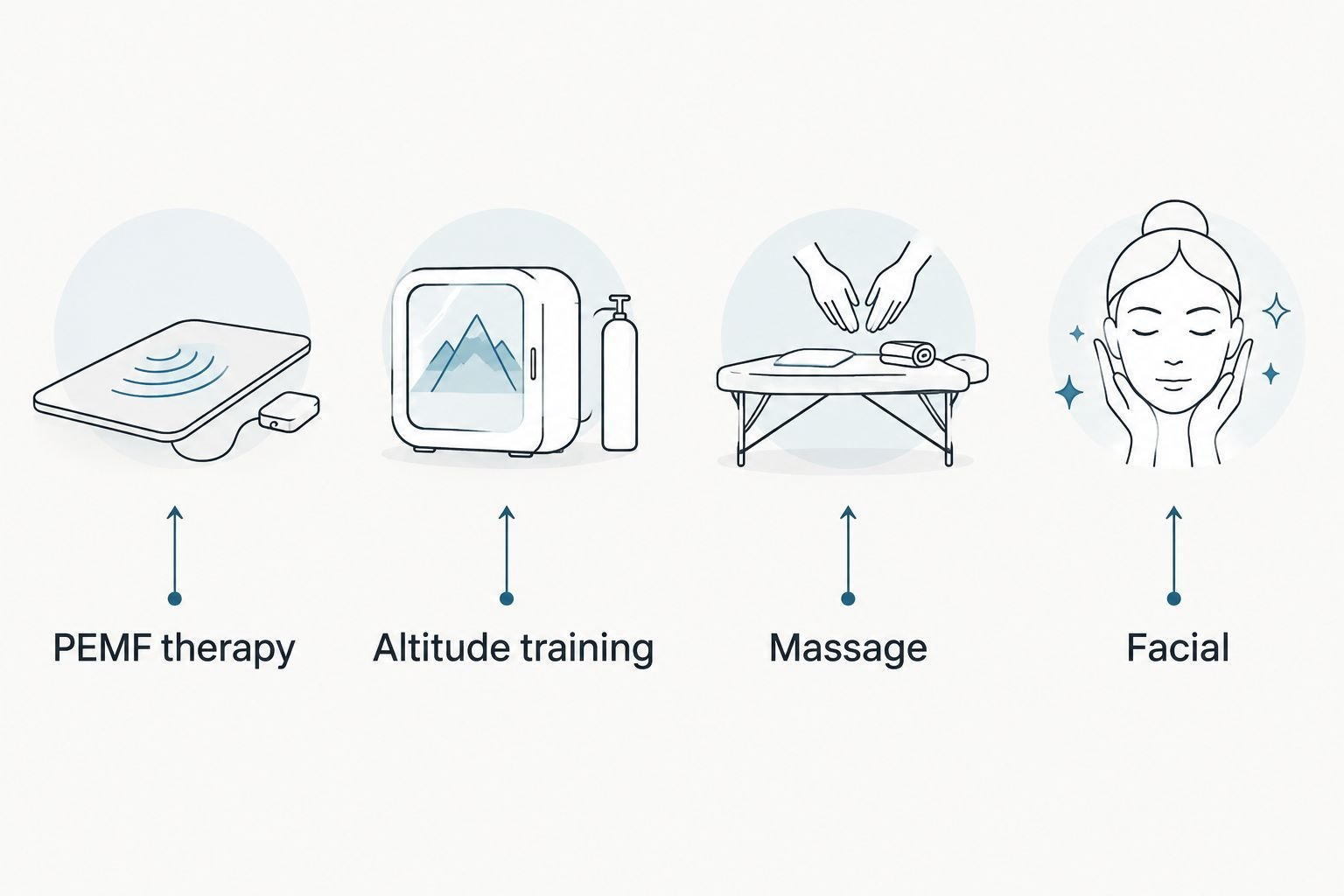
Choose each service for a defined purpose rather than treating every option as exercise recovery.
Appointment sequence and safety checks
Establish a separate baseline
- Start separately. If both services are new to you, arrange separate experiences rather than asking for simultaneous treatment. This makes it easier to describe what happened during each appointment.
- Confirm the exact setup. Ask staff to explain the equipment, positioning, supervision, and stopping procedure. Do not choose oxygen settings, exposure duration, or PEMF intensity from an online example.
- Keep other changes limited. Avoid introducing several unfamiliar treatments alongside a new workout schedule. Otherwise, even a clear symptom becomes difficult to associate with one change.
- Review before combining. Discuss your response with staff and, when relevant, your clinician or coach. A comfortable first session is information, not automatic clearance to increase exposure.
Expected result: You understand each appointment independently and know who controls treatment settings and stopping decisions.
For a 2026 training calendar, mark altitude exposure as training-related demand rather than automatically placing it in the recovery column. Your clinician or qualified training professional can help decide how it fits with exercise; this article does not supply a universal duration or oxygen target.
Agree on stop signals
Tell staff immediately about dizziness, headache, nausea, unusual breathlessness, or feeling faint during reduced-oxygen exposure. Stop rather than trying to finish the appointment. Chest pain, fainting, or severe or persistent breathing difficulty require urgent medical assessment.
Ask for the stopping procedure before you begin, while you are comfortable and able to discuss it clearly. Do not rely on motivation, a wearable, or a general wellness goal to override symptoms.
Response tracking and review
Keep a short appointment log
- Record the starting point. Note sleep quality, recent exercise, existing soreness, and how you feel before the appointment. Describe unusual symptoms in words rather than reducing everything to a score.
- Use a consistent comfort scale. If helpful, choose a 0–10 scale for perceived soreness and use the same definition each time. This is a personal tracking aid, not a diagnostic test.
- Record the experience. Write down the service, whether you exercised, any symptoms, and why a session stopped or changed. Ask staff to clarify details you do not understand.
- Check the next day. A note around 24 hours later can help you remember how you slept and felt afterward. That timing is a suggested check-in, not a claim about how long either treatment takes to work.
Expected result: You have a usable account of the appointment instead of a vague impression that the combination “worked.”
Keep three entries together: before the appointment, immediately afterward, and the next-day check. A personal log can reveal questions worth discussing, but it cannot prove that a treatment caused a change in performance or symptoms.
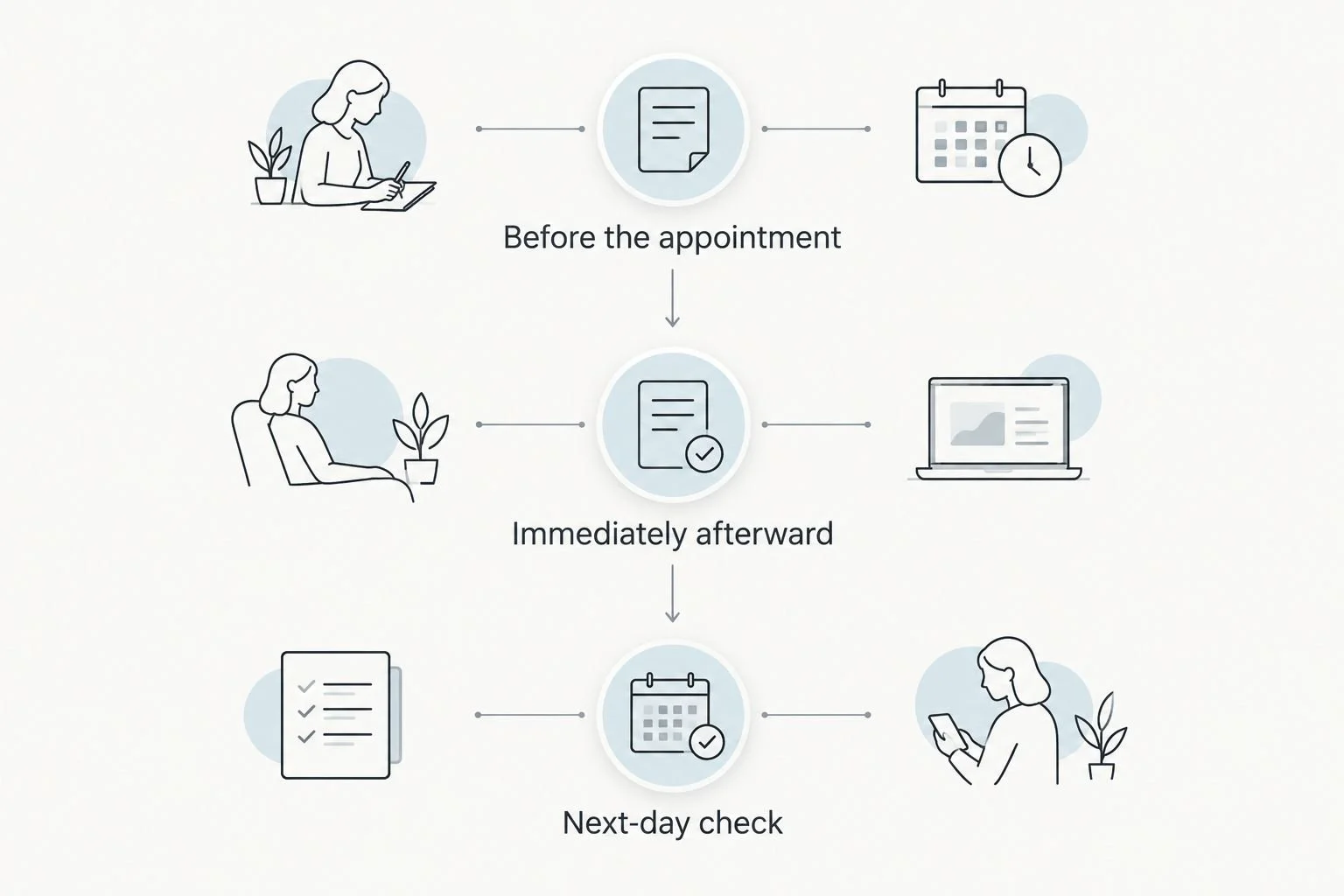
Use the same check-in points so you can describe your experience clearly.
Do not change the plan solely because one score improved. Compare the note with sleep, exercise, illness, and other factors, then decide what needs discussion before another appointment.
Alternative: a spa-focused recovery day
A demanding week does not require an altitude-training appointment. If your immediate goal is relaxation rather than a training stimulus, ask about massage or plan a skin-focused facial instead.
- Name the immediate need. Distinguish feeling mentally drained from having a new injury, unexplained fatigue, or exercise-related symptoms. The latter concerns belong in a healthcare conversation.
- Choose care that matches it. Discuss massage for relaxation or everyday tension, and a facial for skincare goals. Neither needs to be attached to a performance program to justify the visit.
- Keep the day manageable. Ask about appointment order and aftercare before adding another treatment. Do not assume that combining services is necessary or that every combination is suitable.
Expected result: Your visit has a clear purpose without adding reduced-oxygen exposure simply because it is offered.
A quiet treatment space can be part of that choice. The illustration below represents a generic massage setup, not a photograph of Bodycentre Day Spa or its equipment.
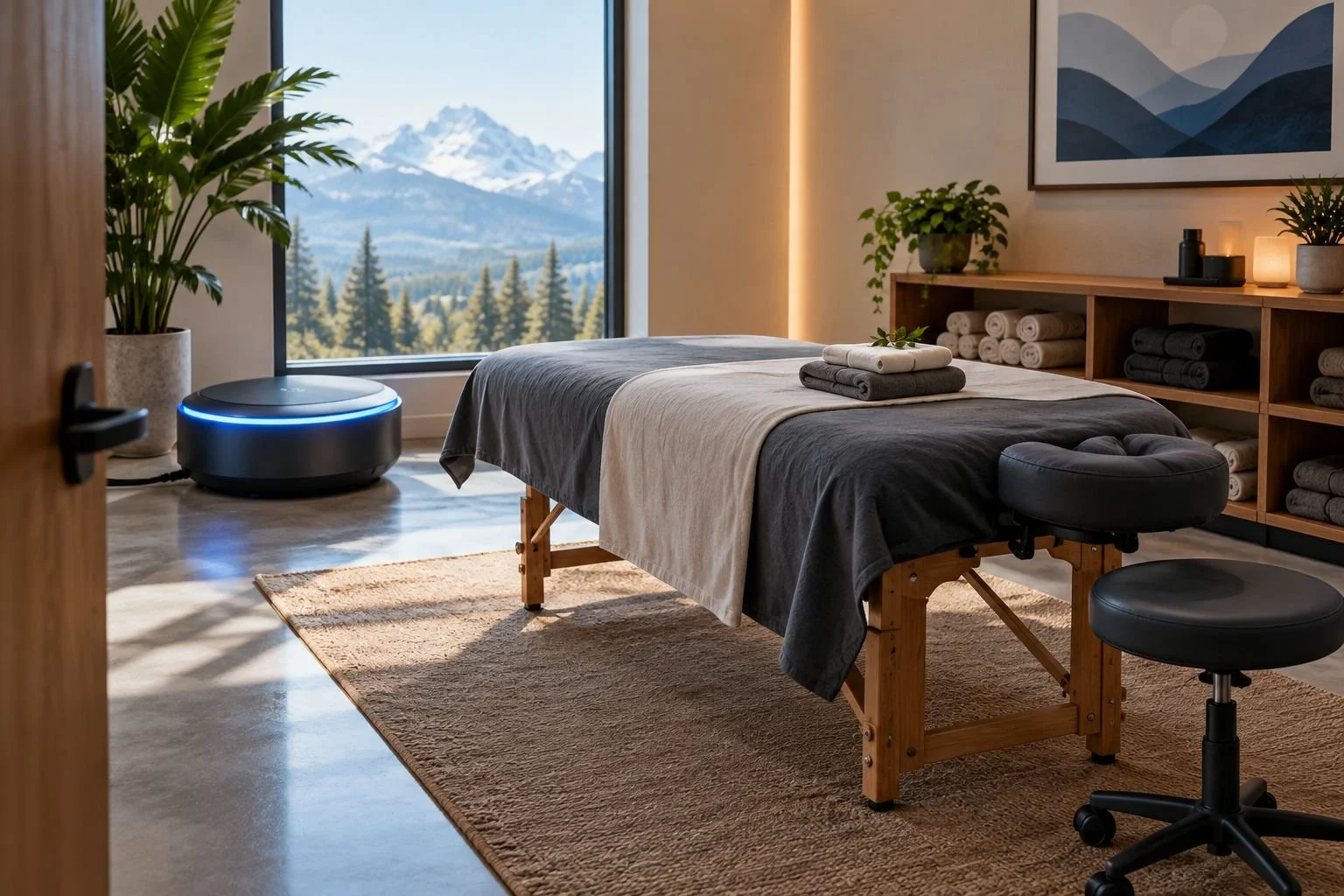
A spa-focused visit can center on relaxation without adding a training session.
Troubleshooting your combined plan
You feel dizzy or unusually breathless
Stop the reduced-oxygen exposure and tell staff immediately. Do not continue because the session is nearly finished, and do not resume without an appropriate assessment. Seek urgent care for severe symptoms, chest pain, fainting, or persistent breathing difficulty.
You cannot tell which service affected you
Return to separate appointments and simplify the log. Changing treatment order, exercise intensity, and several biohacking recovery tools at once makes a personal response harder to interpret. Adding home equipment should not become a way to bypass screening or recreate settings you do not understand.
Your implant information is incomplete
Pause PEMF planning until the relevant device guidance and clinical advice are clear. “I have an implant” is not enough detail to assess compatibility; identify the device and the clinician who manages it. Do not interpret the absence of discomfort as evidence that electromagnetic exposure is safe.
You leave more depleted than expected
Do not automatically add more recovery services. Review the training load, recent sleep, symptoms, and reduced-oxygen exposure with the appropriate professional. Persistent or unexplained fatigue needs medical attention rather than repeated experimentation.
You expected faster results from stacking treatments
Return to the original goal and remove assumptions about combined benefits. Separate service offerings do not establish that using them together improves outcomes. A simpler plan is easier to evaluate and easier to stop when it is not meeting your needs.
Customize your workflow
Use your 2026 schedule to decide what belongs in a training conversation and what belongs in a spa visit. A race-focused athlete, a shift worker seeking relaxation, and someone booking skincare have different appointment goals; none needs every available treatment.
Keep these boundaries clear:
- Training: Discuss exercise and altitude exposure in the context of your wider workload.
- Recovery care: Explain symptoms, treatment preferences, and relevant medical guidance before booking.
- Skincare: Share current skin concerns and recent treatments when discussing a facial.
- Travel: Allow for the trip to Costa Mesa whether you are coming from Irvine, Newport Beach, Huntington Beach, or another Orange County city.
Bodycentre Day Spa combines traditional spa care with advanced recovery services, but your plan should stay selective. Ask which service fits your stated goal and what screening must happen first.
Discuss your recovery visit
Ask about service suitability, screening, and appointment planning at the Costa Mesa location.
FAQ
Can I combine PEMF therapy and altitude training for recovery?
Discuss both services with staff and complete relevant screening before combining them. Separate initial appointments make your response easier to describe; do not assume the combination provides an added recovery benefit.
Should PEMF come before or after altitude training?
There is no universal appointment order to follow from this guide. The actual equipment, session format, health history, and training goal need to inform the decision with the responsible professionals.
Is altitude training the same as oxygen therapy?
No. Altitude training involves reduced oxygen availability, while supplemental oxygen and hyperbaric oxygen therapy use different approaches. Instructions and suitability do not transfer between them.
Can I use PEMF if I have a pacemaker?
Do not proceed without device-specific guidance from the clinician responsible for your pacemaker. Electromagnetic exposure can interfere with some implanted electronic devices, so staff need the relevant device information before assessing the appointment.
How long should my first combined session last?
Do not choose a combined-session duration from a general online guide. Ask staff to explain the actual service format and screening, and start separately when both services are unfamiliar.
What should I track in my 2026 recovery plan?
Track your starting symptoms, recent exercise, the service received, any symptoms during treatment, and how you feel afterward. A consistent log supports a clearer conversation but does not prove treatment effectiveness.
Can I book massage or a facial instead of altitude training?
Yes, you can discuss a spa-focused visit that matches relaxation or skincare goals instead. Bodycentre Day Spa offers massage and facials at its Costa Mesa location alongside advanced recovery services.
One last thing
Your most useful appointment question is: “What should make me stop?” A clear answer is more valuable than a long list of proposed benefits. Ask it before each unfamiliar treatment, and keep permission to decline an added service firmly in your plan.