Best altitude training programs for endurance athletes
/Best overall for trained endurance athletes planning a dedicated altitude block: live high, train low. Best local starting point for Orange County athletes exploring altitude training: Bodycentre Day Spa in Costa Mesa. Best for mountain-race preparation: a destination-specific altitude camp. This 2026 guide compares program formats, explains their limitations, and shows you what to ask before committing.
TL;DR
- Live high, train low separates altitude exposure from lower-elevation endurance workouts.
- Bodycentre Day Spa offers altitude training in Costa Mesa; confirm the session format before booking.
- Mountain-race preparation requires terrain practice and acclimatization, not just simulated altitude exposure.
- Choose altitude training around your race, health, and training schedule—not a promised performance gain.
Why this matters
Altitude training is not one standardized treatment. Living in the mountains, exercising in reduced-oxygen conditions, and sleeping in a hypoxic tent create different exposures. A short appointment does not reproduce a residential training camp.
The best program matches the adaptation you need without undermining the training you already do. For a sea-level race, preserving workout quality matters. For a mountain event, becoming familiar with elevation and terrain matters too.
Bodycentre Day Spa combines altitude training with massage, facials, skincare, and other recovery services in Costa Mesa. That gives local athletes and spa guests different reasons to visit, but those services serve different purposes. A facial is skincare; massage is hands-on bodywork; neither substitutes for altitude acclimatization.
What makes the best altitude training program?
Evaluate these criteria before comparing providers or buying equipment:
- Race relevance: Does the program address a sea-level performance goal, a mountain event, or general curiosity about reduced-oxygen exercise?
- Exposure format: Are you exercising, resting, sleeping, or living at altitude? These are not interchangeable.
- Workout quality: Can you maintain the sessions that matter most to your endurance plan?
- Individual oversight: Who reviews your health history, adjusts the session, and responds if you feel unwell?
- Measurable progress: Can you assess your normal training performance rather than relying on a device reading alone?
- Practical fit: Can you sustain the travel, scheduling, equipment setup, and recovery demands?
For your 2026 plan, ask for the actual protocol before choosing a package. A treatment name alone does not explain the oxygen setting, exposure duration, exercise demands, or suitability for your health.
Altitude training programs at a glance
Bodycentre Day Spa altitude training
- Best for: Orange County athletes exploring a local option
- Standout feature: Costa Mesa location alongside spa and recovery services
- Key limitation: Confirm the altitude-training method and oversight before choosing
Live high, train low
- Best for: Trained athletes planning a dedicated altitude block
- Standout feature: Separates residential altitude exposure from lower-elevation training
- Key limitation: Requires suitable geography or a carefully managed simulated setup
Live high, train high
- Best for: Athletes preparing for a mountain race
- Standout feature: Combines daily altitude exposure with elevated training terrain
- Key limitation: Usual sea-level training pace becomes harder to maintain
Home sleep-high setup
- Best for: Athletes whose main constraint is relocation
- Standout feature: Adds simulated exposure around an existing training location
- Key limitation: Equipment management and sleep disruption can outweigh convenience
These are program formats, not equivalent products. A local appointment, a residential camp, and a home sleeping system should not be judged by the same session count.
1. Bodycentre Day Spa: best altitude training starting point locally
Best for: Orange County athletes who want to investigate altitude training without planning a residential camp.
Bodycentre Day Spa offers altitude training at its Costa Mesa location. Its wider service mix includes massage, facials, hyperbaric oxygen, PEMF, and red light therapy, giving visitors access to traditional spa care and advanced recovery services under one roof.
Before booking, establish what altitude training means in this setting. Ask whether the session involves exercise or rest, how reduced oxygen is delivered, and who determines whether the session suits your training and health history.
For athletes coming from Irvine, Newport Beach, Huntington Beach, or Costa Mesa, the relevant comparison is how an appointment fits around normal training. The physical spa is in Costa Mesa, not a network of branches across neighboring cities.
Bodycentre Day Spa pros:
- Provides a local place to ask about altitude training.
- Offers massage and other recovery services alongside spa care.
- Lets you consider a local service before committing to a residential camp.
Bodycentre Day Spa cons:
- The service name alone does not establish the exposure method or training protocol.
- A local session should not be treated as equivalent to living at altitude.
Ask how treatment scheduling interacts with demanding workouts. Do not combine several unfamiliar recovery treatments simply because they are offered in the same place; first establish what each appointment is intended to do.
Verdict: Hold until the session format, screening, and training fit are clear; choose it for local exploration, not an assumed camp-equivalent effect.
2. Live high, train low: best for a dedicated endurance block
Best for: Trained endurance athletes who can organize an altitude block around established training.
Live high, train low means spending substantial time at elevation while completing important workouts lower down. The aim is to combine altitude exposure with the ability to train harder than you could at the higher living elevation.
This format separates two competing demands. Reduced oxygen creates an altitude stimulus, but it also makes a familiar running pace or cycling power output more demanding. Training lower helps protect workout quality.
Live high, train low pros:
- Separates altitude exposure from key workout intensity.
- Supports a clear distinction between living conditions and training conditions.
- Provides a structured framework for a dedicated training block.
Live high, train low cons:
- Requires suitable locations, transport, or a managed simulated environment.
- Travel between elevations adds logistical demands.
- Individual responses differ; completion does not guarantee a faster race.
For a 2026 sea-level race, discuss this format with your coach before selecting dates or accommodation. Your plan needs room for adjustment if sleep, recovery, or workout quality deteriorates.
Verdict: Buy into a coached plan when the logistics work; skip the assumption that elevation alone improves performance.
3. Live high, train high: best for mountain-race preparation
Best for: Runners, cyclists, and other endurance athletes preparing to compete at elevation.
Live high, train high means living and training at altitude. A destination-specific camp can also expose you to the climbing, descending, footing, and weather conditions relevant to your event.
Its strongest practical advantage is specificity. You learn how effort feels at elevation instead of expecting your sea-level pace to transfer unchanged.
Live high, train high pros:
- Places daily living and training in an elevated environment.
- Supports practice on race-relevant terrain when the location matches.
- Helps you develop effort-based pacing rather than chase sea-level numbers.
Live high, train high cons:
- Reduced oxygen limits the pace or power you can sustain at a given effort.
- Rapid ascent introduces altitude-illness risk.
- Travel and terrain demands can add fatigue to the training block.
Start with the race's actual elevation profile and terrain. A mountainous destination is not automatically a good match for every mountain event, and an aggressive opening workout is not an acclimatization strategy.
Verdict: Buy for event-specific preparation with a gradual ascent plan; skip a camp selected only for its altitude.
4. Home sleep-high setups: best when relocation is the constraint
Best for: Athletes considering simulated altitude exposure while keeping their usual training location.
A home sleep-high setup uses reduced-oxygen air in a sleeping enclosure or room. It recreates part of the oxygen-exposure challenge without reproducing mountain terrain or the lower air pressure of terrestrial altitude.
This is an equipment-based approach, not a simple substitute for a local appointment. You need clear instructions for operation, monitoring, maintenance, and suitability before using it.
Home sleep-high setup pros:
- Keeps regular training routes and facilities accessible.
- Avoids relocating to a mountain training base.
- Separates sleeping exposure from outdoor workout location.
Home sleep-high setup cons:
- Equipment operation and environmental monitoring require attention.
- Noise, enclosure conditions, or reduced oxygen can disrupt sleep.
- It does not provide mountain terrain practice or prove race readiness.
A setup that damages sleep is a poor fit for an endurance plan, even if its oxygen readings look impressive. Evaluate how you feel and train, not just whether the equipment reaches a target setting.
Verdict: Hold until suitability, setup, and sleep quality are addressed; skip an unsupervised experiment close to an important race.
How the programs are ranked
The ranking prioritizes practical fit, workout quality, exposure format, oversight, and race relevance. It does not rank businesses by claimed results or treat every altitude method as equally effective.
The local option appears first because it answers a local service question. Live high, train low remains the overall choice for trained athletes organizing a dedicated block; a mountain camp wins when preparation for elevated terrain is the main goal.
Build the program around your actual goal
Use this sequence to narrow your 2026 shortlist before discussing individual sessions or camp dates:
- Race goal: Write down whether you are preparing for sea-level competition, a mountain event, or exploratory wellness sessions.
- Training baseline: Identify the workouts, sleep habits, and recovery routines you need to preserve.
- Health review: Discuss relevant conditions and medications with a qualified clinician before reduced-oxygen exposure.
- Exposure plan: Establish the format, progression, oversight, and reasons to stop.
- Review point: Decide when you will assess sleep, symptoms, and normal training performance.
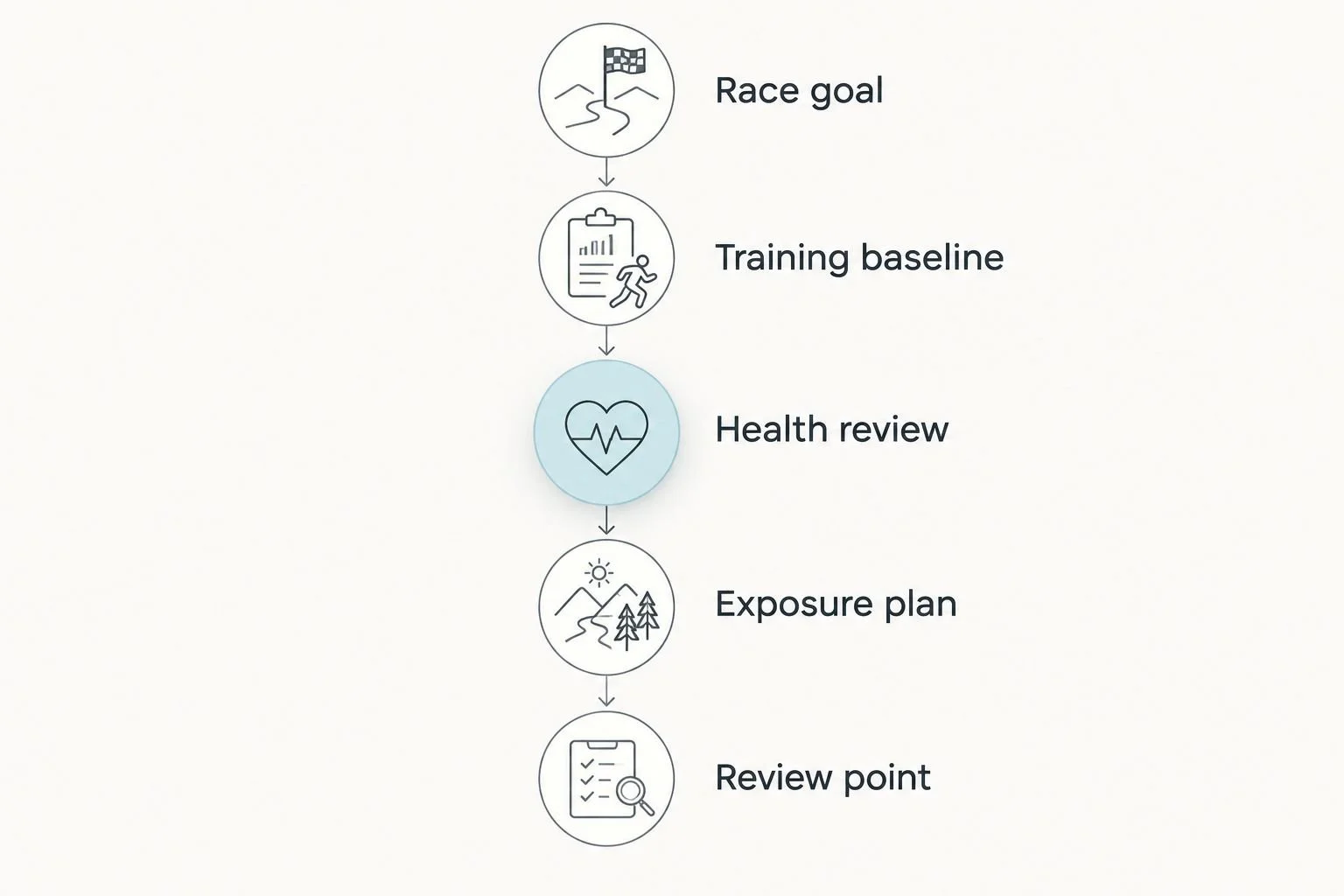
Choose the goal and review health before choosing the exposure.
Bring a normal training week to the discussion. It gives a coach or provider something concrete to work around, rather than asking them to build a plan from a vague request for better endurance.
Safety checks before altitude exposure
Terrestrial altitude and simulated hypoxia require different operating precautions. Neither should be treated as a challenge to tolerate symptoms.
The CDC Yellow Book 2026 guidance on high-altitude travel identifies unacclimatized travelers sleeping at about 2,500 meters or higher as at risk for altitude illness. Above 3,000 meters, it advises limiting increases in sleeping elevation to 500 meters per night, with an extra acclimatization night for each additional 1,000 meters gained.
Those figures concern travel and sleeping elevation. They are not instructions for programming a hypoxic machine or choosing an appointment duration.
Stop exposure and seek assessment for concerning symptoms. At terrestrial altitude, do not ascend with symptoms of altitude illness; confusion, trouble walking, or breathlessness at rest requires urgent medical attention and descent when feasible.
Which altitude training program should you choose?
Choose live high, train low when you are a trained athlete organizing a dedicated endurance block and can protect workout quality. Choose a destination-specific mountain camp when the race itself demands altitude and terrain familiarity.
For a local 2026 starting point, ask about the Costa Mesa service format before booking. Keep massage, skincare, and recovery appointments tied to their own purposes rather than treating every service as an endurance intervention.
Explore your local training options
Review the Costa Mesa spa and ask which altitude-training format fits your goals.
FAQ
What's the best altitude training program for endurance athletes?
Live high, train low is the strongest overall fit for trained athletes planning a dedicated altitude block while preserving key workouts. A mountain-race camp is more specific when your event takes place at elevation.
Can I try altitude training near Irvine or Newport Beach?
Bodycentre Day Spa offers altitude training in Costa Mesa, serving nearby Orange County clients. Ask about the exposure method, screening, and session structure before deciding whether it fits your training.
Is simulated altitude the same as training in the mountains?
No. Simulated altitude reduces oxygen availability without necessarily reproducing lower atmospheric pressure, terrain, weather, or the demands of mountain travel.
Does altitude training guarantee a faster race?
No altitude training program guarantees a faster race. Your response, normal training quality, recovery, and event demands all affect whether the program is useful.
Should I keep my normal running pace at altitude?
Do not force sea-level pace simply to match your training log. Reduced oxygen makes the same pace more demanding, so discuss effort-based adjustments with your coach.
Is an altitude appointment the same as an altitude camp?
No. A local appointment and a residential camp differ in exposure duration, daily environment, and training context. Ask providers to explain the actual protocol rather than assuming the names describe equivalent programs.
Can massage or facials replace altitude acclimatization?
No. Massage and facials serve different purposes from acclimatization to reduced oxygen. Choose bodywork for its intended role and skincare for your skin needs, not as substitutes for mountain preparation.
One last thing
A lower oxygen-saturation reading is not a performance result. Before starting altitude training, decide what would make you stop: worsening sleep, concerning symptoms, or declining workout quality. That decision is more useful than choosing the most demanding setting.