Best recovery treatments for athletes in Costa Mesa
/Best overall for hands-on attention to muscle tension: sports massage therapy. Best for relaxation: gentle massage. Best approached as optional add-ons: red light therapy and PEMF; reserve hyperbaric oxygen for clinician-directed decisions. This 2026 guide compares athlete recovery options in Costa Mesa by purpose, limitations, and what to ask before booking.
TL;DR
- Sports massage therapy is the first choice here for hands-on attention to muscle tension, not injury diagnosis.
- Bodycentre Day Spa suits Costa Mesa athletes seeking massage and advanced recovery services in one location.
- Red light therapy and PEMF are optional additions, not replacements for sleep, nutrition, or appropriate medical care.
- Hyperbaric oxygen requires medical screening; routine post-workout soreness alone does not establish a reason to use it.
Why this matters
A hard workout, a stressful week, and an injury call for different responses. Choosing the most technical-sounding treatment does not solve that distinction. Start with what you need: hands-on muscle work, a calmer experience, or assessment of a problem that should not be handled as routine soreness.
Bodycentre Day Spa is a fit for Costa Mesa athletes who want massage and advanced recovery options in the same location. The Bodycentre Day Spa offering includes massage, facials, skincare, and recovery services. Ask which appointment matches your goal rather than assuming every massage appointment is sports-specific.
Newport Beach, Irvine, Huntington Beach, and Costa Mesa athletes can use the same selection criteria. The physical spa location is Costa Mesa; plan your visit around that destination rather than assuming a neighboring-city branch.
What makes the best athlete recovery treatment?
Use these criteria for your 2026 recovery plan before comparing equipment or treatment names:
- Goal match: Choose muscle-focused work for muscle tension and a relaxation-focused appointment when unwinding is the priority.
- Evidence fit: Separate support for a specific condition from broad claims about athletic performance. One does not establish the other.
- Safety screening: Disclose injuries, medications, medical conditions, and recent procedures before treatment.
- Adjustable intensity: You should be able to discuss pressure, comfort, positioning, and reasons to stop.
- Training compatibility: Explain your next demanding workout or competition so the provider understands the context.
- Clear limits: A useful recommendation explains what a service does not address, including when medical assessment belongs first.
A treatment earns its place by addressing a defined need. A long menu is not a reason to combine everything into one visit.
Athlete recovery treatments at a glance
Sports massage therapy
- Best for: Focused attention to muscle tension
- Standout feature: Hands-on work adjusted through feedback
- Key limitation: Does not diagnose or repair an injury
Gentle massage
- Best for: Relaxation when firm pressure is unwanted
- Standout feature: A lower-intensity hands-on experience
- Key limitation: Less suited to someone specifically seeking focused muscle work
Red light therapy
- Best for: Exploring a light-based adjunct
- Standout feature: Uses selected wavelengths of light
- Key limitation: Research findings depend on the device and treatment protocol
PEMF
- Best for: Discussing an electromagnetic adjunct
- Standout feature: Uses pulsed electromagnetic fields
- Key limitation: Evidence for a particular medical use does not establish general athletic benefits
Hyperbaric oxygen
- Best for: Clinician-directed decisions about oxygen treatment
- Standout feature: Delivers oxygen in a pressurized chamber
- Key limitation: Requires screening and is not a default response to workout soreness
1. Sports massage therapy: best for focused muscle attention
Sports massage therapy uses hands-on techniques directed toward the needs of an active person. The useful distinction is the appointment's focus, not a promise of harder pressure. Tell the therapist which movements feel restricted, what you trained, and what you want from the session.
Massage research supports some short-term effects on perceived soreness and flexibility, but that does not establish faster injury healing or better competition results. Choose sports massage therapy for the experience and symptom-focused goal, not a guaranteed performance gain.
Sports massage therapy pros
- Lets you identify areas that deserve attention.
- Gives you a way to provide immediate feedback about pressure.
- Can focus on comfort and perceived muscle tension without adding a device.
Sports massage therapy cons
- Firm work can leave you sore rather than ready for another demanding session.
- A massage appointment cannot establish why persistent or worsening pain exists.
Best for: Athletes seeking focused, hands-on attention to familiar muscle tension.
Before booking, ask whether the therapist offers sports-focused work and how the session changes around your training. Bodycentre Day Spa offers massage therapy; confirm the appropriate appointment rather than assuming a particular technique or sports credential.
Verdict: Buy for a clear muscle-tension goal; seek assessment instead for unexplained pain.
2. Gentle massage: best for relaxation without firm pressure
A gentler massage prioritizes comfort and relaxation rather than intensive attention to a particular muscle group. Ask for lighter pressure and explain any areas you do not want treated. You do not need to tolerate painful pressure to have a worthwhile appointment.
This option makes sense when you want to unwind and do not want demanding bodywork. It is a different use case from seeking targeted attention to a familiar tight area after training.
Gentle massage pros
- Keeps comfort at the center of the appointment.
- Allows a hands-on experience without requesting deep pressure.
- Fits a relaxation goal without implying an athletic performance outcome.
Gentle massage cons
- Does not satisfy every athlete's preference for focused muscle work.
- Still requires screening; lighter pressure does not make every situation appropriate for massage.
Best for: Active people whose immediate priority is relaxing rather than addressing a specific muscle concern.
Describe your preferred pressure in ordinary language. Saying that you want to leave comfortable, rather than feeling worked over, gives the therapist a clearer direction than asking for the strongest treatment.
Verdict: Buy when relaxation is the goal; skip firm pressure you do not want.
3. Red light therapy: best for exploring a light-based adjunct
Red light therapy exposes tissue to selected wavelengths of light. You will also encounter the term photobiomodulation, which describes using light to influence biological processes. Research findings are tied to factors such as wavelength, dose, treatment area, and the condition studied.
That detail matters: the phrase red light therapy alone does not tell you whether a particular session matches a published research protocol. Ask what equipment is used and what outcome the provider is discussing.
Red light therapy pros
- Offers an option without massage pressure.
- Has a research base for specific applications rather than relying only on testimonials.
- Gives you a defined protocol to question before deciding.
Red light therapy cons
- Findings from one device or protocol do not automatically apply to another.
- A session does not replace rehabilitation or assessment of an injury.
Best for: Athletes interested in an optional light-based service who are willing to examine the treatment details.
Disclose medications and conditions that affect light sensitivity. Follow the device's eye-protection instructions rather than assuming that visible red light is harmless in every setting.
Verdict: Hold until the provider explains the protocol, safety instructions, and relevant evidence.
4. PEMF: best for discussing an electromagnetic adjunct
PEMF means pulsed electromagnetic field therapy. A device produces changing electromagnetic fields; the treatment is not the same thing as massage or light exposure. The important question is what the particular device is intended to do.
Some electromagnetic devices have established medical applications, including certain bone-healing uses. Those applications do not establish that a general wellness session improves athletic recovery. Ask for evidence that matches the device and the claimed outcome.
PEMF pros
- Provides a device-based option without hands-on muscle pressure.
- Has a clearly identifiable technology that you can ask the provider to explain.
- Allows discussion of a specific intended use rather than a vague recovery promise.
PEMF cons
- Evidence from medical devices cannot be transferred automatically to wellness equipment.
- Implanted electronic devices and other health factors require careful compatibility screening.
Best for: Athletes evaluating a specific electromagnetic treatment after discussing its purpose and safety.
If you have an implanted electronic device, do not rely on a general reassurance. Confirm compatibility with the relevant clinician and manufacturer guidance before using PEMF.
Verdict: Hold until device-specific safety and the intended benefit are clear.
5. Hyperbaric oxygen: best for clinician-directed decisions
Hyperbaric oxygen therapy involves breathing oxygen in a pressurized chamber. Pressure changes how much oxygen can dissolve in the blood, but that mechanism alone does not establish a benefit for routine training soreness.
Hyperbaric oxygen has recognized medical uses. An athlete's desire to recover faster is not, by itself, evidence that treatment is appropriate. Ask about medical oversight, chamber specifications, and the reason for recommending it.
Hyperbaric oxygen pros
- Has established applications for particular medical conditions.
- Offers a defined treatment mechanism rather than an undefined wellness concept.
- Can be evaluated against a clinician's specific recommendation.
Hyperbaric oxygen cons
- Pressure exposure carries risks, including ear and sinus problems.
- Medical screening is necessary, and general recovery claims are not equivalent to established indications.
Best for: People whose clinician identifies a relevant reason to consider hyperbaric oxygen.
Do not use a recovery booking to work around unexplained symptoms. A chamber appointment is not a substitute for finding out why a problem persists.
Verdict: Skip as a default post-workout purchase; consider only with appropriate clinical guidance.
Choose your next step before choosing a treatment
Use these 3 questions to make your 2026 booking more useful:
- Set your goal: Are you seeking muscle-focused attention, relaxation, or help evaluating a persistent problem?
- Check safety: What injuries, medications, implants, or recent procedures must the provider know about?
- Match the service: What will this appointment address, and what should it not be expected to do?
Keep 2 checkpoints in mind: how comfortable you feel during the appointment and how you respond afterward. Neither checkpoint proves that a treatment accelerated biological recovery, but both help you discuss whether the experience suited your goal.
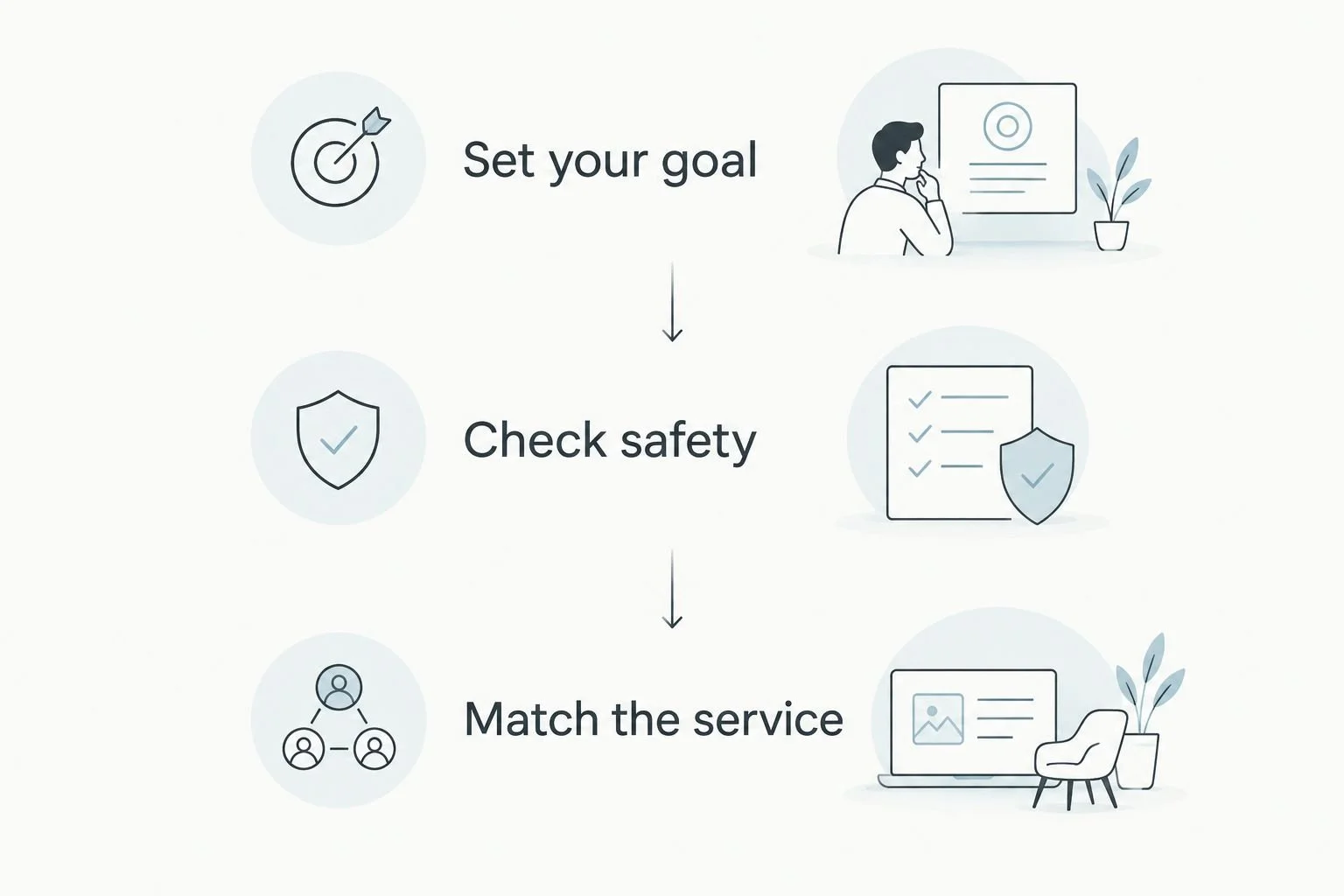
Choose the purpose of the appointment before choosing the equipment.
How these recovery options rank
This 2026 ranking puts direct goal matching first, followed by safety, adjustable treatment, and the limits of the evidence. It does not rank services by technical complexity or claim that every athlete needs treatment after exercise.
Sports-focused massage leads for hands-on muscle attention. Gentle massage serves a separate relaxation goal. Red light and PEMF require more specific questions, while hyperbaric oxygen belongs behind a clinical decision rather than a routine recovery checklist.
Which recovery treatment should you choose?
Start with massage when your goal is hands-on comfort; start with medical assessment when your concern is an injury. Keep advanced services optional until you understand their purpose and limitations.
Bodycentre Day Spa combines massage, facials, skincare, and advanced recovery services in Costa Mesa. A facial belongs in a skin-care plan, not a muscle-recovery claim. Likewise, altitude training is a training stimulus, not simply another name for passive recovery; discuss its demands separately from a relaxation appointment.
Choose the service that answers your current need, whether you are visiting from Costa Mesa, Newport Beach, Irvine, or Huntington Beach.
FAQ
What's the best recovery treatment for athletes in Costa Mesa?
Sports massage therapy is the first choice in this guide for focused, hands-on attention to muscle tension. Choose gentler massage for relaxation, and seek medical assessment for suspected injury rather than booking a recovery service.
Is sports massage therapy better than deep tissue massage?
Neither label guarantees a better appointment. Sports massage describes an activity-focused purpose, while deep tissue generally describes an approach to deeper tissues; ask how the therapist will match pressure and technique to your goal.
Should a sports massage hurt to work?
No, pain is not a requirement for a useful massage. Tell the therapist if pressure feels sharp, distressing, or excessive, and ask for an adjustment or stop.
Can red light therapy replace massage after a workout?
Red light therapy and massage are different services, not interchangeable treatments. Massage offers hands-on attention, while light-based treatment depends on a device and protocol whose evidence should match the intended use.
Is PEMF a proven recovery treatment for every athlete?
No, evidence for a specific PEMF application does not establish a benefit for every athlete. Ask about the exact device, intended outcome, and safety screening, particularly if you have an implanted electronic device.
Should athletes book hyperbaric oxygen for ordinary soreness?
Ordinary post-workout soreness alone does not establish a reason to use hyperbaric oxygen. Discuss suitability with a qualified clinician rather than treating chamber sessions as a routine requirement.
What should I ask before booking sports massage therapy in 2026?
Ask whether the appointment supports your specific goal, how pressure is adjusted, and what health information the therapist needs. Explain your training schedule and distinguish familiar muscle tension from new or worsening pain.
One last thing
For your next 2026 appointment, write one sentence before booking: I want this session to help me with... Finish it with a concrete goal, such as relaxing or receiving attention to a familiar tight area. If the answer is finding out why something hurts, choose assessment before treatment.