Best acupressure and aromatherapy treatments for relaxation
/Best overall for focused pressure: adjustable acupressure; best for scent-led relaxation: aromatherapy massage; best for fragrance-sensitive guests: scent-free gentle massage. This acupressure spa guide compares five relaxation approaches for 2026, with comfort, consent, and personal preference determining the right choice.
TL;DR
- Choose adjustable acupressure for focused pressure, not simply because you want a stronger massage.
- Choose aromatherapy massage when you enjoy fragrance; choose scent-free massage when you do not.
- Ask an acupressure spa to explain pressure, oil application, and scent exposure before treatment.
- BodyCentre Day Spa combines spa care and advanced recovery at its Costa Mesa location.
BodyCentre Day Spa offers massage, facials, skincare, and advanced recovery services in Costa Mesa. BodyCentre Day Spa is best for Orange County guests seeking traditional spa care and advanced recovery at one Costa Mesa location. The approaches below are a decision guide, not a statement that every treatment combination appears on the spa's menu.
Why this matters
Acupressure and aromatherapy describe different parts of a treatment. Acupressure uses deliberate pressure at selected points; aromatherapy uses aromatic plant oils, usually through inhalation or appropriately diluted topical application.
Neither name tells you how forceful a session feels, whether fragrance fills the room, or whether oil touches your skin. Those details matter more to your comfort than a treatment's name.
For your 2026 visit, separate the experience you want from claims about what a treatment cures. Relaxation is a reasonable booking goal; a spa appointment is not a substitute for evaluating persistent pain or a medical condition.
What makes the best acupressure spa treatment?
Use these criteria before comparing the options:
- Adjustable pressure: You can request lighter pressure, ask the practitioner to avoid an area, and stop uncomfortable work.
- Clear scent choices: You know whether oils are inhaled, applied to skin, or used elsewhere in the room.
- Relevant screening: The practitioner asks about relevant health conditions, pregnancy, injuries, allergies, and skin concerns.
- Consent throughout: You understand positioning, draping, touch, and changes to the treatment before they happen.
- A realistic purpose: The appointment matches your relaxation preferences without promising detoxification, disease treatment, or guaranteed results.
Begin with 1 main priority, such as focused pressure or a scent-free experience. Then identify 2 preferences you can communicate clearly, such as lighter touch and avoiding work around a sensitive shoulder. These are planning prompts, not treatment prescriptions.
Relaxation treatments at a glance
This 2026 comparison ranks approaches by their fit for different preferences, not by clinical effectiveness. No single method wins for every guest.
Adjustable acupressure
- Best for: Focused pressure
- Standout feature: Pressure directed at selected points
- Key limitation: Concentrated pressure can feel uncomfortable
Aromatherapy massage
- Best for: Scent-led relaxation
- Standout feature: Combines massage with an aromatic component
- Key limitation: Fragrance or topical oils can be unsuitable
Scent-free gentle massage
- Best for: Fragrance avoidance
- Standout feature: Removes intentionally added fragrance from the treatment
- Key limitation: Does not guarantee a fragrance-free building
Acupressure with optional aromatherapy
- Best for: Flexible preferences
- Standout feature: Separates pressure choices from scent choices
- Key limitation: Requires clear agreement about each component
Inhaled aromatherapy without bodywork
- Best for: No bodywork
- Standout feature: Offers a scent-based experience without massage
- Key limitation: Provides no hands-on pressure or massage
Your priority should determine the choice: focused pressure, scent-led relaxation, fragrance avoidance, flexible preferences, or no bodywork. Treat the table as a way to narrow your questions before booking, rather than a reason to request every option.
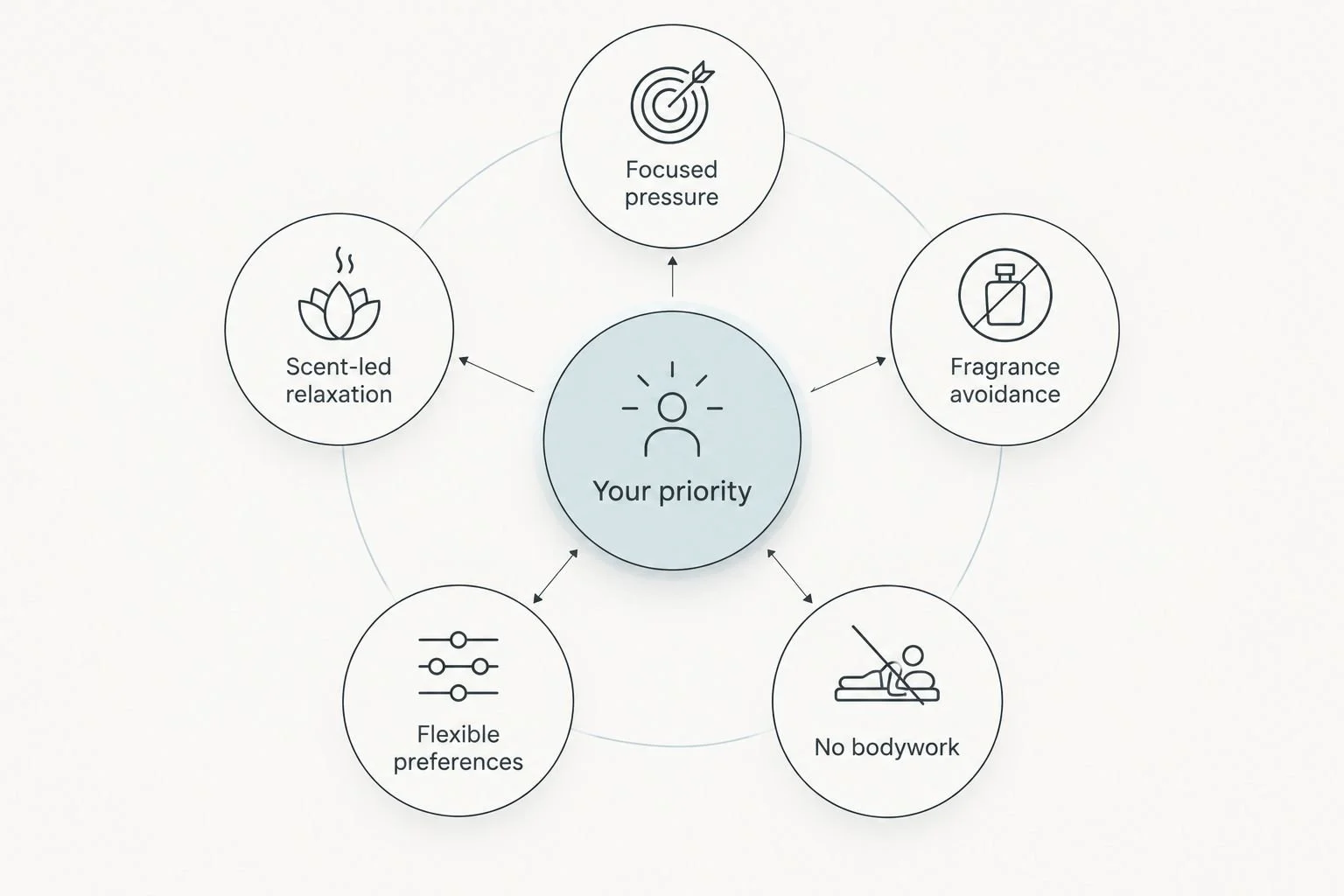
Choose the experience you want before choosing a treatment name.
1. Adjustable acupressure: best for focused pressure
Acupressure involves pressure applied at selected points, commonly using fingers or thumbs. Unlike a massage built around continuous strokes, the experience can include sustained contact at particular locations.
Choose this approach if deliberate pressure sounds more appealing than flowing massage. Ask the practitioner to explain the technique and begin within your comfort level; intense sensation is not proof of a better treatment.
Adjustable acupressure pros:
- Gives you a clear way to discuss specific pressure preferences.
- Does not require an aromatic component.
- Allows you to request that sensitive areas be avoided.
Adjustable acupressure cons:
- Concentrated pressure can be unpleasant even when broader massage feels comfortable.
- The label alone does not explain the practitioner's training or method.
Best for: Guests who prefer focused touch and want clear control over pressure.
Before booking, ask whether acupressure is a distinct service or a technique incorporated into massage. Those descriptions are not interchangeable, and neither confirms how the session will feel.
Verdict: Buy this approach for focused pressure; skip it if sustained point pressure is not comfortable.
2. Aromatherapy massage: best for scent-led relaxation
Aromatherapy massage combines hands-on massage with an aromatic component. Depending on the treatment, essential oils are used through inhalation, appropriately diluted topical application, or both.
The best reason to choose it is straightforward: you enjoy the proposed fragrance and want it included in your massage. Do not choose an oil because its name comes with a promise to treat anxiety, correct hormones, or remove toxins.
Aromatherapy massage pros:
- Combines touch and scent within one experience.
- Gives fragrance-loving guests a clear preference to discuss.
- Can be selected for enjoyment without making a medical claim.
Aromatherapy massage cons:
- Fragrance can be unwelcome or trigger symptoms in sensitive guests.
- Topical essential oils can irritate skin or cause allergic reactions.
Best for: Guests who already know they enjoy fragrance and want massage alongside it.
Ask what will be used and how it will be applied. A pleasant smell is not evidence that an ingredient suits your skin, and natural ingredients are not automatically harmless.
Verdict: Buy this approach for a scent you enjoy; skip it when fragrance causes discomfort.
3. Scent-free gentle massage: best for fragrance avoidance
Scent-free gentle massage prioritizes comfortable touch without intentionally added aromatic oils in the treatment. It is a useful alternative when your relaxation goal is simple but fragrance complicates the decision.
Scent-free treatment products do not establish that the whole facility is fragrance-free. Ask about room scent, linens, cleaning products, and nearby treatments if exposure matters to you.
Scent-free gentle massage pros:
- Keeps the treatment focused on touch rather than aroma.
- Makes a preference for lighter pressure explicit.
- Avoids adding an essential-oil component you do not want.
Scent-free gentle massage cons:
- Shared spaces can still contain fragrance.
- Gentle massage does not provide the focused sensation sought by some acupressure guests.
Best for: Guests who want relaxation without intentionally added fragrance.
Describe what you need rather than relying only on the word sensitive. A dislike of perfume, a history of skin reactions, and breathing symptoms require different conversations before an appointment.
Verdict: Buy this approach when fragrance avoidance is your priority; hold booking until exposure questions are answered.
4. Acupressure with optional aromatherapy: best for customization
This approach treats pressure and fragrance as separate decisions. You choose whether focused pressure suits you, then decide independently whether an aromatic component belongs in the experience.
It is a useful request when you like parts of both treatments but do not want a fixed combination. Confirm the arrangement before booking rather than assuming a practitioner can change any service on arrival.
Acupressure with optional aromatherapy pros:
- Separates your touch preferences from your scent preferences.
- Lets you discuss areas to avoid before treatment begins.
- Makes it easier to decline aroma without rejecting focused bodywork.
Acupressure with optional aromatherapy cons:
- Not every service is designed for this combination.
- Combining preferences creates more details to confirm in advance.
Best for: Guests who want a tailored conversation rather than choosing by treatment name alone.
Keep your request simple: explain the pressure you enjoy, the areas you want avoided, and whether you want any fragrance. BodyCentre Day Spa guests can discuss their relaxation goals without treating a menu label as a complete treatment plan.
Verdict: Buy this approach only after the practitioner confirms the requested combination.
5. Inhaled aromatherapy: best for avoiding bodywork
Inhaled aromatherapy uses an aromatic component without requiring topical application or massage. Consider it only when you enjoy fragrance but do not want hands-on treatment.
This is a different experience from visiting an acupressure spa for pressure-based work. Confirm whether a provider offers a standalone scent-based experience; do not assume it is a separate service.
Inhaled aromatherapy pros:
- Does not require massage or focused pressure.
- Avoids applying essential oils directly to your skin.
- Keeps the choice centered on whether you enjoy the scent.
Inhaled aromatherapy cons:
- Inhaled fragrance can still cause discomfort or symptoms.
- It offers no hands-on component for guests seeking bodywork.
Best for: Fragrance-tolerant guests who prefer no massage.
You do not need to replace unwanted touch with scent. If neither appeals to you, choose a different experience rather than forcing a fit with this list.
Verdict: Consider this approach for scent without touch; skip it if fragrance is unwelcome.
How this 2026 ranking works
The ranking uses the criteria above: adjustable pressure, clear scent choices, relevant screening, consent, and a realistic purpose. It ranks suitability for relaxation preferences, not measured treatment outcomes or individual practitioners.
Adjustable acupressure leads for readers specifically seeking focused pressure. Scent-free gentle massage is the stronger default when fragrance is the deciding concern. No position represents a clinical trial or a guarantee of results.
Before you book in Costa Mesa
Ask 3 questions: What does the treatment involve? Can pressure and fragrance be adjusted? What health information should you share beforehand? The answers should make your appointment easier to understand, not add more unexplained terminology.
Tell the practitioner about pregnancy, recent procedures, injuries, allergies, and relevant medical conditions. Seek appropriate medical advice for unexplained symptoms rather than asking spa care to diagnose them.
For a broader comparison, use this guide to choosing the right massage in Costa Mesa. Start with the sensation you want, then compare treatment descriptions.
Whether you live in Costa Mesa, Newport Beach, Irvine, or Huntington Beach, BodyCentre Day Spa's physical location is Costa Mesa. Plan your visit around that location rather than assuming there are branches in neighboring cities.
Which relaxation treatment should you choose?
Choose adjustable acupressure for focused pressure and scent-free gentle massage when fragrance is a concern. Choose aromatherapy massage when scent is a welcome part of the experience, not because it sounds more therapeutic.
For your 2026 plans, keep spa relaxation and advanced recovery goals distinct. A facial addresses a different service preference from massage; biohacking services such as PEMF, which uses pulsed electromagnetic fields, require their own discussion about suitability and purpose.
BodyCentre Day Spa brings those service areas together in Costa Mesa. You do not need to combine them all: one clearly chosen appointment is a better starting point than a schedule built around unfamiliar treatment names.
Explore your spa options
Review BodyCentre Day Spa and ask which approach fits your pressure and fragrance preferences.
FAQ
What's the best acupressure spa treatment for relaxation?
Adjustable acupressure is the best fit when you want focused pressure and clear control over intensity. Choose by your comfort preferences rather than assuming stronger pressure produces better results.
Is acupressure the same as aromatherapy massage?
No. Acupressure uses pressure at selected points, while aromatherapy adds an aromatic component, sometimes alongside massage. Ask how each element will be used in your appointment.
Should I choose aromatherapy if I have sensitive skin?
Discuss your skin history and the proposed ingredients before choosing topical aromatherapy. Essential oils can cause irritation or allergic reactions, and avoiding skin application does not eliminate concerns about inhaled fragrance.
Can I ask for an acupressure session without essential oils?
Ask whether the practitioner offers acupressure without aromatic products. Acupressure does not inherently require fragrance, but room scent and the provider's treatment setup need separate confirmation.
Does acupressure have to hurt to work?
No; pain is not a quality standard for a relaxation appointment. Request less pressure or stop the technique when it feels uncomfortable, and do not push through sharp or worsening pain.
Where is BodyCentre Day Spa located?
BodyCentre Day Spa is located in Costa Mesa, California. Guests from Newport Beach, Irvine, Huntington Beach, and elsewhere in Orange County should plan for the Costa Mesa location.
Can I combine massage with a facial or recovery service?
Ask about suitability and scheduling before combining services. Massage, facials, and advanced recovery treatments serve different purposes, so explain your priorities rather than assuming every combination is appropriate.
One last thing
Scent and pressure are separate choices. You can enjoy focused touch without fragrance, or enjoy fragrance without wanting deep pressure. Saying that clearly before your 2026 appointment gives the practitioner a more useful starting point than asking for the strongest treatment.