Best red light therapy uses for skin and muscle recovery
/Best overall cosmetic use: fine-line care. Best for active adults: post-exercise recovery support. Best for acne concerns: a dermatologist-guided add-on. For red light therapy Orange County visitors, the right choice starts with a specific goal—not a promise that one treatment fixes skin, soreness, and injuries alike.
TL;DR
- For red light therapy Orange County searches, choose by treatment goal rather than broad wellness claims.
- BodyCentre Day Spa suits Orange County guests seeking red light therapy alongside spa care in Costa Mesa.
- Skin rejuvenation and muscle recovery require different expectations; neither guarantees a result.
- Acne and injury concerns need clinical guidance, not a replacement for prescribed treatment.
Why this matters
Red light therapy uses selected wavelengths of light without intentionally damaging the skin. You will also hear the term photobiomodulation, which describes using light to influence biological activity. Some systems include near-infrared light, which sits outside the visible red spectrum.
Those terms describe a treatment category, not a guaranteed outcome. Research findings depend on the condition, equipment, exposure, and treatment schedule. A study of one device does not establish what every panel, mask, or treatment bed delivers.
BodyCentre Day Spa offers red light therapy alongside massage, facials, skincare, and other recovery services at its Costa Mesa location. Guests traveling from Irvine, Newport Beach, Huntington Beach, and Costa Mesa should make the same distinction: choose a service for a defined purpose, then confirm its suitability.
BodyCentre Day Spa is best for Orange County guests seeking red light therapy alongside traditional spa care in Costa Mesa. That combination offers different ways to approach a visit without treating every service as interchangeable.
What makes the best red light therapy use?
For your 2026 treatment shortlist, judge each option against these criteria:
- Goal fit: Match the treatment to skin appearance, exercise recovery, or a concern requiring medical evaluation.
- Relevant evidence: Ask whether research addresses your actual concern, not just light therapy generally.
- Device clarity: Confirm what equipment is used and whether it delivers red light, near-infrared light, or both.
- Safety screening: Discuss medications, light sensitivity, eye protection, and relevant health conditions before treatment.
- Progress tracking: Decide what improvement would look like before starting, rather than relying on impressions afterward.
Choose 1 primary goal for your first discussion. A focused question—such as whether the treatment fits a fine-line routine—is easier to answer than asking for total-body optimization.
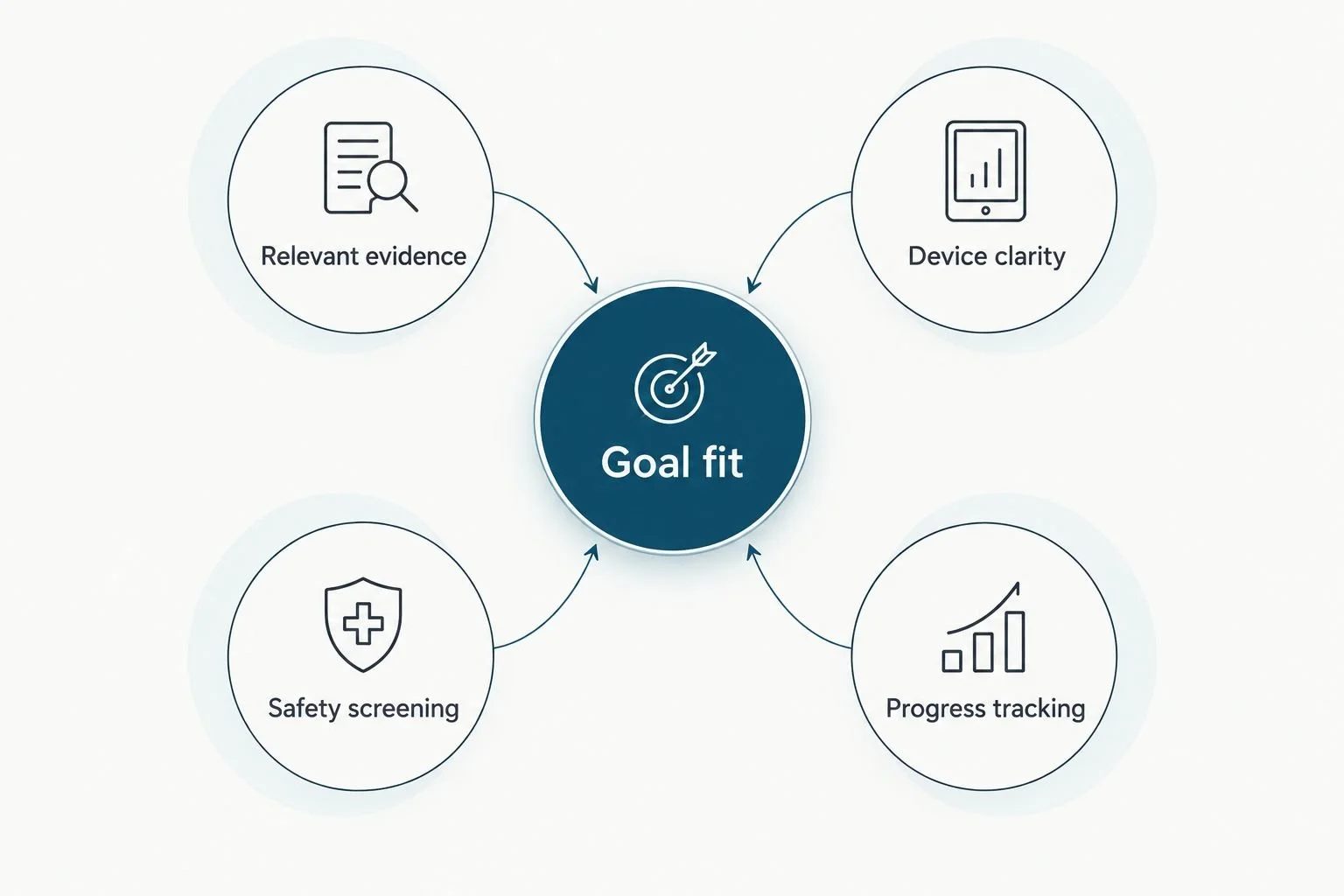
Start with your goal, then check evidence, equipment, safety, and how you will assess progress.
Red light therapy uses at a glance
These rankings organize uses by practical fit. They do not rank devices or claim that one application produces better results than another.
Fine-line care
- Best for: Adults with a cosmetic skin-aging goal
- Standout feature: Noninvasive addition to skincare
- Key limitation: Results vary; it does not replace sun protection
Post-exercise recovery support
- Best for: Active adults managing ordinary training soreness
- Standout feature: Recovery-focused use beyond facial skincare
- Key limitation: Research protocols differ; soreness is not an injury diagnosis
Acne-care support
- Best for: People already following an acne treatment plan
- Standout feature: Potential adjunct for inflammatory acne
- Key limitation: Red light is not equivalent to blue light or prescription care
Clinician-guided rehabilitation support
- Best for: People with a diagnosed muscle or tendon concern
- Standout feature: Condition-specific treatment discussion
- Key limitation: A general spa session is not a rehabilitation plan
1. Fine-line care: best for a cosmetic skin-aging goal
Red light therapy has been studied for signs of skin aging, including fine lines and changes in skin appearance. It is a noninvasive option to discuss when your goal is cosmetic improvement rather than treatment of a suspicious lesion or an unexplained rash.
Set a narrow objective. Red light therapy does not physically remove loose skin, replace lost facial volume, or substitute for daily sun protection. Dramatic lifting language is a poor basis for choosing a treatment.
Fine-line care pros
- Adds a light-based option to a skincare discussion without exfoliating the skin.
- Addresses a cosmetic goal that you can document with consistent photographs.
- Provides a separate choice from hands-on facial treatments.
Fine-line care cons
- Improvement is not guaranteed, and research results do not apply equally to every device.
- It does not address every cause of uneven skin appearance.
- A treatment visit does not replace sunscreen or an appropriate home routine.
Best for: Adults seeking a conservative addition to an established skincare routine.
For your 2026 baseline, take 1 reference photo before starting, using repeatable lighting and camera placement. Compare skin appearance under those same conditions rather than switching between flattering daylight and harsh overhead light.
Ask how red light therapy fits around exfoliation, active skincare products, or other procedures. Do not assume that adding more treatments makes a routine more effective.
Verdict: Buy into a clearly defined cosmetic plan; skip promises of a nonsurgical facelift.
2. Post-exercise recovery: best for active adults with ordinary soreness
Red and near-infrared light have been studied in exercise recovery, including muscle soreness and performance-related outcomes. Results depend on treatment parameters and study design. Those findings do not establish that any red light session improves your next workout.
For a recreational athlete, the useful question is whether a particular service fits an existing recovery routine. Sleep, appropriate training loads, nutrition, and rest remain the foundation. A light-based treatment is an addition, not permission to train through pain.
Post-exercise recovery pros
- Creates a recovery-focused option distinct from cosmetic skin treatment.
- Does not require the hands-on pressure used in massage.
- Encourages a specific conversation about soreness, training demands, and recovery goals.
Post-exercise recovery cons
- Ordinary soreness and an injury require different decisions.
- Study findings do not translate automatically across equipment or exposure schedules.
- Feeling better after a session does not establish that damaged tissue has healed.
Best for: Active adults exploring an optional addition to sensible training and recovery habits.
BodyCentre Day Spa offers red light therapy and massage in Costa Mesa, giving local guests different service categories to discuss. Ask about each separately: massage uses hands-on techniques, while light therapy applies light. Neither should be presented as universally better.
Stop treating pain as routine soreness when symptoms are severe, persistent, or accompanied by weakness or swelling. Get assessed rather than adding another recovery appointment.
Verdict: Buy only as an optional recovery adjunct; skip it as a substitute for injury assessment.
3. Acne-care support: best for a dermatologist-guided plan
Red light is used in some acne treatment approaches, including systems that combine different types of light. Red light and blue light are not interchangeable. A treatment described simply as light therapy needs a clearer explanation before you choose it for acne.
Acne also varies in severity and cause. Deep, painful breakouts, scarring, and persistent acne deserve medical advice rather than a trial-and-error sequence of spa services.
Acne-care support pros
- Offers a light-based adjunct to discuss with a dermatologist.
- Gives you a specific reason to ask which wavelengths a treatment uses.
- Encourages coordination between professional treatment and home skincare.
Acne-care support cons
- A red-light-only service is not the same as a combined-light acne protocol.
- It does not replace prescribed medication or address every acne pattern.
- Adding products and procedures together makes irritation and progress harder to interpret.
Best for: People whose dermatologist considers light therapy appropriate alongside an acne plan.
Bring your current skincare and medication list to the discussion. Include prescription treatments, over-the-counter acne products, and recent procedures; relevant safety information is not limited to what you apply on treatment day.
For your 2026 skincare plan, separate acne control from general facial maintenance. A facial, red light session, and prescription acne treatment have different purposes, even when your concern is the same patch of skin.
Verdict: Hold until the light type and acne plan are clear; skip blanket acne-clearing promises.
4. Rehabilitation support: best for clinician-led decisions
Light-based therapies are studied and used in some musculoskeletal care settings. That does not make a general wellness session equivalent to treatment for a diagnosed tendon, muscle, or joint problem.
The distinction is assessment. Rehabilitation connects a diagnosis with a treatment plan, appropriate activity, and progress checks. Choosing a spa appointment from a menu does not establish any of those things.
Rehabilitation support pros
- Gives you a focused question to discuss with a qualified treating clinician.
- Keeps the underlying diagnosis central to treatment selection.
- Creates a reason to check whether a proposed device and protocol match the intended use.
Rehabilitation support cons
- Evidence and protocols vary by condition.
- A general red light service does not establish medical suitability.
- Symptom relief alone does not prove readiness to return to sport or unrestricted activity.
Best for: People with an established diagnosis whose treating clinician recommends considering light-based therapy.
Ask the clinician what role, if any, the treatment has in your plan. Clarify who will monitor progress and what symptoms require reassessment. Do not transfer a protocol from an online recovery story to your own injury.
Verdict: Wait for clinical guidance; skip self-directed treatment of an undiagnosed injury.
How these uses are ranked
The order starts with a straightforward cosmetic goal, then separates ordinary exercise recovery from acne care and diagnosed injuries. The latter uses require more condition-specific guidance.
The ranking reflects decision clarity, safety, and goal fit, not a claim that one use has the strongest evidence across every device. For 2026, keep the same standard when comparing providers: a precise explanation is more useful than a long list of possible benefits.
Which red light therapy use should you choose?
Choose fine-line care if your main goal is cosmetic skin appearance. Choose a recovery discussion if your concern is ordinary post-workout soreness. Put acne and injury questions into the appropriate medical conversation before booking around a promised result.
BodyCentre Day Spa combines spa care and advanced recovery services at its Costa Mesa location. That makes a goal-led discussion useful: a facial addresses different needs from massage, and neither becomes unnecessary because red light therapy is also offered.
Bring 3 questions to your first conversation:
- What equipment and type of light will the service use?
- What evidence supports this treatment for my specific goal?
- What safety checks and progress measures belong in my plan?
Ask about session length, recommended frequency, and preparation for the actual equipment being used. There is no responsible universal schedule to copy from a different device or a social media post.
Before you book in Orange County
For a 2026 appointment, prioritize clear screening over broad claims about cellular optimization. Tell the provider about light sensitivity, medications, relevant medical conditions, and recent skin procedures. Follow the equipment's eye-protection instructions rather than assuming closed eyelids are sufficient.
Ask your clinician before treatment if you are pregnant, receiving cancer treatment, or unsure whether a medication increases light sensitivity. New or changing skin lesions need medical evaluation; a cosmetic light session is not a diagnostic service.
Travel planning matters too. Whether you live in Costa Mesa, Irvine, Newport Beach, or Huntington Beach, choose an appointment schedule you can realistically follow. The physical spa is in Costa Mesa—not a separate branch in each neighboring city.
FAQ
What's the best use of red light therapy for skin?
Fine-line care is a reasonable cosmetic goal to discuss when considering red light therapy. Results depend on the equipment and treatment plan, and it does not replace sunscreen or evaluation of concerning skin changes.
Does red light therapy help muscle recovery?
Red and near-infrared light have been studied for exercise recovery, but findings vary by protocol. Treat a session as an optional adjunct to recovery habits, not proof that an injury has healed.
Where is BodyCentre Day Spa located for Orange County red light therapy?
BodyCentre Day Spa is located in Costa Mesa, California. It offers red light therapy alongside massage, facials, skincare, and other recovery services for local Orange County guests.
Is red light therapy the same as a facial?
No, red light therapy applies selected wavelengths of light, while a facial involves skincare treatments. Ask which approach fits your main concern and whether combining them is appropriate.
Can red light therapy replace acne medication?
Do not replace prescribed acne medication with red light therapy unless your prescribing clinician changes your plan. Light-based acne treatments differ, and red light is not interchangeable with blue light.
How often should I book red light therapy?
The appropriate schedule depends on the equipment, intended use, and your suitability for treatment. Ask the provider for device-specific guidance rather than copying a generic online schedule.
Should I choose massage or red light therapy for soreness?
Choose by your goal and whether hands-on pressure is appropriate for you. Massage and red light therapy are different services; severe, persistent, or unexplained pain needs assessment rather than a menu-based decision.
One last thing
A treatment name is not a treatment protocol. Two services called red light therapy do not automatically use the same equipment, exposure, or intended application.
Before committing, ask the provider to connect the actual session to your stated goal. If that explanation stays vague, pause. A clear answer matters more than an impressive list of skin and recovery claims.