Best PEMF therapy benefits for pain relief and recovery
/Best overall: clinician-guided pain support. Best for active adults: recovery support alongside exercise management. Best for relaxation: a hands-off wellness session. This 2026 guide ranks pulse PEMF uses by practical fit and explains where a spa session ends and medical treatment begins.
TL;DR
- Pulse PEMF is an optional adjunct, not a replacement for diagnosing persistent pain or following a rehabilitation plan.
- Bodycentre Day Spa combines spa care and advanced recovery services at its Costa Mesa location.
- For exercise recovery, prioritize appropriate training, sleep, and rehabilitation before adding PEMF.
- Prescription bone-growth stimulation is a separate medical use, not proof that a spa session heals injuries.
Why this matters
PEMF stands for pulsed electromagnetic field. A device produces changing magnetic fields; the treatment is different from massage, electrical muscle stimulation, and red light therapy.
The difficulty is that the same acronym covers different devices, settings, and treatment purposes. Evidence for one application does not establish benefits for every other application.
Bodycentre Day Spa is best for local guests who want spa care and recovery services in the same Costa Mesa setting. Guests traveling from Newport Beach, Irvine, and Huntington Beach visit that Costa Mesa location, not separate neighborhood branches. Start with Bodycentre Day Spa when deciding whether a wellness visit fits your goals.
What makes the best pulse PEMF use?
A useful 2026 decision starts with the purpose of the session, not the longest list of promised benefits.
- Clear goal: Name the activity or symptom you want to address, rather than asking for general optimization.
- Relevant evidence: Ask whether research concerns the same condition and a comparable device.
- Appropriate screening: Discuss health conditions, pregnancy, and implanted electronic devices before treatment.
- Complementary role: Keep prescribed care, appropriate exercise, and recovery habits in place.
- Observable outcome: Track comfort or function instead of relying on a vague feeling that something happened.
Pulse PEMF uses at a glance
The ranking below reflects decision usefulness, not a claim that PEMF produces the listed outcome for every guest. None of these options is a guaranteed benefit.
1. Clinician-guided pain support
- Best for: People with an assessed musculoskeletal complaint
- Practical strength: Keeps an optional treatment connected to a defined care goal
- Key limitation: Evidence depends on the condition and device
2. Post-exercise recovery support
- Best for: Active adults managing ordinary training soreness
- Practical strength: Fits alongside a planned recovery routine
- Key limitation: Does not establish faster healing or readiness to train
3. Hands-off relaxation
- Best for: Guests who prefer a non-manual wellness experience
- Practical strength: Does not rely on massage pressure
- Key limitation: Relaxation is not proof of tissue repair
4. Prescribed bone-growth stimulation
- Best for: Patients with a specific medical indication
- Practical strength: Has a defined medical purpose
- Key limitation: Not interchangeable with a general spa session
5. General wellness experimentation
- Best for: People curious about the experience itself
- Practical strength: Can be approached without a medical promise
- Key limitation: Broad optimization claims lack a clear, measurable target
1. Clinician-guided pain support: best for a defined care goal
Pain support is the most sensible starting point when a qualified clinician has assessed the problem and discussed whether PEMF belongs in your care. Research on PEMF for musculoskeletal complaints does not support treating every type of pain as the same problem.
The useful question is specific: does the proposed session fit your diagnosis, your treatment plan, and the device being used? A general statement about electromagnetic fields cannot answer that.
Clinician-guided pain support pros:
- Connects the session to an identified complaint.
- Gives you a functional outcome to monitor.
- Keeps established treatment in the decision.
Clinician-guided pain support cons:
- Findings from one condition do not transfer automatically to another.
- Temporary comfort does not establish that an injury has healed.
Best for: Adults with an assessed complaint who want to discuss an additional, non-manual option with their clinician.
Choose a familiar task, such as walking or climbing stairs, as your reference point. Record how it feels before treatment and afterward without deliberately provoking pain.
Verdict: Hold until the cause of persistent or recurring pain has been assessed.
2. Post-exercise recovery support: best for a structured routine
For an active adult, PEMF belongs in the optional part of a recovery plan. Training load, sleep, nutrition, and appropriate rehabilitation still need attention; a session does not compensate for repeatedly exceeding your capacity.
Ordinary soreness and an injury are not interchangeable. New swelling, marked weakness, or pain that changes how you move calls for assessment rather than another recovery appointment.
Post-exercise recovery support pros:
- Gives you a defined place to evaluate an optional recovery service.
- Keeps exercise habits central rather than treating a device as the whole plan.
- Allows comparison against your usual recovery pattern.
Post-exercise recovery support cons:
- Feeling better does not prove that returning to intense exercise is safe.
- Changing several recovery treatments together makes results difficult to interpret.
Best for: Active adults managing familiar training soreness, without signs suggesting a new injury.
For a practical 2026 recovery check, record soreness on a 0–10 rating scale, using the same familiar movement each time. Compare the result after 24 hours, but treat that interval as a personal tracking choice, not a promised treatment timeline.
Verdict: Hold until the basics of your recovery routine are in place.
3. Hands-off relaxation: best for avoiding massage pressure
Some guests want a wellness appointment without hands-on pressure. A PEMF session is a different experience from massage, but the absence of manual treatment does not establish a medical advantage.
If relaxation is your goal, say so directly. You do not need a claim about cellular repair to decide whether a quiet, non-manual session appeals to you.
Hands-off relaxation pros:
- Does not depend on massage pressure.
- Separates the desired experience from an injury-treatment claim.
- Gives guests another service format to discuss.
Hands-off relaxation cons:
- A pleasant experience does not demonstrate a physiological treatment effect.
- Device-specific screening still matters, even without manual pressure.
Best for: Guests who prefer a non-manual appointment and understand that relaxation is a subjective outcome.
Bodycentre Day Spa offers massage, facials, skincare, and recovery services under one roof. Choose by purpose: hands-on muscle work, skin-focused care, and a PEMF experience are different appointments, not substitutes for one another.
Verdict: Buy only if the experience itself matches your relaxation goal, without expecting injury treatment.
Match the service to the goal
Before choosing a 2026 appointment, write down the main reason you are booking. That keeps a broad menu from turning into a list of treatments you feel obliged to combine.
- Pain assessment: Start with a qualified clinician when symptoms are unexplained, persistent, or worsening.
- Muscle tension: Discuss massage pressure, comfort, and relevant health history.
- Skin care: Discuss a facial or skincare service around your skin concerns.
- Recovery routine: Identify the training or daily activity you want to support before considering an add-on.
These goals can coexist, but they need different conversations. A facial does not answer a question about knee pain, and a recovery device does not replace skin-focused care.
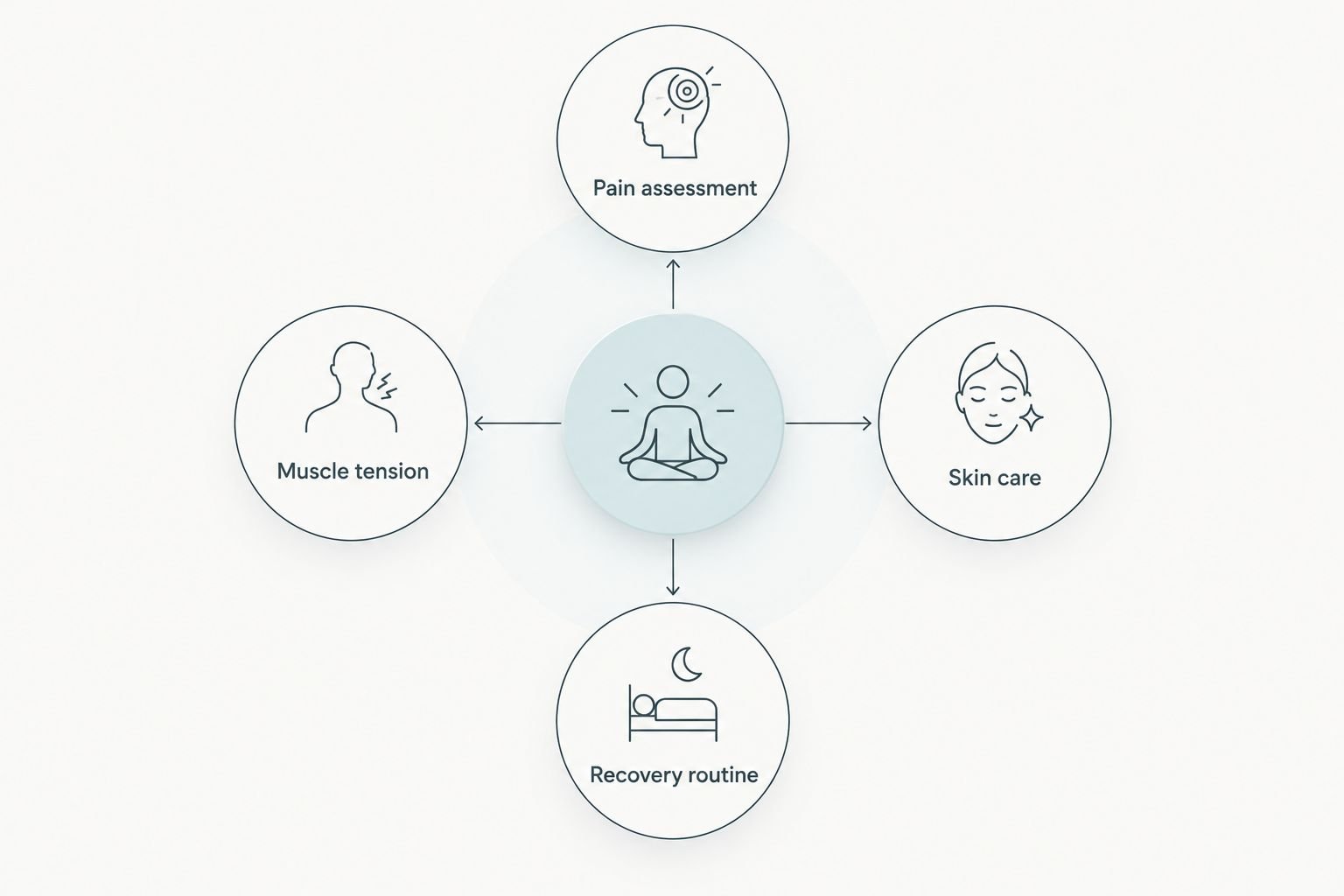
Choose the goal before choosing the service.
4. Prescribed bone-growth stimulation: best for medical indications
Electromagnetic bone-growth stimulation has specific medical applications. That does not mean a general wellness PEMF session is an equivalent treatment for a fracture or a bone-healing problem.
A prescribed device comes with a defined indication and instructions. If you are recovering from surgery or a fracture, your treating clinician should decide whether electromagnetic stimulation belongs in the plan and which device is appropriate.
Prescribed bone-growth stimulation pros:
- Addresses a specific medical indication.
- Uses a prescribed treatment protocol.
- Places follow-up within clinical care.
Prescribed bone-growth stimulation cons:
- It is not a general-purpose wellness recommendation.
- Its medical applications cannot substantiate unrelated spa claims.
Best for: Patients whose treating clinician has recommended a specific bone-growth stimulation device.
Treatment names also matter when comparing recovery services. Discussions of shockwave therapy for pain relief concern acoustic energy, while PEMF uses electromagnetic fields; a similar treatment goal does not make the mechanisms or evidence interchangeable.
Verdict: Wait for a prescription and device-specific instructions; skip substituting a spa session.
5. General wellness experimentation: best for curiosity, not promises
Claims about whole-body optimization often combine several different outcomes: energy, sleep, circulation, inflammation, and athletic performance. Each is a separate claim that needs relevant evidence, not a shared assumption based on the word PEMF.
Curiosity is a valid reason to ask about a service. It is not evidence that the service will change your health.
General wellness experimentation pros:
- Lets you explore an experience without assigning it a medical purpose.
- Encourages questions about the actual device and session.
- Can use a single, clearly defined personal goal.
General wellness experimentation cons:
- Vague goals make meaningful evaluation difficult.
- Trying several new services together obscures what affected your experience.
Best for: Adults interested in the experience who accept that broad wellness benefits are not established by a service description.
For a simple 2026 comparison, keep a 7-day log of your chosen outcome before changing your routine. That is an organizational suggestion, not a validated test of effectiveness, and a personal improvement cannot establish causation.
Verdict: Skip broad optimization promises; consider only a clearly described experience.
How these uses were ranked
The order prioritizes a defined goal, relevant evidence, appropriate screening, and outcomes you can describe. It does not rank machines, claim that all PEMF devices are equivalent, or report treatment results.
Medical bone-growth stimulation sits separately because it is not a routine spa choice. Its position is about relevance to a wellness reader, not the strength of a particular prescribed device.
Questions to ask before a session
A useful 2026 consultation should make the proposed service clearer, not add more technical language.
- What device is used, and what is its intended purpose?
- What evidence applies to my particular goal?
- Which health conditions or implanted devices require clearance?
- What should I expect during the session?
- What symptoms mean I should stop?
- How will we distinguish comfort from a medical treatment outcome?
Tell the provider about pregnancy, implanted electronic devices, recent procedures, and ongoing medical treatment. Follow the device's contraindications and your clinician's advice rather than assuming every electromagnetic treatment has identical restrictions.
Do not use a wellness appointment to investigate urgent symptoms. Chest pain, sudden weakness, or severe symptoms after an injury require prompt medical attention.
Which PEMF use should you choose?
Choose a defined goal, not the broadest benefit claim. For pain, start with assessment; for exercise recovery, address training and recovery habits; for relaxation, choose the experience you actually prefer.
Bodycentre Day Spa's combination of spa care and recovery services suits guests who want those choices in one Costa Mesa location. Whether you live in Costa Mesa, Newport Beach, Irvine, or Huntington Beach, ask about the service that matches your goal rather than booking several unrelated treatments at once.
FAQ
What is pulse PEMF therapy?
Pulse PEMF refers to pulsed electromagnetic field therapy, which uses changing magnetic fields. The term alone does not identify a specific device, protocol, or proven benefit.
What's the best PEMF benefit for pain relief?
There is no single best PEMF benefit for every type of pain. An assessed condition, relevant evidence, and the proposed device determine whether it is a reasonable adjunct to discuss with your clinician.
Does PEMF help muscles recover faster?
A general spa PEMF session should not be presented as proof of faster muscle healing. Feeling less sore also does not establish that you are ready to resume intense exercise.
Is PEMF better than massage?
Neither PEMF nor massage is best for every goal. Massage involves hands-on tissue work, while PEMF uses electromagnetic fields; choose according to your preferences, health history, and care needs.
Can I use PEMF if I have a pacemaker?
Do not begin PEMF with a pacemaker or another implanted electronic device without clearance from the clinician managing it. The proposed PEMF device's instructions and compatibility restrictions also matter.
Is spa PEMF the same as a bone-growth stimulator?
A spa PEMF session is not interchangeable with prescribed bone-growth stimulation. Medical devices have specific indications and instructions that do not automatically apply to wellness equipment.
Where is Bodycentre Day Spa located?
Bodycentre Day Spa is physically located in Costa Mesa, California. It serves local Orange County guests seeking massage, facials, skincare, and advanced recovery services.
One last thing
Before booking, finish this sentence: I want to make this specific activity more comfortable. If you cannot name the activity or desired experience, clarify the goal first; that conversation is more valuable than collecting treatments with overlapping promises.