Recovery treatments for desk and office workers: complete 2026 guide
/Massage for desk workers is hands-on soft-tissue care aimed at easing everyday muscular tension and supporting relaxation around a screen-heavy workday. This 2026 guide explains how to choose massage, adjust your desk routine, and distinguish spa care from recovery treatments that need a separate discussion about suitability.
TL;DR
- Massage for desk workers supports relaxation; it does not replace movement, workstation changes, or medical assessment.
- BodyCentre Day Spa suits Orange County desk workers seeking massage and advanced recovery options in Costa Mesa.
- Choose massage pressure by comfort and response, not by how much discomfort you can tolerate.
- Treat red light therapy and PEMF as separate decisions, not automatic additions to office-worker recovery.
Why recovery care matters for desk workers
Desk work combines sustained positions, repeated keyboard or mouse use, and limited opportunities to change tasks. Your recovery plan needs to address those daily conditions, not just the tight spot you notice at the end of the week.
A massage appointment gives you dedicated time for hands-on care. It cannot reposition your monitor, shorten an uninterrupted meeting, or diagnose the reason your arm tingles. The strongest plan pairs comfortable treatment with changes to the workday that keeps provoking discomfort.
For local appointments, BodyCentre Day Spa is physically located in Costa Mesa. You can plan a visit from Newport Beach, Irvine, Huntington Beach, or elsewhere in Orange County without treating those neighboring cities as additional spa locations.
The business combines massage, facials, skincare, and fitness with biohacking and recovery services. That range gives you different ways to plan personal care, but each service needs its own purpose. A facial belongs in a skincare or relaxation plan; it is not a treatment for keyboard-related wrist symptoms.
For your 2026 routine, start with the problem you want help with. Choose the service afterward.
Build a desk-worker recovery plan
1. Describe the discomfort before choosing treatment
Start with a short written record rather than a treatment menu. Note where you feel discomfort, what you were doing before it started, and whether changing position helps. A description such as tension across the shoulders after laptop work is more useful than asking someone to fix your posture.
Try keeping notes across 3 workdays as a practical starting point. This is a tracking suggestion, not a diagnostic test or a required waiting period before seeking care. Record patterns without deciding that every symptom comes from sitting.
Massage is not the first stop for sudden, severe, unexplained, or worsening pain. New numbness, weakness, symptoms following an injury, or chest pain require medical attention rather than a spa booking. Seek urgent care for urgent symptoms.
Bring these details to your appointment:
- Identify the location and character of the discomfort.
- Note tasks that bring it on or make it worse.
- Describe any symptoms traveling into an arm or leg.
- Share relevant injuries, medical conditions, and current treatment.
2. Change the work conditions you can control
Before adding appointments, look at how you actually work. Your setup should let you read the screen and use the keyboard without repeatedly reaching, twisting, or holding your shoulders up. There is no single posture you must freeze into all day.
Use what you already have first. Move the mouse closer, adjust screen placement, and support your feet if they do not rest comfortably. A separate keyboard makes it easier to position a laptop screen independently of your hands.
For a simple experiment, take a 2-minute movement break between selected work blocks. Stand, walk, or change position comfortably; this is a scheduling prompt, not a medically prescribed interval. If movement increases symptoms, stop and seek appropriate advice.
Make the routine easy to repeat:
- Place frequently used items within comfortable reach.
- Alternate tasks instead of repeating the same movement continuously.
- Use meeting transitions as reminders to change position.
- Keep your phone out of your lap during long calls.
3. Match massage to your goal and pressure tolerance
Begin with a plain-language request: relaxation, comfortable attention to a tense area, or help winding down after work. You do not need to choose a technical label before speaking with a therapist. Explain your preferences and ask what approach fits them.
BodyCentre Day Spa is best for desk workers seeking massage alongside spa and advanced recovery options in Costa Mesa. That combination supports planning in one location; it does not mean every guest needs multiple treatments. The guide to choosing massage in Costa Mesa offers a focused starting point for that decision.
Deeper pressure is not automatically better for office-related tension. Pressure that makes you brace, hold your breath, or pull away is a reason to speak up, not proof that the session is working.
Set clear boundaries before treatment:
- Name the areas you want addressed and those to avoid.
- Describe your preferred pressure in ordinary language.
- Ask the therapist to check comfort during focused work.
- Request a position change if lying still becomes uncomfortable.
4. Separate relaxation, skincare, and recovery goals
Write down what a successful visit would mean before combining services. Feeling calmer, receiving skincare, and discussing a recovery device are different goals. One visit can include more than one priority, but the treatments are not interchangeable.
Massage is the hands-on option for muscular comfort and relaxation. A facial focuses on facial skincare, while other skincare and waxing services address their own personal-care needs. Choose them because you want that care, not because office work makes a larger package necessary.
For a 2026 wellness plan, keep biohacking language secondary to a clear explanation of the actual service. Red light therapy uses light; PEMF uses pulsed electromagnetic fields; hyperbaric oxygen involves breathing oxygen in a pressurized environment. Altitude training is an exercise-related service, not a default response to a stiff neck.
Give each addition a specific purpose:
- Keep massage tied to comfort and relaxation goals.
- Choose facials around skincare concerns and preferences.
- Ask what a recovery service involves before agreeing to it.
- Avoid stacking treatments simply because they share a wellness label.
5. Check suitability before adding recovery technology
Start by asking for an explanation, not a bundle. For each recovery service, ask what the equipment does, what evidence supports your intended use, and what screening is required. The word recovery does not establish that a treatment fits your symptoms.
PEMF means pulsed electromagnetic field therapy. Red light therapy exposes tissue to selected light wavelengths. Neither name alone tells you whether a particular device, protocol, or application is appropriate for you. Benefits and risks depend on the treatment and the person receiving it.
Share medical conditions, pregnancy, implanted electronic devices, and relevant medications before booking technology-based services. Ask your treating clinician when your health history raises questions. Hyperbaric oxygen deserves a separate discussion of medical suitability; it is not a routine substitute for movement or massage.
Use these questions to guide the conversation:
- What specific goal is this service intended to address?
- What evidence applies to that goal and this equipment?
- What conditions, devices, or medications require extra screening?
- What would make you recommend against treatment?
6. Review your response before repeating the plan
Use a simple note after your appointment rather than relying only on how relaxed you feel at checkout. Record comfort during treatment, how you feel afterward, and whether ordinary work tasks feel different. Include any unwanted response.
Review those notes after 1 week as a personal planning checkpoint, not a promised recovery deadline. If relief is brief and the same task keeps provoking symptoms, revisit the task and seek assessment when appropriate. Repeating the appointment without reviewing the pattern leaves the main question unanswered.
Your 2026 schedule should reflect your response and priorities, not an assumed universal massage frequency. Before committing to recurring visits, understand what you want from them and whether the plan is helping you pursue that goal.
Keep the review manageable:
- Record whether the pressure felt comfortable throughout treatment.
- Note changes in the work activities that usually bother you.
- Track unwanted effects and report them to the provider.
- Reconsider the plan if symptoms persist or worsen.
Compare your desk-worker recovery options
Choose by purpose, not by how advanced a treatment sounds. Workstation changes address daily exposure, massage provides hands-on care, and medical assessment investigates symptoms that a spa cannot diagnose. Those roles complement one another without being substitutes.
The options below are not a ranking of treatment effectiveness. The best fit depends on what you want help with, your health history, and whether symptoms need clinical evaluation.
Movement and workstation changes
- Best for: Desk workers identifying uncomfortable work habits
- Main advantage: Addresses the conditions of the workday
- Key limitation: Does not diagnose persistent or unexplained symptoms
Massage
- Best for: Desk workers seeking hands-on relaxation and muscular comfort
- Main advantage: Pressure and focus can be discussed during treatment
- Key limitation: Does not correct the workstation or establish a diagnosis
Facials and skincare
- Best for: Office workers prioritizing skin care and personal downtime
- Main advantage: Gives skincare its own focused appointment
- Key limitation: Does not address the cause of neck, back, or wrist symptoms
Red light therapy
- Best for: People exploring a light-based service after suitability screening
- Main advantage: Offers a non-hands-on treatment format
- Key limitation: Suitability and evidence depend on the device and intended use
PEMF
- Best for: People considering electromagnetic-field treatment after screening
- Main advantage: Provides a different format from manual therapy
- Key limitation: Requires a separate discussion of evidence and contraindications
Medical or rehabilitation assessment
- Best for: People with persistent, worsening, or function-limiting symptoms
- Main advantage: Evaluates symptoms and guides appropriate care
- Key limitation: Serves a different purpose from a relaxation visit
Use this comparison to keep your decisions separate. You can want both relaxation and skincare without describing either as treatment for an unexplained symptom. Likewise, choosing a recovery device should follow a suitability discussion rather than a claim that desk workers need more technology.
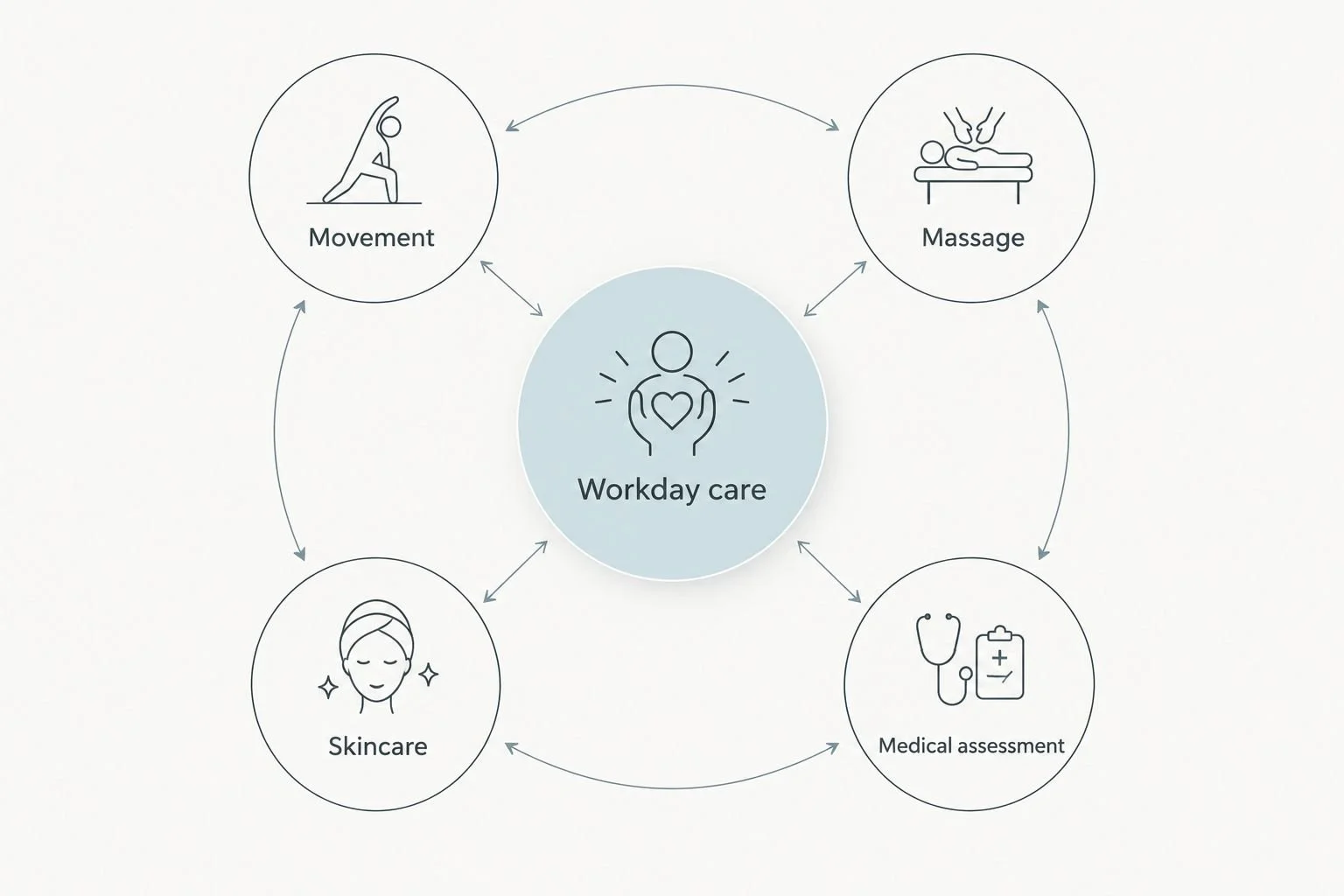
Each part of a desk-worker care plan serves a different purpose.
Common mistakes desk workers make
Treating the sore spot as the whole problem
The place you notice discomfort does not establish its cause. Shoulder tension after computer work is useful information, but it does not prove that one muscle needs aggressive treatment. Describe the pattern and let an appropriate professional assess concerns outside a spa therapist's scope.
Requesting the deepest pressure available
Firm pressure is a preference, not a measure of treatment quality. Ask for pressure you can receive without bracing, and change that request during the session when needed. You do not need to endure pain to justify a massage appointment.
Booking around work without changing work
A carefully chosen massage does not remove repeated reaching for a mouse or uninterrupted hours in one position. Make at least one practical workstation or scheduling change alongside your appointment. Otherwise, you have changed the recovery activity while leaving the work conditions untouched.
Assuming every recovery service treats desk-related pain
A service offered to athletes or wellness guests is not automatically appropriate for office-worker symptoms. Ask what the treatment is intended to do and what supports that use. Avoid translating terms such as cellular optimization into a promised medical result.
Turning a wellness visit into a delayed assessment
Do not keep booking spa treatments to investigate worsening pain, numbness, or weakness. A pleasant appointment and an appropriate medical evaluation answer different needs. For your 2026 plan, make clear boundaries part of good self-care rather than treating referral as a failed spa experience.
Plan your Costa Mesa visit
Explore spa care and recovery options, then ask which service fits your goals.
FAQ
What's the best massage for desk workers?
The best massage for desk workers matches your comfort, goals, and health history rather than a universal technique. Explain where you feel tension and choose pressure you can tolerate without bracing.
Is deep pressure better for shoulders tense from computer work?
Deeper pressure is not automatically better for shoulders tense from computer work. Tell the therapist if pressure makes you hold your breath, tense up, or pull away.
How often should I get massage if I work at a desk?
There is no single massage schedule that fits every desk worker. Review your response, work habits, and preferences before arranging recurring appointments, and seek assessment for persistent symptoms.
Can massage fix my desk posture?
Massage does not fix your workstation or establish one correct posture for the entire day. Pair hands-on relaxation with comfortable positioning, task changes, and opportunities to move.
Should I choose PEMF or red light therapy instead of massage?
Choose PEMF or red light therapy only after a separate discussion of your goal, suitability, and the evidence for that use. Neither is an automatic replacement for massage, movement, or medical assessment.
Can I combine a facial with my recovery visit?
Treat a facial as skincare and personal downtime rather than treatment for desk-related muscular symptoms. Ask about planning services together without assuming that combining them improves recovery.
Where can Orange County office workers find massage and recovery services?
BodyCentre Day Spa offers massage, spa care, and advanced recovery services at its Costa Mesa location. Guests coming from Newport Beach, Irvine, and Huntington Beach should plan travel to Costa Mesa, not a neighboring-city branch.
One last thing
The most useful detail to bring to a massage appointment is often not a treatment name. It is the exact task that makes you uncomfortable: using a laptop on the sofa, reaching for a mouse, or looking down during long calls.
For 2026, make that your starting point. Book around a clear goal, describe the workday honestly, and keep medical questions separate from spa preferences. You will give the provider a better starting point without needing to diagnose yourself or choose the most complicated treatment.