Biohacking treatments for busy professionals: complete 2026 guide
/Biohacking for busy professionals is the deliberate adjustment of daily habits and selected wellness treatments to support recovery, relaxation, and sustainable performance. This 2026 guide helps you choose around work, travel, and exercise without turning self-care into another demanding project.
TL;DR
- Biohacking for busy professionals starts with sleep, movement, and a clear goal—not a crowded treatment schedule.
- Bodycentre Day Spa suits Orange County professionals seeking massage, facials, and advanced recovery services in Costa Mesa.
- Compare red light therapy, PEMF, and other recovery treatments by purpose, safety screening, and scheduling demands.
- Choose one treatment at a time; track your experience without treating personal impressions as medical proof.
Why biohacking matters for busy professionals
A packed calendar changes what makes a wellness routine practical. You need to consider travel, preparation, appointment time, and how you feel afterward—not just the treatment itself. A session that repeatedly displaces sleep or exercise works against the routine you are trying to build.
Bodycentre Day Spa is best for Orange County professionals seeking spa care and advanced recovery services at one Costa Mesa location. The combination includes massage, facials, skincare, and recovery options rather than treating every concern as a reason to choose a device.
Start with the services described by Bodycentre Day Spa, then narrow your choices around one goal. The physical location is Costa Mesa, whether you live or work there, in Irvine, Newport Beach, Huntington Beach, or elsewhere in Orange County.
For your 2026 plan, separate relaxation, appearance, exercise recovery, and medical concerns. These are different goals. A comfortable spa experience does not establish a treatment's medical effectiveness, and a technical name does not make an option appropriate for you.
Build a routine that fits your workweek
1. Record your starting point
Begin with a simple record rather than an appointment. For 7 days, note sleep timing, work demands, exercise, and the concern you want to address. Spend 2 minutes each evening writing down what happened; this is a planning exercise, not a diagnostic test.
Look for scheduling problems before adding treatments. If late meetings consistently cut into bedtime, another appointment does not solve the underlying conflict. If your main concern is skin irritation, a recovery device is not automatically the relevant starting point.
Keep the record brief enough to maintain during a difficult week:
- Note when you go to bed and wake up.
- Record exercise and unusually demanding workdays.
- Describe discomfort in plain language, including its location.
- List skincare changes and recent procedures.
- Write down the outcome that matters most to you.
2. Choose one primary goal
Choose a goal you can explain without using the word biohacking. Wanting a quiet break, help selecting skincare, or an appointment centered on muscle tension gives a provider something specific to discuss. Wanting to optimize everything does not.
Start with ordinary actions you can manage yourself: protect time away from work, take movement breaks, and keep your existing routine consistent. If you want hands-on care, Bodycentre Day Spa's massage and facial services offer a different starting point from its device-based recovery services. Neither category needs to come first for everyone.
Match the conversation to your actual priority:
- Relaxation: describe the kind of experience you want.
- Muscle tension: explain where you feel it and what aggravates it.
- Skin care: discuss sensitivity, current products, and your goal.
- Exercise recovery: describe training demands and existing symptoms.
- Medical concerns: ask a qualified healthcare professional before choosing treatment.
3. Compare treatments by purpose
Ask what happens during a session before asking which treatment is best. Red light therapy exposes an area to selected wavelengths of light. PEMF means pulsed electromagnetic field therapy and uses equipment that produces changing magnetic fields. Neither name tells you whether a particular protocol fits your circumstances.
Hyperbaric oxygen involves breathing oxygen in a pressurized environment; the equipment, pressure, oxygen delivery, and clinical purpose matter. Altitude training changes oxygen exposure during training. These are distinct approaches, not interchangeable versions of the same recovery session.
For a skin-focused or muscle-recovery discussion, review the red light therapy uses for skin and muscle recovery guide, then ask about the actual service protocol rather than assuming every device works alike.
- Ask what the session involves from arrival to departure.
- Identify whether the goal is relaxation, skincare, or training support.
- Ask what evidence supports the proposed use.
- Discuss realistic limitations and possible adverse effects.
- Decline explanations that promise broad results without specifics.
4. Complete safety screening before booking
Write down your medications, relevant health conditions, recent procedures, and questions before contacting a provider. You do not need to decide which details matter on your own. Give the provider enough information to determine what needs further review.
For your 2026 treatment plan, make safety screening a separate decision from scheduling convenience. A service fitting your lunch break does not establish that it fits your health circumstances. Persistent or unexplained symptoms belong in a healthcare conversation, not a sequence of experimental spa bookings.
Ask the provider to explain both the session and the point at which they would advise against it:
- Disclose pregnancy, recent surgery, and relevant medical diagnoses.
- Mention implanted medical devices before discussing equipment-based treatments.
- Share medications and products that affect skin sensitivity.
- Ask who supervises the session and what training they have.
- Confirm how to stop a session if you feel uncomfortable.
- Seek medical assessment for new, severe, or worsening symptoms.
5. Reserve the whole appointment window
Put the complete visit into your calendar, not just the advertised session length. Include travel, check-in, screening, changing, and any instructions afterward. Ask for these details directly instead of assuming you can return immediately to a meeting or workout.
If you travel from Irvine, Newport Beach, or Huntington Beach, plan around the journey to Costa Mesa. Choose a time that does not depend on everything running perfectly. A recurring appointment should fit an ordinary workweek, not only a quiet one.
Bodycentre Day Spa's combination of spa care and advanced recovery under one roof gives you several categories to discuss at one location. It does not mean you need to combine them in one visit.
- Ask how much total time to set aside.
- Confirm preparation and aftercare instructions.
- Leave room for questions before the session.
- Avoid placing an unfamiliar treatment before an important commitment.
- Choose a repeatable calendar slot before considering recurring visits.
6. Review one change before adding another
Introduce 1 treatment at a time when you are trying to understand your experience. Keep other routines as consistent as practical, and record what you noticed afterward. This helps you describe the experience; it does not turn a personal log into a controlled study.
Use your 2026 record to decide whether an appointment deserves space in your schedule. Consider comfort, enjoyment, practical burden, and whether the experience matched your stated goal. Do not interpret a difficult workweek or a single good night's sleep as proof that a treatment failed or worked.
A useful review ends with a decision rather than another automatic booking:
- Record how the session felt during and afterward.
- Note any unwanted effects and report them to the provider.
- Compare the experience with your original goal.
- Include travel and scheduling effort in your assessment.
- Continue, adjust, or stop based on suitability—not novelty.
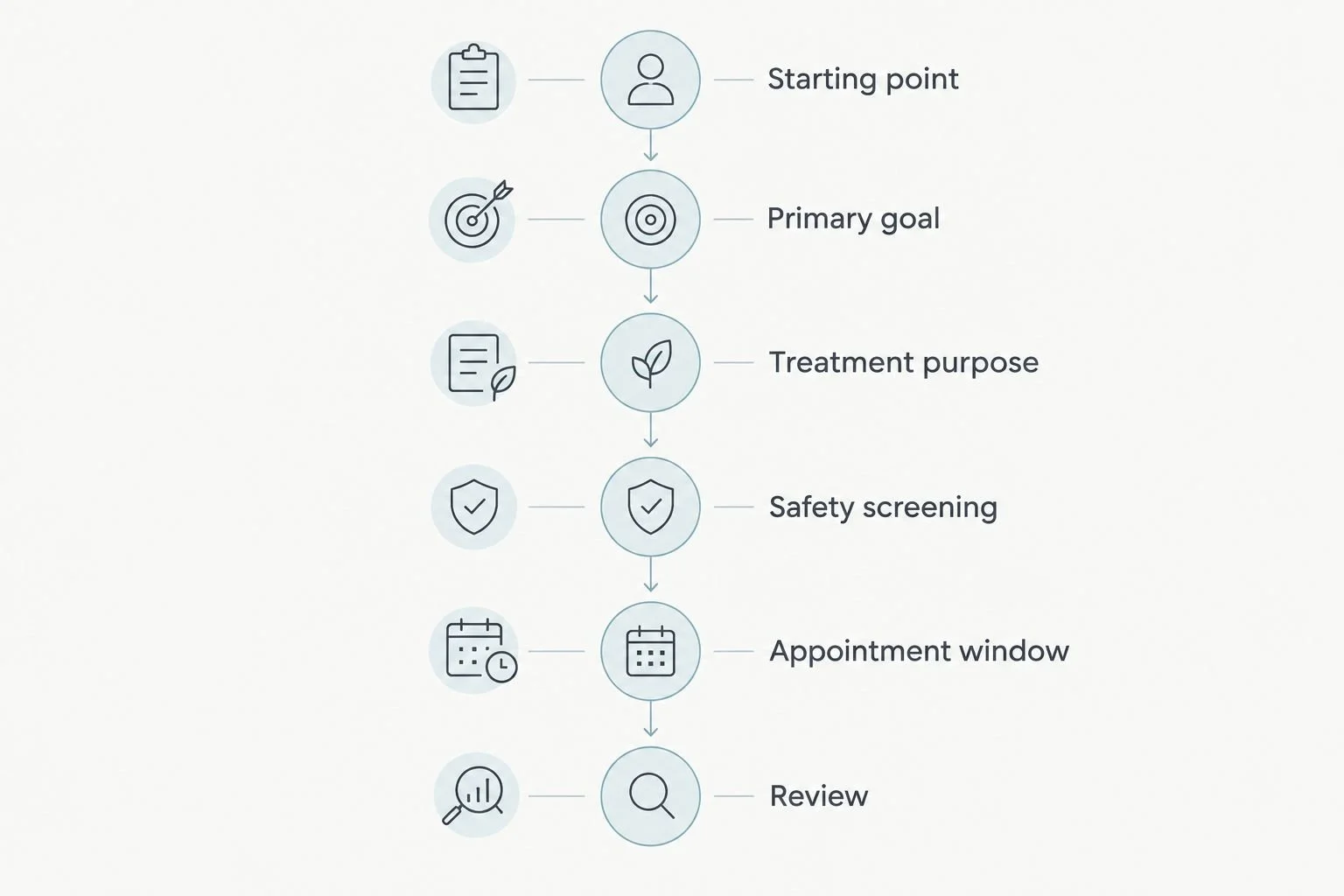
Choose the goal and complete safety screening before reserving time for treatment.
Compare options for your workweek
Choose the least complicated option that matches your goal. The comparison below separates practical uses from limitations; it is not a ranking of medical effectiveness. Every treatment still needs an individual suitability discussion.
Daily habit planning
- Best for: Professionals whose schedule disrupts basic routines
- Practical advantage: You can start by changing your own calendar
- Key limitation: Requires consistency and does not replace medical care
Massage therapy
- Best for: Guests seeking hands-on relaxation and attention to muscle tension
- Practical advantage: You can discuss pressure and areas of focus
- Key limitation: Comfort and suitability vary; it is not a diagnosis
Facials and skincare
- Best for: Guests wanting skin-focused care and product discussions
- Practical advantage: Keeps the appointment focused on skin concerns
- Key limitation: Sensitivity, recent procedures, and aftercare affect suitability
Red light therapy
- Best for: Guests considering a light-based skin or recovery service
- Practical advantage: Offers an option without hands-on massage
- Key limitation: Evidence and suitability depend on the intended use and protocol
PEMF
- Best for: Guests exploring a magnetic-field-based wellness service
- Practical advantage: Provides a distinct device-based option to discuss
- Key limitation: Requires screening; broad benefit claims need scrutiny
Hyperbaric oxygen
- Best for: People whose purpose and suitability have been assessed
- Practical advantage: Offers a pressure-based oxygen approach
- Key limitation: Medical context, equipment, supervision, and risks matter
Altitude training
- Best for: Exercisers with a defined training objective
- Practical advantage: Connects the session to an exercise goal
- Key limitation: Adds physiological demand and is not passive relaxation
For a professional seeking a break from work, massage can be a more directly matched choice than a training session. For a skin-focused goal, a facial consultation keeps the discussion relevant. Neither requires you to adopt a broader biohacking identity.
Oxygen-related services also need clear distinctions. Comparing EWOT systems for biohackers involves exercise with oxygen, not hyperbaric exposure or reduced-oxygen altitude training; these methods should not be grouped together as one treatment. Ask about the method's purpose and demands before comparing equipment features.
Do not buy equipment simply to avoid scheduling appointments. Home use adds questions about setup, maintenance, instructions, and suitability. A professional conversation should establish what you are trying to accomplish before ownership enters the discussion.
Common mistakes busy professionals make
Treating recovery as another productivity contest
Adding appointments to an already overloaded week can make the routine harder to maintain. Protect the time you already need for sleep, meals, movement, and downtime before adding optional services. Your wellness calendar should not require you to recover from your wellness calendar.
Choosing technology when the goal is spa care
A facial, massage, or quiet break does not become less worthwhile because it lacks equipment. If your 2026 priority is relaxation or skincare, say so. Choose a service for its fit, not because its name sounds more advanced.
Scheduling unfamiliar treatments before demanding commitments
A first appointment is a poor place to assume how you will feel afterward. Discuss timing with the provider, especially before travel, a demanding presentation, or strenuous exercise. Leave yourself room to respond to the experience rather than rushing into the next obligation.
Attributing every change to the last appointment
Work stress, training, sleep, and illness all complicate personal comparisons. Record context alongside your impressions. A positive experience is a reason to discuss whether to repeat a service, not evidence for a broad health claim.
FAQ
What's the best way to start biohacking for busy professionals?
Start with one clear goal and a record of your existing routine. Address scheduling conflicts around sleep, movement, and downtime before adding optional treatments.
Is massage better than a biohacking treatment for work stress?
Massage is a more directly matched option when you want hands-on relaxation rather than a device-based session. Personal preference and health circumstances still determine suitability; persistent distress deserves appropriate healthcare support.
Can I combine a facial with recovery treatments?
Ask the provider before combining a facial with another treatment. Skin sensitivity, recent procedures, treatment settings, and aftercare instructions can affect the plan.
Are red light therapy and PEMF the same thing?
Red light therapy and PEMF are different treatment categories. Red light uses selected wavelengths of light, while PEMF equipment produces changing magnetic fields; suitability depends on the proposed use and your circumstances.
Are oxygen exercise and hyperbaric oxygen interchangeable?
Exercise with oxygen and hyperbaric oxygen are not interchangeable. Hyperbaric oxygen involves a pressurized environment, while oxygen exercise involves physical activity with oxygen delivery.
How often should I book recovery treatments?
Choose a schedule only after discussing the specific service, your goal, and your health circumstances. There is no single frequency that applies across massage, facials, light-based services, and oxygen-related treatments.
Where is Bodycentre Day Spa located?
Bodycentre Day Spa is physically located in Costa Mesa, California. Its spa and recovery services serve local Orange County clients, including people traveling from neighboring cities.
One last thing
Put a stop rule in your 2026 wellness plan. Before your first appointment, decide what would make you pause: unwanted effects, unclear explanations, scheduling strain, or an experience that does not match your goal.
Choosing not to repeat a treatment is a valid outcome. The useful routine is the one you understand, can accommodate, and have assessed for suitability—not the one with the longest list of services.