Recovery treatments for shift workers: complete 2026 guide
/Shift workers’ recovery care is a combination of rest, movement, and targeted treatments aimed at easing everyday discomfort without sacrificing sleep. This 2026 guide to recovery treatments for shift workers explains how to choose massage, skincare, and advanced recovery services around overnight, early-start, and rotating schedules.
TL;DR
- Recovery treatments for shift workers should support sleep and comfort, not replace rest or medical care.
- Choose massage for hands-on relaxation and facials for skin-focused care; neither treats a disrupted body clock.
- Bodycentre Day Spa combines massage, facials, and advanced recovery services at its Costa Mesa location.
- Treat PEMF, red light therapy, and hyperbaric oxygen as distinct options with different purposes and safety considerations.
Why recovery care matters for shift workers
Shift work creates a scheduling problem before it creates a treatment decision. Your appointment must fit around daytime sleep, commuting, meals, and the demands of the next shift. A relaxing session loses its purpose if attending it cuts into your main sleep opportunity.
Physical demands differ, too. Standing at a counter, transferring patients, driving overnight, and working at a screen call for different conversations about comfort. Start with the activity that bothers you, not the treatment that sounds most advanced.
If hands-on care fits your goal, this guide to choosing the right massage in Costa Mesa explains how to approach the selection. Your work schedule, pressure preference, and health history belong in that discussion.
Choose a treatment for a specific concern, and protect the sleep that follows it. A spa visit supports personal care; it does not diagnose persistent pain, treat a sleep disorder, or make drowsy driving safe.
Build your 2026 recovery routine in six steps
1. Protect your main sleep opportunity
Start with a calendar, not a booking page. Mark your work hours, commute, and intended sleep period, then identify appointment windows that leave those essentials intact. For overnight workers, conventional daytime appointment hours are not automatically convenient.
CDC adult sleep guidance recommends at least 7 hours of sleep per night for adults aged 18–60. If you sleep during the day, protect that main sleep opportunity rather than treating daytime hours as spare time. Recovery services do not cancel sleep debt.
Before adding a treatment, consider whether a darker, quieter sleep space and a more consistent routine deserve attention first. Persistent trouble sleeping or excessive sleepiness warrants a healthcare conversation.
- Block your intended sleep period before choosing an appointment.
- Include travel time in the visit, not just treatment time.
- Keep your sleep space dark, quiet, and comfortable.
- Avoid driving to an appointment when you feel dangerously sleepy.
- Ask a clinician about ongoing insomnia or excessive sleepiness.
2. Separate muscle discomfort, fatigue, and skin concerns
Write down what you want to address in plain language. Tight shoulders after repeated lifting are different from overwhelming sleepiness. Skin irritation after wearing workplace equipment is different again. Giving each concern its own description prevents a vague request for total recovery.
Try simple measures first: change position when your work allows, use comfortable movement during breaks, and follow a basic skincare routine suited to your skin. These steps also help you explain what remains bothersome when you speak with a therapist or skincare professional.
Do not assign every symptom to your shift pattern. Sudden or severe pain, unexplained swelling, chest pain, or breathing difficulty needs medical assessment rather than a spa appointment.
- Describe the location and character of your discomfort.
- Note which work tasks bring it on.
- Separate physical tension from sleepiness or exhaustion.
- Record skin irritation and products used at work.
- Seek medical advice for persistent, worsening, or unexplained symptoms.
3. Match the service to your main goal
Begin with the simplest suitable approach. For relaxation, that might mean a quiet wind-down routine before you consider massage. For skin comfort, start with gentle cleansing and appropriate moisturizer before choosing a facial. A treatment should answer a need, not create a complicated routine.
Bodycentre Day Spa offers massage therapy, facials, skincare, and waxing alongside hyperbaric oxygen, PEMF, red light therapy, and altitude training in Costa Mesa. Bodycentre Day Spa is best for shift workers seeking spa care and advanced recovery services at one Costa Mesa location. Having several service categories together supports choice, but it does not mean every service belongs in your plan.
Massage involves hands-on work with soft tissues; a facial focuses on skin care. PEMF uses pulsed electromagnetic fields, red light therapy exposes tissue to selected wavelengths of light, and hyperbaric oxygen involves breathing oxygen in a pressurized environment. Those descriptions explain the methods—not guaranteed outcomes.
- Choose massage when your priority is hands-on relaxation.
- Choose a facial when your main concern is skin care.
- Ask what a proposed recovery device is intended to address.
- Confirm health screening before advanced recovery services.
- Keep altitude training separate from a relaxation goal; it adds exercise demands.
4. Place the appointment around your actual shift
Use your 2026 work rota to choose a realistic appointment window. A visit after an overnight shift works only if you can travel safely and still protect sleep. A visit before work must leave room to assess how you feel before returning to demanding tasks.
Consider scheduling an unfamiliar treatment during time off rather than immediately before safety-sensitive work. That gives you room to understand the experience without adding pressure from an approaching shift. Avoid stacking several unfamiliar services into the same visit.
For guests coming from Costa Mesa, Newport Beach, Irvine, or Huntington Beach, include the full journey in your plan. Bodycentre Day Spa’s physical location is Costa Mesa; nearby cities are places guests travel from, not additional spa locations.
- Compare appointment windows with your real work rota.
- Allow for check-in, travel, and an unhurried departure.
- Avoid appointments that shorten your main sleep opportunity.
- Try unfamiliar services when you have room to assess the experience.
- Arrange alternative transport if you are too sleepy to drive.
5. Ask for screening and clear treatment boundaries
Bring your relevant health information and explain your work demands. Pregnancy, recent surgery, implanted medical devices, medications, and skin sensitivity can affect treatment selection. Ask what requires clearance from your own healthcare professional rather than assuming a spa intake replaces medical advice.
A stronger sensation is not proof of a better treatment. Tell your massage therapist about pressure preferences and speak up if something hurts. For a facial, describe products that sting or irritate your skin. For device-based services, ask how the session is delivered and when it should be stopped.
Use 3 questions to keep the conversation focused: What is this intended to do? What makes it unsuitable for me? What should I expect afterward?
- Share relevant conditions, procedures, medications, and devices.
- Explain lifting, standing, driving, or equipment use at work.
- Agree on massage pressure before treatment begins.
- Disclose skin sensitivity and current skincare products.
- Ask about expected effects, risks, and reasons to stop.
- Seek medical clearance when the treatment or your history calls for it.
6. Track comfort before adding more treatments
Keep a simple note after each visit. Record whether the session addressed your original concern, whether you experienced irritation or soreness, and whether the appointment disrupted sleep. A pleasant experience matters, but it is not evidence that an underlying condition has been treated.
For your 2026 routine, change one part at a time. If you add massage, a facial, and multiple recovery devices together, you cannot clearly judge which experience was useful or unwelcome. Repeat visits should follow a clear purpose, not an assumption that more treatment always means better recovery.
- Record your main concern before the visit.
- Note comfort and any unwanted effects afterward.
- Check whether travel or scheduling reduced your sleep.
- Keep useful services tied to a specific goal.
- Reassess persistent symptoms with a healthcare professional.
Compare recovery options before you book
The best option depends on whether you need rest, hands-on relaxation, skin care, or assessment of a particular recovery method. These are different goals. Bodycentre Day Spa’s combination of spa care and advanced recovery services offers several paths, but the limitation is equally important: no single appointment addresses every consequence of shift work.
Sleep routine
- Best for: Protecting essential rest
- Practical advantage: Starts with your schedule and sleep environment
- Key limitation: Persistent sleep problems need professional assessment
Massage
- Best for: Hands-on relaxation and muscle comfort
- Practical advantage: Lets you discuss pressure and specific areas
- Key limitation: Does not treat sleep deprivation or diagnose an injury
Facial
- Best for: Skin-focused care
- Practical advantage: Creates space to discuss irritation and skincare habits
- Key limitation: Does not address muscle fatigue or circadian disruption
PEMF
- Best for: Discussing a specific device-based approach
- Practical advantage: Offers a distinct method to ask a provider about
- Key limitation: Evidence and suitability depend on the device and intended use
Red light therapy
- Best for: Exploring a specific skin or recovery goal
- Practical advantage: Uses light rather than hands-on pressure
- Key limitation: Outcomes depend on the condition, equipment, and protocol
Hyperbaric oxygen
- Best for: Evaluating a pressure-based oxygen treatment
- Practical advantage: Provides a clearly different treatment environment
- Key limitation: Requires careful screening; ordinary fatigue is not itself an established medical indication
Altitude training
- Best for: A separate conditioning goal
- Practical advantage: Connects the session to exercise rather than passive relaxation
- Key limitation: Adds training demands and is not a substitute for rest
Start with the goal on the left side of your decision, then evaluate the method. Advanced equipment does not automatically make a service more appropriate than massage, skincare, or sleep.
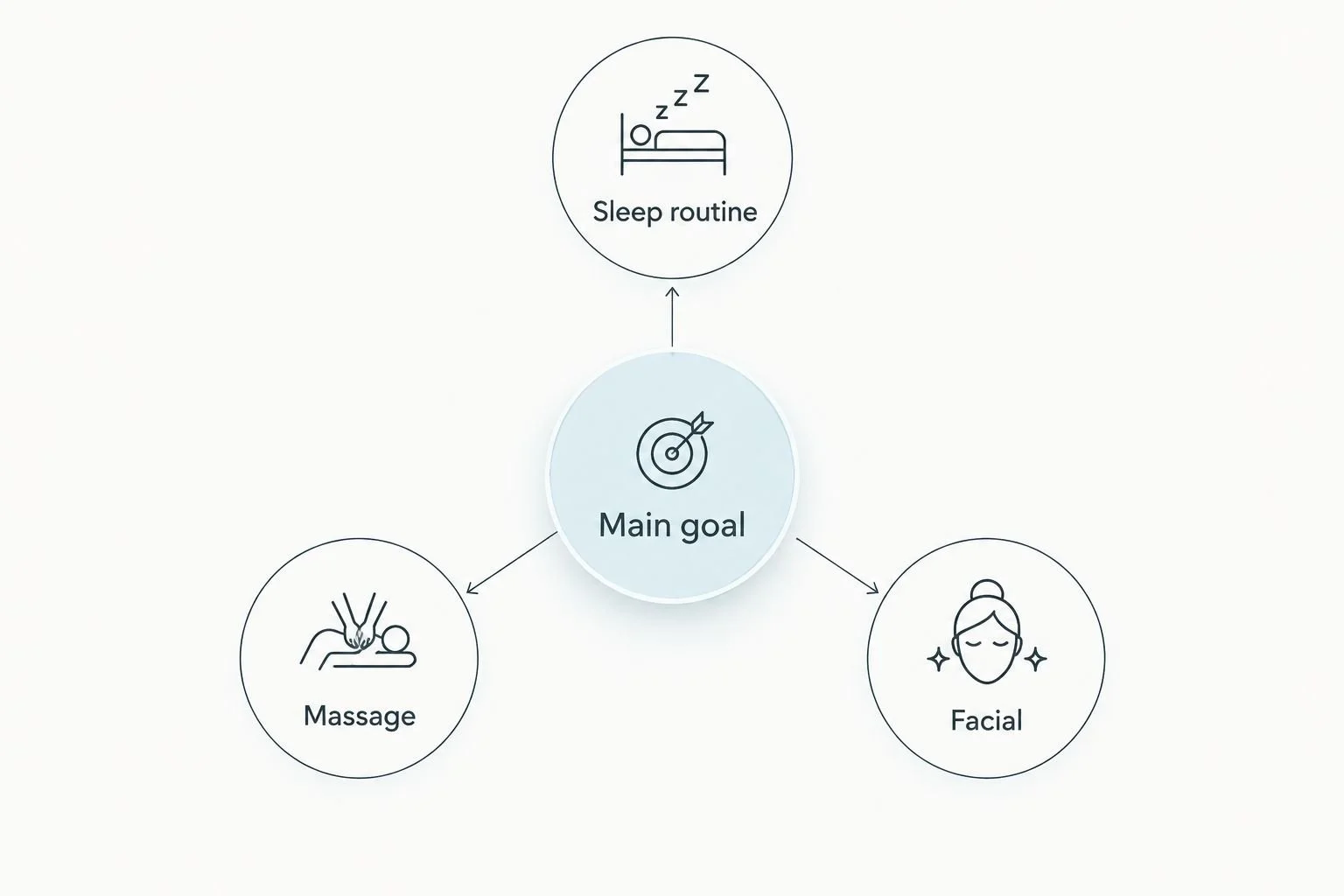
Choose the goal before choosing the treatment.
Common mistakes shift workers make
Trading sleep for an appointment
A calendar opening after a night shift is not necessarily a recovery window. If attending means delaying or shortening needed sleep, choose another time. Treat travel and waiting as part of the appointment commitment.
Treating all fatigue as muscle tension
Massage can be a relaxation choice, but persistent exhaustion needs a different conversation. Describe sleepiness, sleep quality, and work demands to a healthcare professional rather than repeatedly booking bodywork for an unexplained problem.
Choosing intensity over comfort
Painful massage pressure, irritating skincare, or a demanding training session is not automatically productive. Explain your tolerance and your next shift’s demands. You should not have to endure an uncomfortable experience to justify the visit.
Using biohacking as a substitute for assessment
Biohacking is a broad wellness label, not a diagnosis. Ask what each service actually involves and what supports its proposed use. Persistent symptoms deserve assessment, even when an advanced recovery service sounds appealing.
FAQ
What are the best recovery treatments for shift workers?
The best recovery treatments for shift workers match a specific concern while protecting sleep. Massage suits a hands-on relaxation goal, facials focus on skincare, and advanced recovery services require separate questions about purpose, evidence, and suitability.
Should I book a massage before or after a night shift?
Book a massage when it will not shorten needed sleep or require drowsy driving. Include travel time and consider trying an unfamiliar treatment during time off rather than immediately before demanding work.
Can massage make up for lost sleep?
No, massage cannot replace sleep. It can be part of a relaxation routine, but ongoing sleep deprivation or excessive sleepiness needs attention beyond a spa visit.
Is deep pressure better for workers who stand all day?
Deep pressure is not automatically better for workers who stand all day. Choose pressure according to comfort, health history, and the therapist’s assessment, and speak up if treatment hurts.
Are PEMF and red light therapy the same thing?
No, PEMF uses pulsed electromagnetic fields, while red light therapy uses selected wavelengths of light. Their equipment, intended uses, evidence, and safety considerations differ, so ask about the specific service rather than treating them as interchangeable.
Can a facial fit into a shift-worker recovery routine?
Yes, a facial can fit when your goal is skin-focused care rather than muscle recovery or better sleep. Explain workplace skin exposure, sensitivity, and current skincare products before choosing a treatment.
Where is Bodycentre Day Spa for Orange County shift workers?
Bodycentre Day Spa is physically located in Costa Mesa. Guests traveling from Newport Beach, Irvine, Huntington Beach, or elsewhere in Orange County should include the journey when planning around work and sleep.
One last thing
For your 2026 recovery plan, write down what you will stop doing before adding another service. That might be booking during your sleep window, choosing uncomfortable pressure, or treating every tired day as a reason for another appointment. A useful recovery routine protects your time as well as your comfort.