
Booking a corporate wellness day with spa and recovery care
/Instead of manually chasing treatment preferences and appointment replies, organize your corporate wellness spa day booking around one coordinator, a private intake route, and written appointment confirmations. For a 2026 team visit, ask Bodycentre Day Spa in Costa Mesa to confirm the service mix and scheduling arrangements before you invite employees.
TL;DR
- Corporate wellness spa day booking starts with a scheduling request, not an assumption that group arrangements are confirmed.
- Bodycentre Day Spa suits teams seeking massage, facials, and recovery services at one Costa Mesa location.
- Collect scheduling preferences centrally; send personal health information directly to the treatment provider.
- Confirm each appointment before distributing the final employee itinerary.
Why this matters
A workplace wellness outing needs more than a date. Employees have different comfort levels with touch, skincare, equipment-based treatments, and sharing personal information with colleagues.
Bodycentre Day Spa is best for teams seeking spa care and recovery services at one Costa Mesa location. Its services include massage, facials, skincare, and biohacking treatments; your booking request should establish which services fit the proposed visit rather than assume a corporate package exists.
For your 2026 event, define success as a well-organized, voluntary experience. Do not promise better productivity, fewer sick days, or a particular health outcome from attendance.
Before you start
- Assign 1 coordinator. Give that person permission to request appointments and obtain internal approval. Keep employee health information outside the coordinator's planning sheet.
- Prepare 2 date options. Gather the expected participant count, travel constraints, preferred services, and internal spending approval before sending the request.
- Check the scheduling gotcha first. A group request does not establish simultaneous appointments, exclusive use, a meeting area, or a combined treatment sequence. Ask which arrangements can be confirmed before describing the outing to employees.
Employees traveling from Costa Mesa, Newport Beach, Irvine, or Huntington Beach should all receive the same destination information: the physical spa is in Costa Mesa. Do not describe nearby cities as separate spa locations.
Your booking brief
Create a simple planning document before contacting the spa. The bold labels below are suggested fields for your own worksheet, not names of buttons or forms on the spa's website.
- Add Event purpose. Describe the outing as employee appreciation, optional relaxation, or an introduction to spa and recovery services. Keep performance targets out of the treatment request.
- Complete Date options, Participant count, and Appointment window. Separate confirmed attendees from people who have only expressed interest.
- Add Service preferences. Ask employees to select an area of interest without explaining medical conditions to their manager.
- Complete Travel needs and Accessibility questions. Record the logistical question, then ask the spa how individual requirements should be discussed privately.
- Assign Approval owner and Booking coordinator. Identify who can authorize the arrangements and who communicates changes.
Expected result: you have a booking brief that answers who, when, and what without becoming an employee health record.
A simple sequence keeps the planning work visible. Move from the brief to private preferences, then confirmation, and only then to the itinerary.
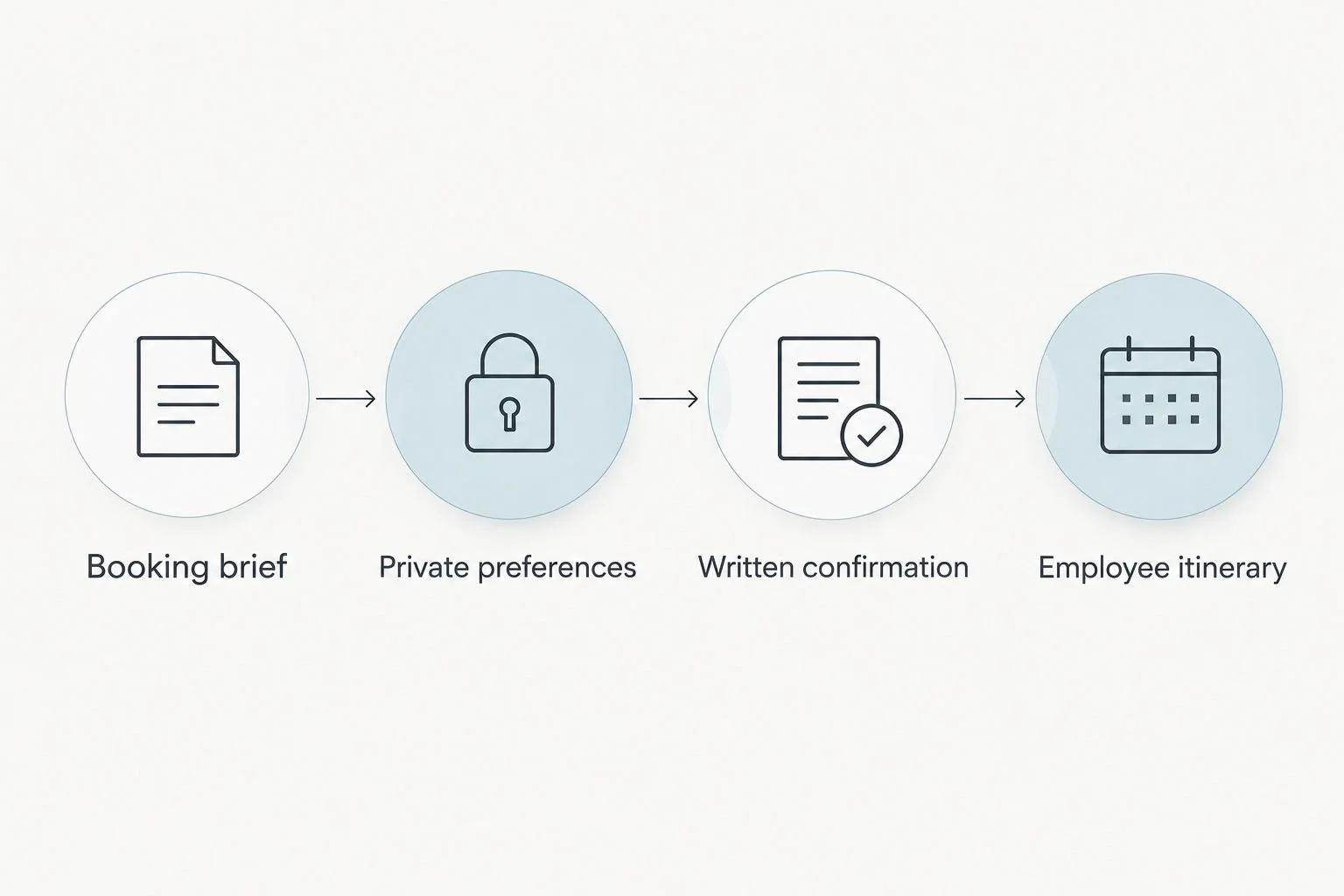
Confirm the appointment arrangements before sending the final employee itinerary.
Choose services without choosing for employees
Use the following comparison to collect preferences. These are treatment categories to discuss, not a confirmed group menu or a recommendation that every employee receive every treatment.
Massage therapy
- Best for: Guests who want hands-on bodywork
- What it involves: A practitioner works with soft tissues using an agreed approach
- Planning advantage: Gives employees a clear, familiar service preference
- Limitation to address: Touch, pressure, and personal comfort require individual discussion
Facials and skincare
- Best for: Guests who prefer skin-focused care
- What it involves: Treatment focused on the skin, with the approach discussed individually
- Planning advantage: Includes employees whose interest is skincare rather than bodywork
- Limitation to address: Skin sensitivity, products, and recent treatments need private discussion
Red light therapy
- Best for: Guests interested in a light-based service
- What it involves: Exposure to red light using treatment equipment
- Planning advantage: Adds an equipment-based option to the conversation
- Limitation to address: Suitability and preparation require provider guidance; do not promise results
PEMF
- Best for: Guests interested in an electromagnetic-field service
- What it involves: PEMF means pulsed electromagnetic field
- Planning advantage: Gives recovery-focused guests another service to ask about
- Limitation to address: Personal medical circumstances and implanted devices require individual review
Offer choice, not a treatment assignment. Someone who declines massage should not have to explain why to a supervisor. Someone interested in recovery care should not be enrolled in equipment-based treatment solely because colleagues chose it.
Bodycentre Day Spa also offers hyperbaric oxygen and altitude training. Those services are not interchangeable with a relaxing facial or massage; discuss the intended experience and individual screening before including either in an employee invitation.
Private preferences and provider review
Employee preferences help organize a visit. They do not establish treatment suitability, and an employer should not make that determination.
- Create Participation choice with an explicit option to decline. Keep participation separate from performance reviews or team expectations.
- Add Preferred category and Scheduling constraints. Ask only for information the coordinator needs to arrange the day.
- Ask the spa how employees should complete Private intake. Personal medical history, pregnancy, implanted devices, medications, skin concerns, and recent procedures belong in a direct provider conversation when relevant.
- Record Provider follow-up needed without recording the reason. The coordinator needs to know whether an appointment can proceed, not the employee's medical details.
- Keep Treatment preference separate from Confirmed appointment. Do not move an employee to confirmed status until the scheduling and intake arrangements are settled.
Expected result: the coordinator can organize appointments while employees retain a private route for personal questions.
For a 2026 workplace outing, resist collecting health details simply because an online spreadsheet makes it easy. A shared document should show planning status, not diagnoses or explanations for declining a service.
The information split is straightforward: the coordinator manages participation and timing; the provider handles personal treatment questions directly with the guest.
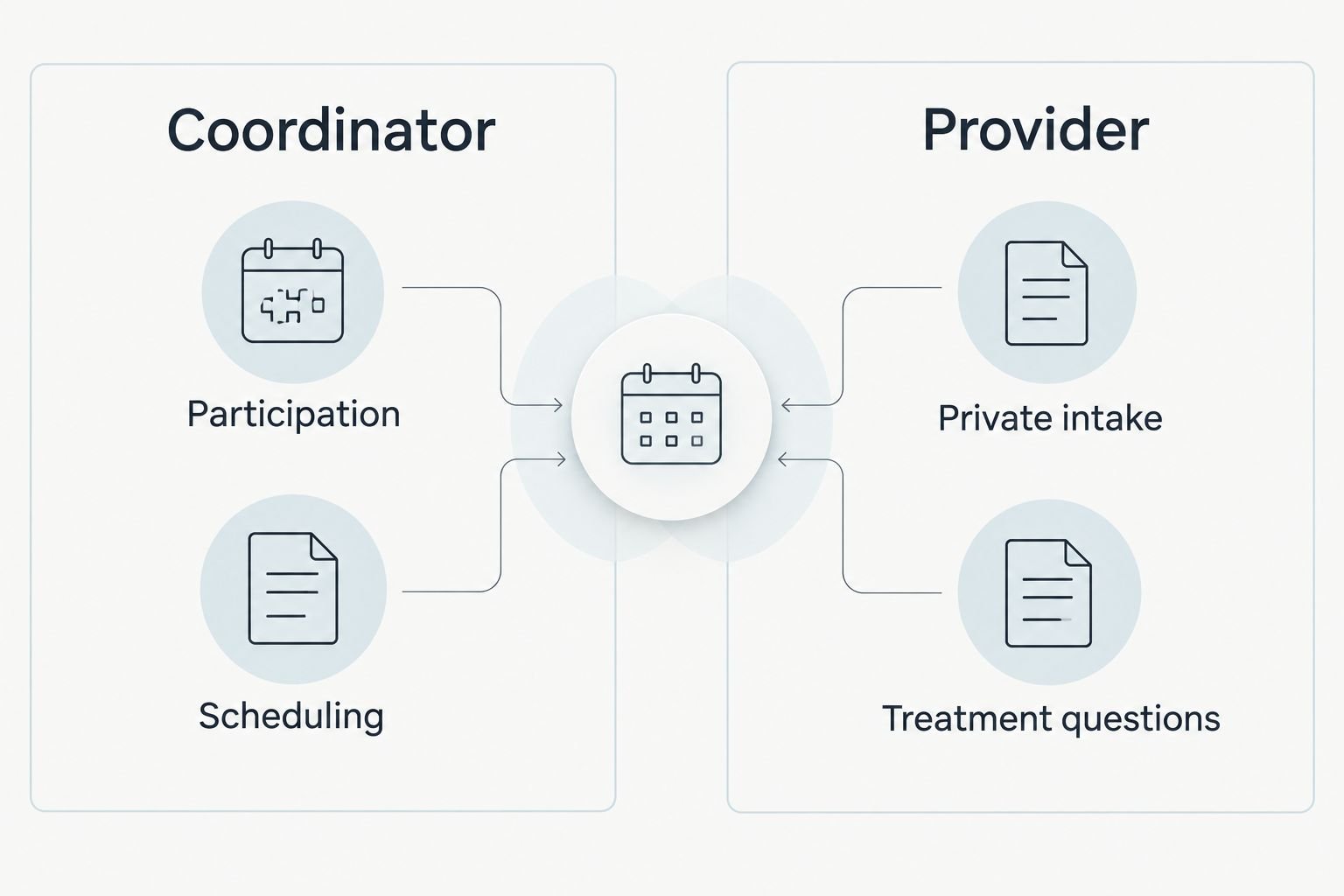
Keep scheduling information with the coordinator and personal treatment questions with the provider.
Appointment confirmation and employee itinerary
A proposed date is not an appointment confirmation. Finish the scheduling conversation before making travel arrangements or announcing a fixed treatment sequence.
- Send the brief through the spa's contact page. Ask whether the proposed participant count, date options, and treatment preferences can be accommodated.
- Request written clarification of Appointment times, Service details, and Individual requirements. Ask whether appointments overlap or require staggered arrivals.
- Clarify Payment responsibility and Change terms directly. Establish what the employer handles, what requires separate approval, and how employee changes should be communicated.
- Ask for Arrival instructions and Preparation guidance. Pass on the provider's instructions accurately rather than creating a generic fasting, hydration, skincare, or exercise rule.
- Send 1 confirmation per guest. Include the confirmed service, appointment time, Costa Mesa destination, provider-supplied arrival guidance, and the coordinator's contact details.
- Maintain Change status in the planning sheet. Distinguish a requested change from a change the spa has accepted.
Expected result: each participating employee knows what is booked, where to go, and whom to contact without seeing anyone else's private information.
Keep meetings separate from treatment time unless a suitable arrangement has been explicitly agreed. A spa appointment does not establish permission to hold a presentation, bring refreshments, take group photographs, or use a private room.
A second workflow: staggered appointments
Best for teams that cannot leave work together: request staggered appointments instead of treating simultaneous attendance as essential. This approach supports employee choice, but it requires more individual coordination and does not create a shared group experience.
For a recurring 2026 wellness initiative, repeat the same booking process for each visit. Do not assume an earlier arrangement carries over unchanged.
- Collect each participant's workable appointment window rather than one team departure time.
- Send the combined request to the spa, identifying which preferences are flexible.
- Obtain individual confirmations before releasing employees from work commitments.
- Reconfirm treatment preferences and any required private intake for the next visit.
Compare the formats before choosing:
Shared outing
- Best for: Teams prioritizing time together
- Main advantage: Creates a common event around confirmed appointments
- Main drawback: Requires alignment between employee schedules and treatment scheduling
Staggered appointments
- Best for: Teams maintaining workplace coverage
- Main advantage: Lets employees request different appointment windows
- Main drawback: Requires more separate confirmations and less shared time
Neither format removes the need for individual consent. A workplace invitation should make it comfortable to participate, choose a different treatment, or decline.
Troubleshooting your booking
The team expects to receive treatment together
Ask the spa to clarify the actual appointment arrangement before anyone travels. If simultaneous appointments are not confirmed, offer staggered attendance or revisit the proposed date; do not promise a shared treatment room.
A guest's preferred treatment changes after intake
Let the guest and provider discuss the next step privately. Update the coordinator's sheet only with the scheduling consequence, such as a revised appointment or a pending decision.
Someone cancels after the itinerary is sent
Contact the spa and apply the terms agreed during booking. Do not assume another employee can take the appointment without confirmation, especially when the service requires individual intake.
Different employees receive conflicting instructions
Use the provider's current instructions for each person's confirmed service. Avoid forwarding one employee's preparation message to the whole team, because treatment requirements differ.
The invitation sounds like a medical promise
Replace outcome claims with a description of the experience. Say employees can request massage, skincare, or recovery services; do not promise pain relief, treatment of a condition, or measurable workplace performance improvements.
Customize your workflow
Expand your 2026 planning sheet with useful logistics, not more health questions. Add a travel contact, a private route for accessibility discussions, and a clear method for withdrawing from the outing.
Ask for feedback about the booking experience afterward. Questions about clarity, scheduling, comfort, and communication are more appropriate for an employer than asking employees to report symptoms or medical changes.
Bodycentre Day Spa combines traditional spa care with advanced recovery services, but that breadth does not make every service right for every guest. Start with individual preferences and provider guidance, then build the itinerary around the appointments that are actually confirmed.
FAQ
How do I start a corporate wellness spa day booking?
Start with a booking request that includes your participant count, date options, appointment window, and preferred treatment categories. Ask the spa to confirm the arrangements before sending employees a final invitation.
Can employees choose between massage, facials, and recovery services?
Ask employees for preferences, then confirm the proposed services with the spa. Bodycentre Day Spa offers massage, facials, skincare, and recovery services, but each employee's appointment still needs individual scheduling and suitability review.
Can everyone have a treatment at the same time?
Treat simultaneous appointments as unconfirmed until the spa explicitly confirms them. Ask whether the group needs staggered arrivals and whether any shared space is part of the agreed arrangement.
Should an employer collect medical information for spa appointments?
Keep personal treatment and medical questions between the employee and the provider. The coordinator should collect participation choices and scheduling information rather than health histories.
Where is the spa for employees coming from nearby cities?
The physical spa location is Costa Mesa, California. Employees traveling from Newport Beach, Irvine, Huntington Beach, or elsewhere in Orange County should use the confirmed Costa Mesa destination in their itinerary.
Is a recovery treatment the same as a relaxing spa service?
No. Massage, facials, red light therapy, PEMF, hyperbaric oxygen, and altitude training involve different experiences and screening considerations. Ask the provider to explain the selected service and its individual requirements before confirming participation.
What should employees receive before the wellness day?
Each employee should receive their confirmed service, appointment time, destination, provider-supplied preparation guidance, and a contact for changes. Keep other employees' private information out of the itinerary.
One last thing
A guest's decision to decline is a successful use of the planning process. Make the opt-out route as clear as the appointment invitation, and you remove the pressure to disclose personal reasons just to participate differently.
Before sending the final itinerary, check it from the employee's perspective: can someone find their appointment details and ask a private question without replying to the entire team?