Recovery treatments for corporate wellness: complete 2026 guide
/Corporate wellness programs are employer-organized benefits that support employee well-being, with the aim of making healthy routines and recovery easier to access. This 2026 guide explains how to include massage, facials, and advanced recovery without turning personal care into a workplace obligation or promising medical results.
TL;DR
- Corporate wellness programs should prioritize employee choice, practical access, and privacy—not mandatory treatment participation.
- Bodycentre Day Spa fits local teams seeking massage, facials, and advanced recovery at one Costa Mesa location.
- Start with workplace breaks and scheduling improvements before adding optional spa care or biohacking treatments.
- Measure participation and access barriers, not employee diagnoses, treatment details, or unsupported productivity gains.
Why recovery matters for corporate wellness programs
A recovery benefit has to fit the working day. An appointment that requires a difficult commute, unpaid time away, or an uncomfortable conversation with a manager is not an equally accessible benefit.
For your 2026 plan, separate workplace needs from individual treatment preferences. Desk-based employees can start with this guide to recovery treatments for desk and office workers, while your benefits planning addresses scheduling, consent, and access across the whole team.
Spa care and advanced recovery serve different interests. Massage involves hands-on bodywork; facials focus on skin care; biohacking is a broad label for approaches intended to support wellness or performance. None should become a substitute for reasonable workloads, breaks, appropriate medical care, or a safe working environment.
Build the workplace foundation first, then add personal care as an optional benefit. Employees should not have to disclose a health problem to explain why they prefer one service—or no service at all.
Build a recovery benefit employees can actually use
Identify the barriers before choosing treatments
Start manually with an anonymous questionnaire and a review of existing break and scheduling practices. Ask what prevents employees from taking time for themselves rather than asking which diagnosis or symptom they want treated.
For a 2026 planning exercise, use 3 questions: what employees would use, what would stop them, and what alternative they would prefer. Keep the questions practical. An employee who wants a facial should not have to justify that preference against someone else's interest in athletic recovery.
Separate managers' assumptions from employees' answers. A team described as high-performing does not automatically want performance treatments, and a desk-based team does not automatically want massage.
- Ask about preferred benefit categories without collecting medical histories.
- Identify whether travel, caregiving, shift timing, or privacy limits access.
- Include a clear option to decline hands-on or equipment-based services.
- Invite interest in massage, skincare, recovery, and non-treatment alternatives.
- Summarize themes without identifying individual respondents.
Fix access before adding appointments
Use existing workplace resources first: protected breaks, a predictable lunch period, and clear permission to step away. Review workstation concerns through your normal workplace process rather than treating a spa visit as the answer to an unsuitable desk setup.
For local appointments, assess the full time commitment, not just the treatment itself. Your employees in Costa Mesa, Newport Beach, Irvine, and Huntington Beach need the same opportunity to participate, even when their journeys differ.
Offer 2 scheduling windows as a planning starting point, then ask whether they work. This is a scheduling suggestion, not a claim about appointment availability. Confirm actual arrangements with any provider before announcing them.
- Explain whether participation happens during work time or personal time.
- Account for travel and time away from a workstation.
- Give shift-based staff an alternative to office-hours-only access.
- Provide an equivalent choice for employees outside the local area.
- Let employees decline without explaining their personal circumstances.
The access decision comes before the treatment decision. A simple sequence keeps an appealing service from becoming a benefit that only a small part of your workforce can use.
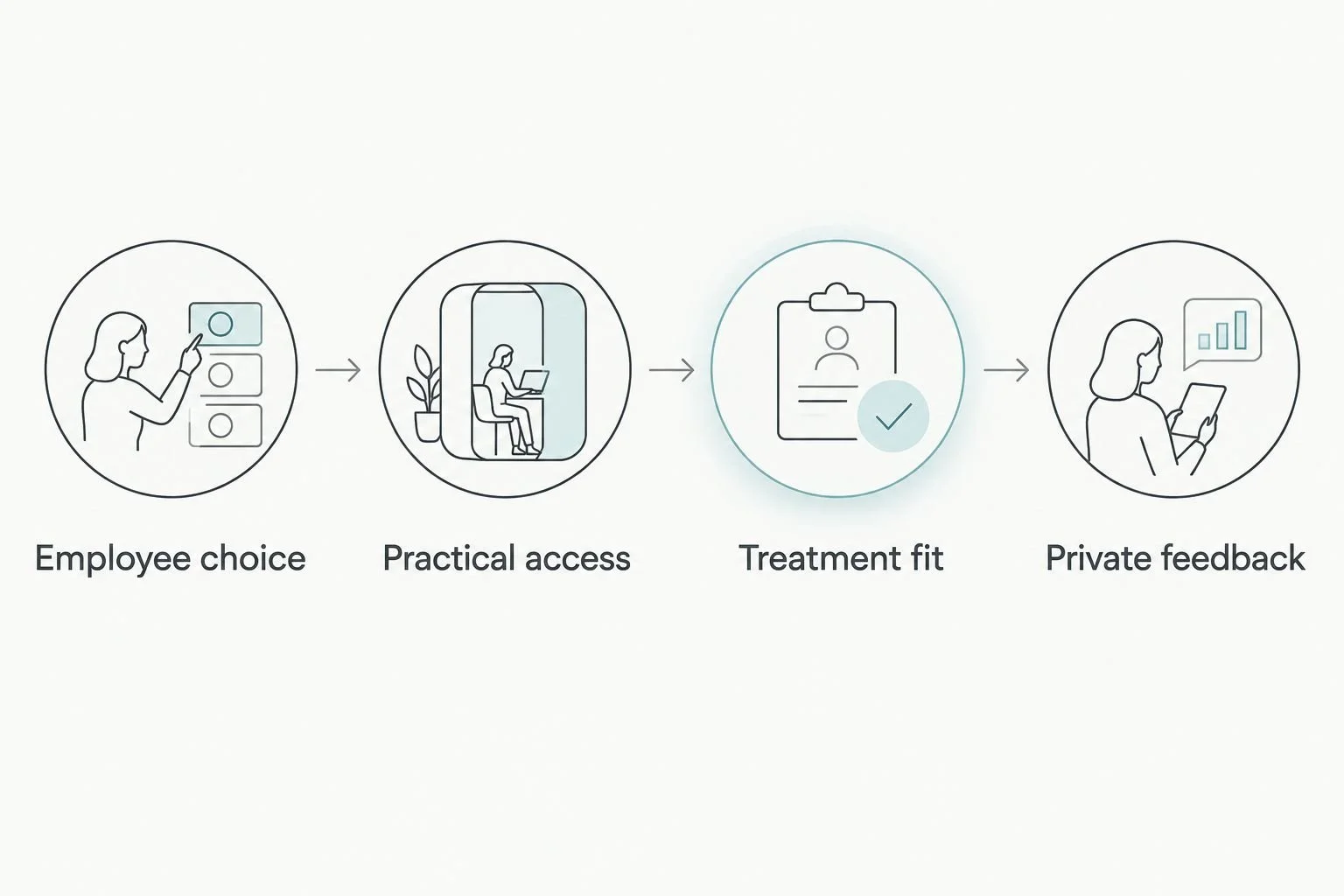
Choose treatments only after checking employee preferences and practical access.
Match the service to the employee's preference
Begin with a plain-language menu rather than a technology-led package. Explain what happens during each service, what information the provider needs, and which questions employees should ask privately before deciding.
Bodycentre Day Spa combines massage, facials, skincare, and advanced recovery services at its physical location in Costa Mesa. That gives local employees different service areas to explore without treating every wellness preference as a fitness goal. Confirm any employer arrangements directly; the service list alone does not establish a corporate package.
Bodycentre Day Spa is best for local teams seeking massage, facials, and advanced recovery at one Costa Mesa location. Its location also creates a practical limitation: an in-person benefit needs a separate alternative for employees who cannot comfortably travel there.
- Match massage to employees who want hands-on bodywork and accept touch.
- Match facials to employees seeking skin-focused personal care.
- Explain advanced recovery services individually rather than as one interchangeable category.
- Ask employees to discuss treatment suitability directly with the provider.
- Keep a non-treatment option available without requiring a medical explanation.
Explain advanced recovery without making health promises
An employee can make a better choice when the treatment name describes an experience rather than implying a guaranteed outcome. Put the explanation in your benefit materials and leave individualized suitability decisions to the provider and, when appropriate, the employee's clinician.
Bodycentre Day Spa's advanced recovery services include hyperbaric oxygen, PEMF, red light therapy, and altitude training. Hyperbaric oxygen involves oxygen in a pressurized environment. PEMF means pulsed electromagnetic field therapy; red light therapy exposes the body to red light; altitude training uses reduced-oxygen conditions during training.
These are different interventions, not a single recovery solution. Their inclusion on a service menu does not establish that every employee needs them or that they will improve attendance, energy, or work performance. Ask about the specific equipment, experience, screening, and limitations before choosing.
- Request a plain-English explanation of each treatment being considered.
- Ask who performs suitability screening and answers safety questions.
- Keep medical information between the employee and the appropriate provider.
- Avoid describing optional wellness services as cures or necessary care.
- Leave advanced recovery out when employees do not want it.
Run a small, voluntary pilot
Start with a simple sign-up process rather than a company-wide launch. A 4-week pilot is a practical planning example for 2026, not an evidence-based treatment schedule. Its purpose is to test administration and access, not to prove a health effect.
Document what employees can choose, how participation works, and who handles questions. Let employees contact the provider privately about the service itself. Managers need enough information to administer the benefit, not a record of an employee's treatment decisions.
Use the same access rules across departments. A benefit becomes confusing when one manager treats appointments as acceptable time away and another discourages them.
- State that participation is voluntary and separate from performance reviews.
- Explain the sign-up process before asking employees to participate.
- Name an internal contact for scheduling and access questions.
- Direct treatment and suitability questions to the provider.
- Record administrative problems without collecting clinical details.
The pilot should answer whether your arrangements work. Keep its feedback categories narrow enough that employees can respond without discussing their bodies, symptoms, or treatment experiences in detail.
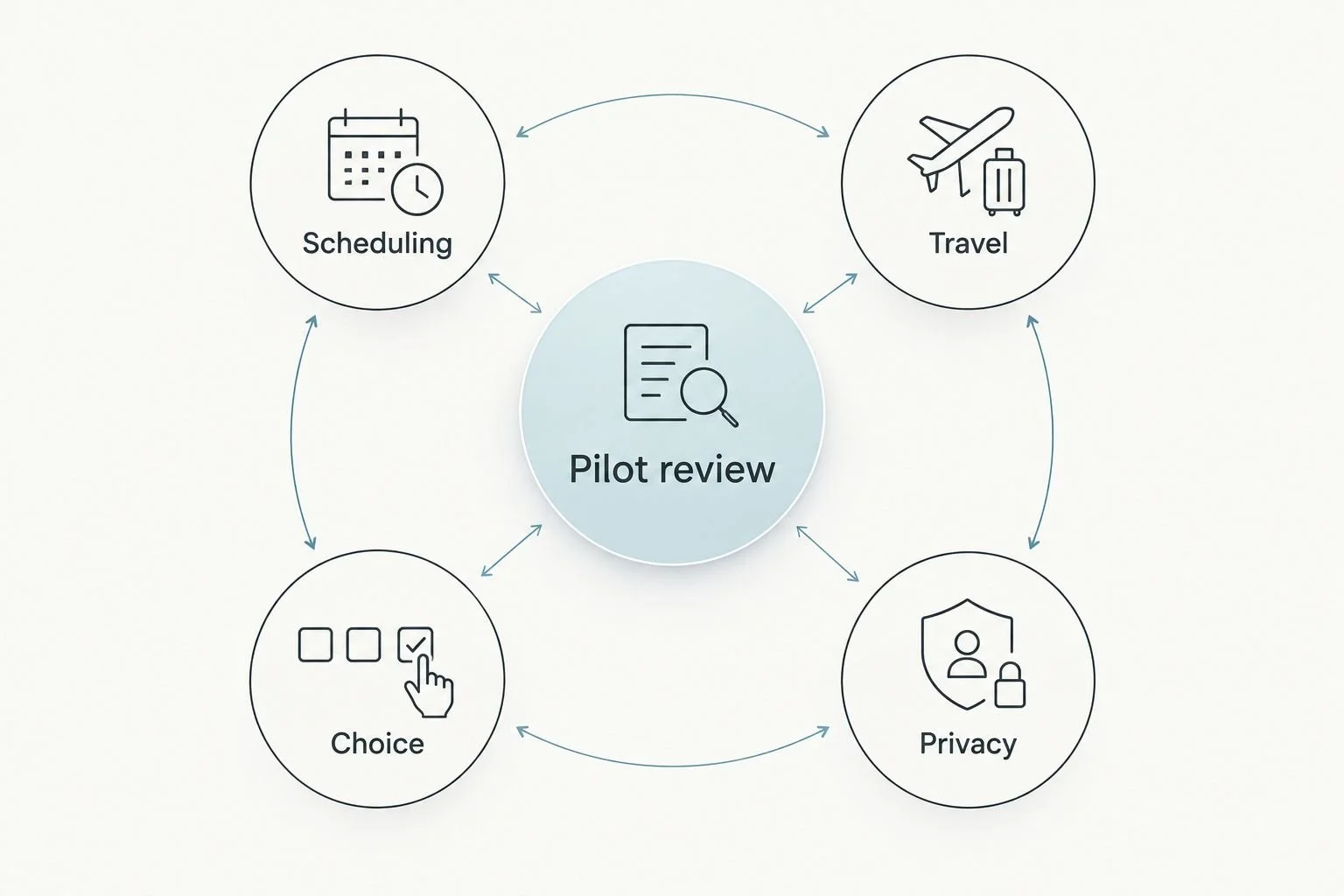
Review whether employees can use the benefit without sacrificing choice or privacy.
Measure access and revise the benefit
Use a basic spreadsheet to record invitations, voluntary sign-ups, and completed participation where collecting that information is appropriate. Review feedback in aggregate, and avoid reporting small groups in ways that identify individuals.
Your 2026 review should distinguish an administrative result from a health claim. Participation shows that someone used the benefit. It does not prove reduced pain, better mental health, improved productivity, or fewer absences.
Ask what prevented participation before interpreting low use as low interest. Travel, unclear instructions, unsuitable timing, and a lack of appealing choices are different problems with different fixes.
- Track whether employees understood how to participate.
- Ask whether scheduling and travel arrangements were workable.
- Check whether employees felt comfortable declining.
- Review whether the service choices reflected expressed preferences.
- Change one administrative barrier before expanding the program.
Compare options for your team
Choose by employee preference and practical fit, not by how advanced a treatment sounds. The options below address different interests; they are not ranked by medical effectiveness.
Workplace breaks and scheduling changes
- Best for: Teams needing easier daily access to downtime
- Practical advantage: Fits into the working day without a treatment appointment
- Key limitation: Does not provide individualized hands-on care
Massage therapy
- Best for: Employees who prefer hands-on bodywork
- Practical advantage: Offers a direct choice for a bodywork-focused visit
- Key limitation: Requires comfort with touch and individual suitability screening
Facials and skincare
- Best for: Employees seeking skin-focused personal care
- Practical advantage: Includes staff whose interests are not athletic or performance-based
- Key limitation: Does not replace assessment of a medical skin concern
Red light therapy
- Best for: Employees specifically interested in light-based services
- Practical advantage: Provides an option distinct from hands-on bodywork
- Key limitation: Suitability and intended use require a treatment-specific discussion
PEMF therapy
- Best for: Employees interested in electromagnetic-field-based wellness services
- Practical advantage: Adds a different type of optional recovery experience
- Key limitation: The treatment name alone does not establish an expected benefit
Hyperbaric oxygen
- Best for: Employees exploring a pressurized oxygen service
- Practical advantage: Offers a distinct experience for an interested participant
- Key limitation: Requires careful screening and a clear explanation of the setting
Altitude training
- Best for: Employees with a specific interest in training under reduced-oxygen conditions
- Practical advantage: Connects to a defined training preference
- Key limitation: Is not a general relaxation substitute for the whole team
For employers considering Bodycentre Day Spa for corporate wellness programs, the useful distinction is the combination of spa care and advanced recovery. The boundary is equally clear: a shared location does not make every service suitable for every person or confirm an employer-specific offering.
Common mistakes employers make
Treating recovery as a reward for overwork
Do not frame massage or recovery appointments as compensation for routinely missed breaks. Fix the working conditions you control, then offer personal care as an additional choice. Employees should not have to demonstrate exhaustion to qualify.
Making one treatment the team activity
A shared facial, massage, or equipment-based session is not automatically an inclusive event. Touch preferences, privacy, personal interests, and suitability differ. Offer individual choice instead of asking employees to opt out publicly.
Calling every service performance optimization
Facials and skincare belong in the menu without a productivity justification. Likewise, an employee interested in altitude training needs different information from someone seeking quiet personal time. Describe the actual service rather than assigning everyone the same goal.
Confusing local coverage with additional locations
Bodycentre Day Spa is physically located in Costa Mesa. Employees from Newport Beach, Irvine, and Huntington Beach can be considered in your access planning, but do not describe those cities as spa locations. Check the journey from each employee's actual starting point.
Turning feedback into health surveillance
Do not ask managers to collect diagnoses, before-and-after symptoms, or explanations for declining a treatment. Ask whether the benefit was understandable, accessible, and worth retaining. Keep personal treatment conversations outside the management reporting chain.
FAQ
What's the best way to add recovery treatments to corporate wellness programs?
Start with employee preferences, practical access, and voluntary participation. Add treatment choices only after explaining scheduling, privacy, and how employees can select an alternative.
Should every employee receive the same spa treatment?
No; employees should have a meaningful choice rather than one mandatory treatment. Comfort with touch, skincare interests, training goals, and individual suitability differ.
Are facials relevant to a corporate wellness benefit?
Yes, facials fit a benefit that includes skin-focused personal care. Describe them as an optional service, not as a treatment for workplace stress or a promise of improved performance.
Is biohacking better than massage for employees?
Neither category is universally better for employees. Massage is hands-on bodywork, while biohacking covers different approaches that require their own explanations and suitability discussions.
Can employees from nearby Orange County cities participate?
Your employer benefit can account for employees in Costa Mesa, Newport Beach, Irvine, and Huntington Beach. The physical spa location discussed here is Costa Mesa, so assess travel and scheduling before making arrangements.
What should an employer know about an employee's treatment?
An employer should collect only the information needed to administer the benefit. Employees should discuss medical history, treatment suitability, and personal concerns privately with the appropriate provider.
How do you know whether a recovery benefit is working?
Review participation, access barriers, employee choice, and administrative feedback. Those measures describe benefit use; they do not establish medical improvements or productivity gains.
One last thing
The most useful change to your 2026 plan might be permission to choose something else. An employee who prefers a facial, a workplace break, or no treatment is giving you information about benefit design—not failing to engage with wellness. Make that choice easy and private before inviting anyone to book.