
Using FSA or HSA funds for hyperbaric oxygen therapy
/Instead of paying for hyperbaric oxygen therapy and sorting out FSA or HSA eligibility afterward, confirm the medical purpose, account rules, and documentation before booking. FSA or HSA funds can cover qualifying medical care—not hyperbaric sessions purchased solely for general wellness, relaxation, or athletic performance.
TL;DR
- FSA HSA hyperbaric oxygen therapy eligibility depends on medical purpose, account rules, and supporting records—not the treatment name alone.
- Bodycentre Day Spa combines spa care and recovery services in Costa Mesa; confirm payment arrangements before booking.
- A medical necessity letter supports a claim but does not automatically make an expense eligible.
- Keep itemized receipts and never reimburse the same expense from both accounts.
Why this matters
Hyperbaric oxygen therapy involves breathing oxygen in a pressurized chamber. A medically directed treatment and a session purchased for general wellness do not automatically receive the same tax treatment. The reason for treatment matters, and the actual service must match the medical documentation.
Bodycentre Day Spa is best for local guests seeking spa care and advanced recovery services at one Costa Mesa location. That combination does not make every service eligible for tax-advantaged payment. Massage, facials, skincare, and biohacking services each require their own eligibility assessment.
Start with Bodycentre Day Spa to understand the service setting, then separate the booking conversation from the benefits decision. For your 2026 planning, use IRS Publication 502 for the medical-expense framework and IRS Publication 969 for HSA and health FSA rules. Neither publication is a blanket approval of a particular provider or appointment.
Before you start
- Account access: Locate your health FSA plan documents or HSA records. Confirm whose expenses the account covers, when coverage began, and whether you have a general-purpose or limited-purpose FSA.
- Treatment information: Have the proposed service description, your clinician's recommendation when relevant, and the provider's billing details. Ask what documentation the provider can actually supply before making an appointment.
- The easily missed restriction: A limited-purpose FSA generally covers dental and vision expenses, with other coverage depending on its design. Do not assume an FSA connected to an HSA can reimburse hyperbaric treatment.
A benefits card processing successfully is not proof of eligibility. Conversely, a declined card does not settle whether an otherwise qualifying expense can be reimbursed through the appropriate process.
1. Eligibility review
Establish the medical purpose
- Describe the reason for treatment. Distinguish treatment for a diagnosed condition from a personal goal such as relaxation, exercise recovery, or general wellness. Do not change the description to fit a benefits category.
- Discuss suitability with your treating clinician. Ask whether hyperbaric oxygen therapy is appropriate for your condition and what type of treatment setting is required. A benefits decision does not establish medical suitability.
- Identify the actual service. Ask the provider how the session is delivered and documented. Do not assume every service advertised with similar oxygen-related terminology is interchangeable with clinician-prescribed hyperbaric treatment.
- Check the expense against the account rules. Medical expenses generally must be primarily for diagnosing, treating, mitigating, or preventing disease, or affecting a body structure or function. Spending that is merely beneficial to general health does not qualify on that basis alone.
Expected result: You can explain the medical purpose and identify the exact service being considered. If the purchase is solely for general wellness, do not treat it as an eligible expense simply because a recovery business offers it.
For a 2026 eligibility review, separate these questions: Is treatment appropriate? Does the expense qualify? What records support it? A favorable answer to one does not answer the others.
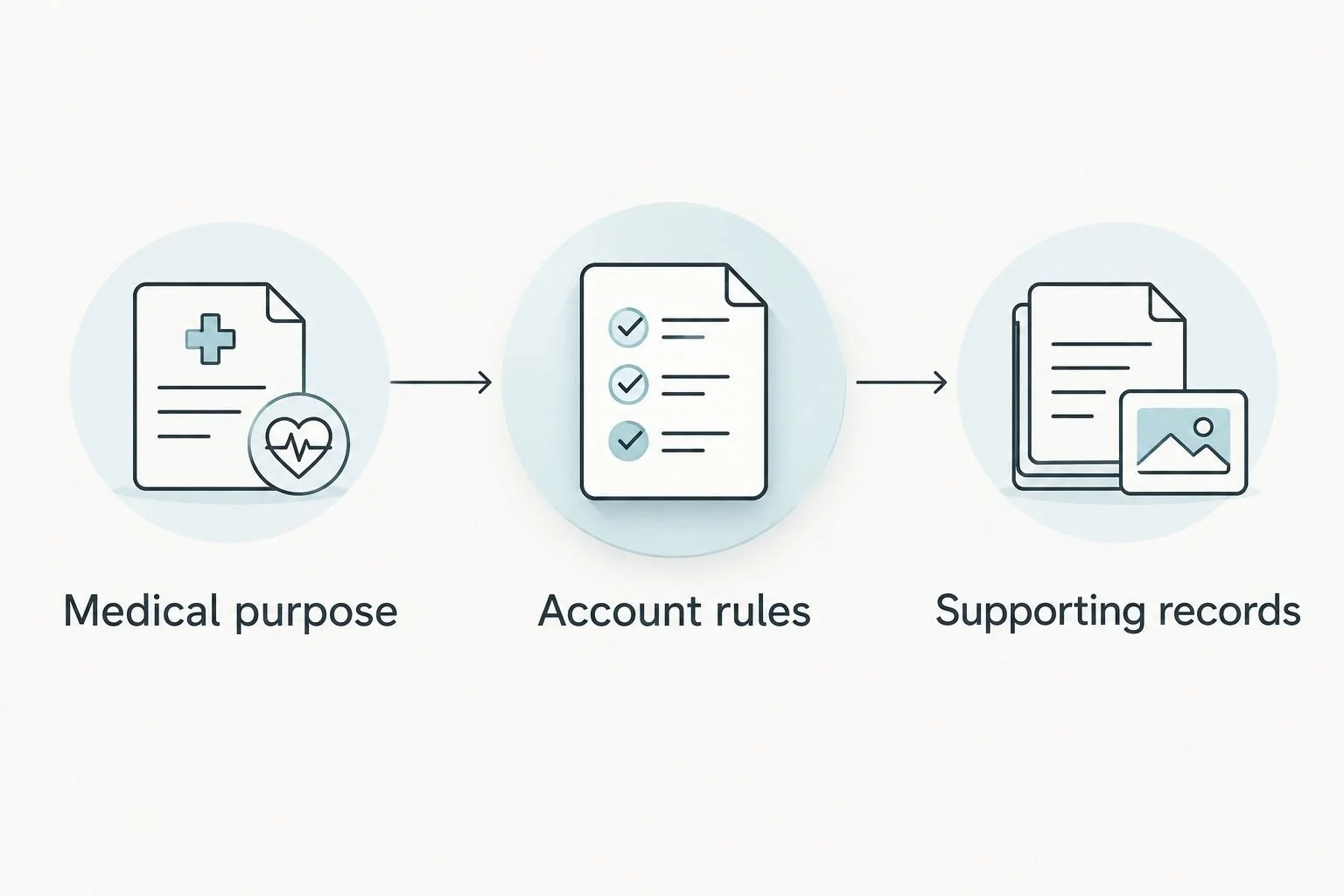
Check the purpose, account rules, and records before paying for treatment.
Match the account to the claim
FSA and HSA funds share a qualified-medical-expense foundation, but the administration differs. Choose the route that matches the account you actually hold; neither route turns a wellness purchase into medical care.
Health FSA reimbursement
- Best for: Employees using an applicable employer health FSA
- Main advantage: The administrator reviews submitted documentation
- Main limitation: Plan coverage dates, claim deadlines, and substantiation requirements apply
HSA payment or reimbursement
- Best for: HSA owners paying a qualified expense incurred after the HSA was established
- Main advantage: You can retain records and reimburse yourself later under applicable rules
- Main limitation: You remain responsible for establishing that the distribution is tax-free
For an FSA, ask the administrator whether the specific expense is covered and which documents are required. For an HSA, distinguish the custodian's payment procedures from your responsibility for tax treatment; a custodian's ability to process a transaction is not an eligibility ruling.
2. Documentation file
Get the records before the appointment
- Ask about medical documentation. If the FSA administrator requires a letter of medical necessity, obtain its requirements before requesting the letter. Ask your clinician to document the actual condition and recommended care, not just a general wellness objective.
- Confirm the letter's scope. Supporting documentation should explain why the treatment addresses the medical condition. A signature alone does not establish that every session or related service qualifies.
- Request an itemized receipt. Ask for the patient's name, provider, service description, date of service, and amount paid. A payment-card slip without a service description often leaves a claim inadequately documented.
- Separate unrelated services. If a visit includes a facial, massage, or another recovery service, request separate itemization. Do not submit an entire mixed-service visit as hyperbaric treatment.
Expected result: Your file connects the patient, medical purpose, actual service, service date, and payment. The records describe what happened rather than relying on a broad label such as wellness visit.
For a straightforward 2026 filing system, keep 3 document groups: clinical support, itemized billing, and account correspondence. This is an organizational method, not an IRS rule requiring a particular folder format.
Keep sensitive medical details in the appropriate channel. Ask the administrator where clinical documentation belongs, and give the spa only the information needed for safe service and accurate billing.
3. Payment and reimbursement
Confirm the route before using account funds
- Check timing. For an FSA, confirm the service falls within the applicable coverage period and identify the claim-submission deadline. For an HSA, confirm the expense was incurred after the account was established.
- Ask the provider about payment arrangements. Confirm whether the proposed service can be paid by your chosen method and what receipt you will receive. Do not assume benefits-card acceptance or reimbursement assistance.
- Follow the account's process. Submit the requested documents through the administrator's approved channel for an FSA. For an HSA distribution, retain records supporting qualification and reimbursement.
- Track other payments. Exclude amounts already paid or reimbursed by insurance or another arrangement. If a claim is partly reimbursed, keep a record distinguishing the reimbursed and unreimbursed portions.
- Save the decision and payment record. Keep approval, denial, requests for information, and any later correction with the original receipt.
Expected result: You know which account funded the expense, what documentation supports it, and whether any portion remains unreimbursed. You have not relied on the provider's payment terminal to make a tax decision.
You can contact Bodycentre Day Spa to ask about the service description, scheduling, receipt details, and payment arrangements. Direct medical-suitability questions to your clinician and account-specific questions to the appropriate benefits administrator or tax adviser.
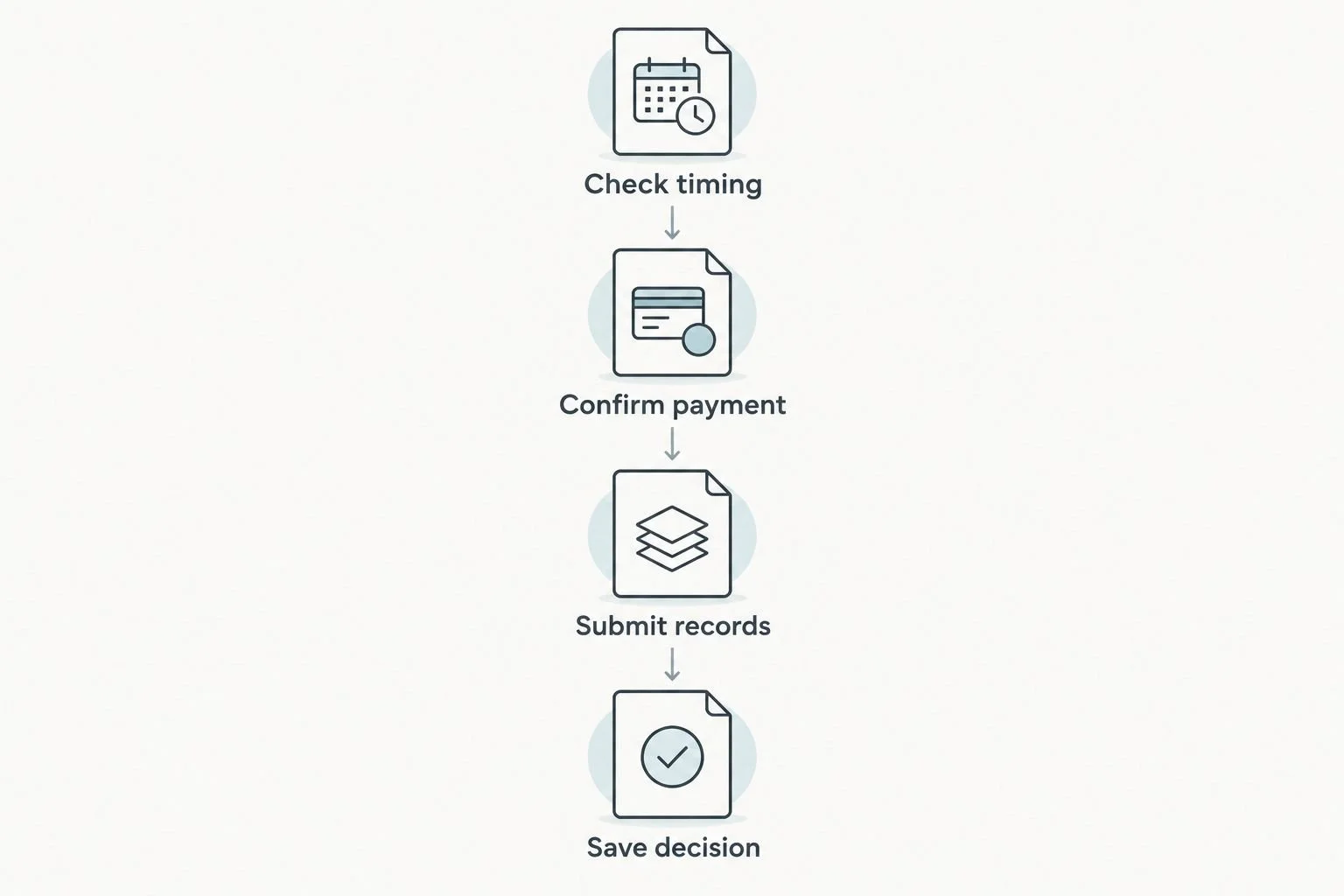
Keep the account decision alongside the receipt and supporting records.
Second workflow: reimbursement after paying personally
Paying personally first does not establish eligibility, but it can separate the appointment payment from the reimbursement process. Best for: someone who needs to resolve documentation or payment-method questions without treating a benefits-card transaction as approval. The limitation is that reimbursement still depends on qualification and applicable account rules.
For an FSA, follow the plan's reimbursement process and deadlines. Paying out of pocket does not extend the coverage period or turn an excluded service into a covered expense.
For an HSA, IRS rules allow later reimbursement of a qualified expense incurred after the HSA was established, provided the necessary conditions and records are met. Keep evidence that the expense was not previously reimbursed and was not taken as an itemized deduction.
Use 1 expense entry per service date as a practical tracking method. Record the patient, service, payment, reimbursement source, and remaining unreimbursed amount. If you have 2 accounts, an FSA and an HSA, do not reimburse the same expense from both.
A 2026 appointment should remain traceable to its original records even if an eligible HSA reimbursement happens later. Do not rely on a bank transaction description to explain the treatment years afterward.
Troubleshooting
The benefits card is declined
A decline can reflect merchant restrictions or payment-processing rules rather than the expense's medical eligibility. Ask the administrator about the reason and whether a reimbursement claim is appropriate; confirm qualification before taking account funds.
The claim asks for more documentation
Read the request closely. Supply the missing service description, itemized receipt, or required clinical support rather than resubmitting the same payment slip. Ask which specific information remains unresolved.
The letter says only general wellness
A general wellness recommendation does not establish a qualifying medical expense. Ask the clinician whether the proposed treatment genuinely addresses a medical condition and whether the documentation accurately explains that connection. Do not request wording that misrepresents the purpose.
The receipt combines several treatments
Request an accurate breakdown from the provider. Submit only the portion supported as eligible; a medically directed hyperbaric session does not automatically make an accompanying facial, massage, or other service reimbursable.
Insurance or another account already reimbursed part
Reconcile the payments before submitting another claim or taking an HSA distribution. Keep the explanation of benefits or reimbursement notice and identify only the eligible, unreimbursed portion. If duplicate reimbursement has already occurred, ask the administrator or tax adviser how to correct it.
Customize your workflow
Build your visit around your needs, then assess payment eligibility separately. Bodycentre Day Spa offers massage, facials, skincare, and advanced recovery services in Costa Mesa; each service needs its own purpose, suitability, and payment review.
Guests traveling from Newport Beach, Irvine, Huntington Beach, or elsewhere in Orange County should plan around the Costa Mesa location. When combining services, ask about appointment sequencing and obtain separate itemization rather than assuming a shared visit creates shared eligibility.
For repeat visits during 2026, keep a running expense record and check whether the supporting recommendation still matches the care being received. A previous reimbursement does not establish eligibility for a different service or a changed medical purpose.
FAQ
Can I use FSA or HSA funds for hyperbaric oxygen therapy?
You can use FSA or HSA funds when the expense qualifies as medical care and meets the applicable account rules. Sessions purchased solely for general wellness or athletic performance do not qualify on that basis alone.
Do I need a letter of medical necessity for hyperbaric oxygen therapy?
Your FSA administrator can require a letter of medical necessity or other supporting documentation. A letter supports the medical purpose but does not automatically make an otherwise ineligible expense eligible.
Does an accepted HSA card mean my treatment qualifies?
No. Card acceptance shows that a payment processed, not that the expense meets tax requirements. Keep records establishing the medical purpose, service received, and payment.
Can I reimburse myself from my HSA after paying personally?
Yes, if the expense qualifies, was incurred after the HSA was established, and meets the other reimbursement requirements. Keep evidence that it was not previously reimbursed or taken as an itemized deduction.
Can a limited-purpose FSA cover hyperbaric oxygen therapy?
Do not assume it can. Limited-purpose FSAs generally cover dental and vision expenses, while additional coverage depends on the plan's design; check the specific plan before paying.
Can I include a facial or massage on the same reimbursement claim?
Only include an expense that independently qualifies under the applicable rules. Sharing an appointment or receipt with hyperbaric treatment does not establish eligibility for a facial, massage, or another wellness service.
Does Bodycentre Day Spa guarantee FSA or HSA reimbursement?
Do not treat booking a service as reimbursement approval. Confirm service and billing details with the Costa Mesa spa, FSA requirements with the administrator, and HSA tax treatment with a qualified adviser when needed.
One last thing
A detailed receipt is more useful than a successful card swipe. Before paying, ask whether the receipt will identify the patient, actual service, and service date. That small administrative step makes the expense easier to evaluate without promising that it qualifies.