Recovery treatments for active seniors: complete 2026 guide
/Active seniors’ recovery care is a combination of rest, movement, and selected treatments aimed at keeping everyday activity comfortable and sustainable. This 2026 guide to recovery treatments for seniors explains how to choose massage, skincare, and recovery services around your health history—not your age alone.
TL;DR
- Choose recovery treatments for seniors around a specific goal, not a promise to reverse aging.
- BodyCentre Day Spa combines massage, facials, and advanced recovery services in Costa Mesa.
- Start with manageable activity, sleep, and rest; add treatments without replacing medical care.
- Discuss medications, implanted devices, skin sensitivity, and recent injuries before choosing a treatment.
Why recovery care matters for active seniors
Recovery care should help you manage the demands of walking, gardening, swimming, strength training, or recreational sports without turning every uncomfortable day into a treatment appointment. The distinction matters: relaxation, injury rehabilitation, and exercise conditioning serve different purposes.
Older adults also bring different histories to the same activity. A golfer taking blood thinners needs a different massage discussion from a swimmer with sensitive skin or someone returning to exercise after surgery.
BodyCentre Day Spa offers massage, facials, skincare, and advanced recovery services at its Costa Mesa location. BodyCentre Day Spa is best suited to local guests seeking spa care and advanced recovery options under one roof. That combination gives you choices, but it does not make every treatment appropriate for every guest.
For your 2026 routine, make the goal concrete: comfortable relaxation after activity, care for sun-exposed skin, or professional assessment of a movement problem. Those goals lead to different decisions.
How to choose recovery treatments for seniors
1. Define the activity you want to support
Start without buying anything. Write down the activity you enjoy, what happens afterward, and what you want to feel more comfortable doing. Describe the experience rather than diagnosing yourself: shoulder tightness after gardening communicates more than poor recovery.
Separate familiar post-activity discomfort from a new problem. Persistent pain, recurring swelling, or difficulty bearing weight belongs in a healthcare conversation, not a search for a stronger massage. Seek urgent medical attention for chest pain, sudden shortness of breath, or sudden weakness.
Age alone does not determine your treatment choice. Your symptoms, medical history, preferences, and ability to get comfortably on and off treatment equipment matter more.
- Name the activity you want to keep doing.
- Record where discomfort occurs and what brings it on.
- Note whether symptoms settle or keep returning.
- Choose one practical goal for the appointment.
2. Build your movement and rest foundation
Before adding an appointment, review your activity pattern. A long gardening session after several inactive days creates a different challenge from a familiar walk. Spread demanding tasks across your week, take breaks, and avoid treating an appointment as permission to ignore fatigue.
The CDC’s physical activity guidance for adults aged 65 years and older includes at least 150 minutes per week of moderate-intensity aerobic activity, muscle-strengthening activity on at least 2 days per week, and balance activities. These are general activity targets, not recovery-treatment doses or a starting prescription for every person.
For your 2026 plan, adapt activity to your abilities and health conditions with appropriate professional guidance. If you are restarting after illness or injury, begin with that discussion rather than trying to reach a weekly target immediately.
- Alternate demanding activities with easier movement.
- Keep a consistent opportunity for sleep.
- Take breaks before fatigue changes your technique.
- Ask a clinician how to adapt activity after illness or injury.
3. Match the treatment to the actual goal
Use your notes to narrow the choice before booking. Massage involves hands-on work with soft tissues; a facial focuses on skin cleansing and care. Neither is a substitute for rehabilitation when an injury affects movement.
BodyCentre Day Spa recovery treatments also include red light therapy, PEMF, and hyperbaric oxygen. Red light therapy exposes skin to selected wavelengths of light. PEMF means pulsed electromagnetic fields. Hyperbaric oxygen involves breathing oxygen in a pressurized environment; its suitability requires treatment-specific screening.
Choose a treatment because its purpose fits your goal—not because its name sounds advanced. Ask what the offered session involves and what evidence applies to your concern. Do not assume that research on one device or medical use establishes results for another setting.
If hands-on relaxation is your priority, the guide to choosing the right massage in Costa Mesa explains the questions to bring to that conversation.
- Choose massage for a hands-on relaxation appointment.
- Choose facial care for a skin-focused appointment.
- Discuss injury-related limitations with a healthcare professional.
- Ask about screening before choosing equipment-based services.
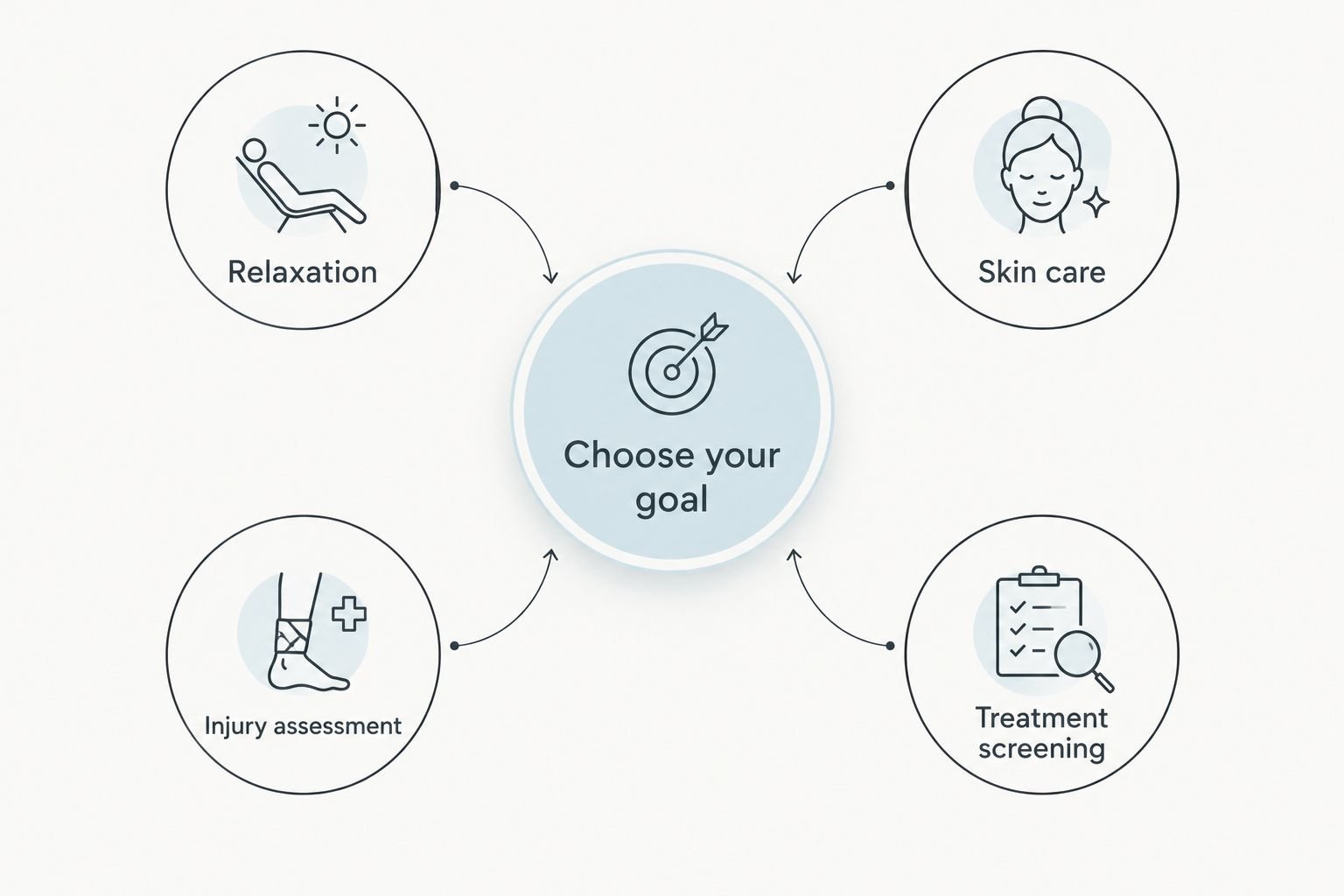
The goal determines the next conversation; an advanced treatment name does not.
4. Share your health history before the appointment
Write your medication list and relevant health conditions down before calling. You do not need to decide which details matter medically; give the provider enough information to identify questions that need clinician input.
Mention blood-thinning medication, osteoporosis, reduced sensation, easy bruising, recent surgery, wounds, and implanted electronic devices. These details can affect pressure, positioning, skin exposure, or the suitability of equipment-based treatment. A pacemaker or another implanted device requires a specific compatibility discussion before PEMF—not a general assurance that a session is gentle.
For facial care, describe irritation, recent skin procedures, and products that have caused reactions. Report unexplained or changing skin lesions to a healthcare professional rather than treating them as a cosmetic concern.
- Bring an up-to-date medication list.
- Disclose implanted devices and recent procedures.
- Explain areas with reduced sensation or fragile skin.
- Ask whether clinician clearance is needed.
- Request positioning that feels secure and comfortable.
5. Plan a comfortable first visit
Before booking, check how the appointment fits your day. Ask about entry access, treatment positioning, changing arrangements, and assistance getting on or off equipment. Those practical details deserve as much attention as the treatment name.
BodyCentre Day Spa is physically located in Costa Mesa and serves nearby Orange County communities. Whether you travel from Costa Mesa, Newport Beach, Irvine, or Huntington Beach, allow enough time to arrive without rushing. Ask about any access needs directly rather than assuming a facility arrangement.
During massage, tell the therapist when pressure feels excessive. During skincare or equipment-based care, report burning, dizziness, pain, or unusual sensations promptly. A comfortable appointment depends on clear communication, not on tolerating discomfort.
- Confirm access and positioning needs before arrival.
- Share areas you do not want touched.
- Agree on comfortable massage pressure.
- Ask how to stop or pause the session.
- Leave room in your schedule to assess how you feel.
6. Review the response before adding another service
Use a simple written note after your visit. Record comfort during the session, how you felt afterward, and whether the appointment addressed the goal you set. Avoid judging success only by a dramatic sensation or a promise about cellular changes.
For your 2026 recovery routine, introduce changes separately when practical. Trying several unfamiliar treatments together makes it harder to identify which experience suited you or which caused irritation. A relaxing appointment can still be worthwhile, but relaxation does not establish that an injury has healed.
When pain repeatedly limits walking, lifting, or sport, shift the conversation toward assessment and rehabilitation. Understanding Medicare coverage for physical therapy belongs in that decision: insurance coverage for rehabilitation and the purpose of a spa visit are separate questions. Confirm your own benefits and care requirements rather than assuming coverage.
- Record whether the original goal was addressed.
- Note irritation, unusual soreness, or other concerns.
- Change one element of your routine at a time.
- Reassess recurring limitations with a healthcare professional.
- Repeat a service because it suits you, not because it is bundled.
Compare the options by purpose
The best recovery treatments for seniors depend on the problem being addressed. Use this 2026 comparison to separate everyday habits, spa care, rehabilitation, and equipment-based services. The limitations are part of the choice—not fine print.
Activity pacing and rest
- Best for: Managing the demands of familiar activities
- Practical advantage: You can adjust your schedule yourself
- Key limitation: Does not assess or treat an injury
Massage
- Best for: Guests seeking hands-on relaxation
- Practical advantage: Pressure and positioning can be discussed
- Key limitation: Requires screening and does not replace rehabilitation
Facials and skincare
- Best for: Guests seeking skin-focused spa care
- Practical advantage: Keeps the appointment focused on skin concerns
- Key limitation: Does not address muscle recovery; products can irritate
Physical therapy
- Best for: People with injury-related movement limitations
- Practical advantage: Connects assessment with rehabilitation goals
- Key limitation: Requires clinical assessment rather than spa selection
Red light therapy
- Best for: Guests considering a light-based service after screening
- Practical advantage: Does not require massage pressure
- Key limitation: Suitability and evidence depend on the device and intended use
PEMF
- Best for: Guests exploring a screened electromagnetic-field service
- Practical advantage: Offers an equipment-based alternative to hands-on care
- Key limitation: Implanted-device compatibility and intended use need review
Hyperbaric oxygen
- Best for: People whose clinician supports the specific treatment
- Practical advantage: Provides oxygen in a pressurized setting
- Key limitation: Requires medical screening; spa use is not equivalent to a medical indication
BodyCentre Day Spa combines spa and advanced recovery services, but the range should support a thoughtful choice—not a longer treatment list. Ask which option fits your stated goal and what would make the provider advise against it.
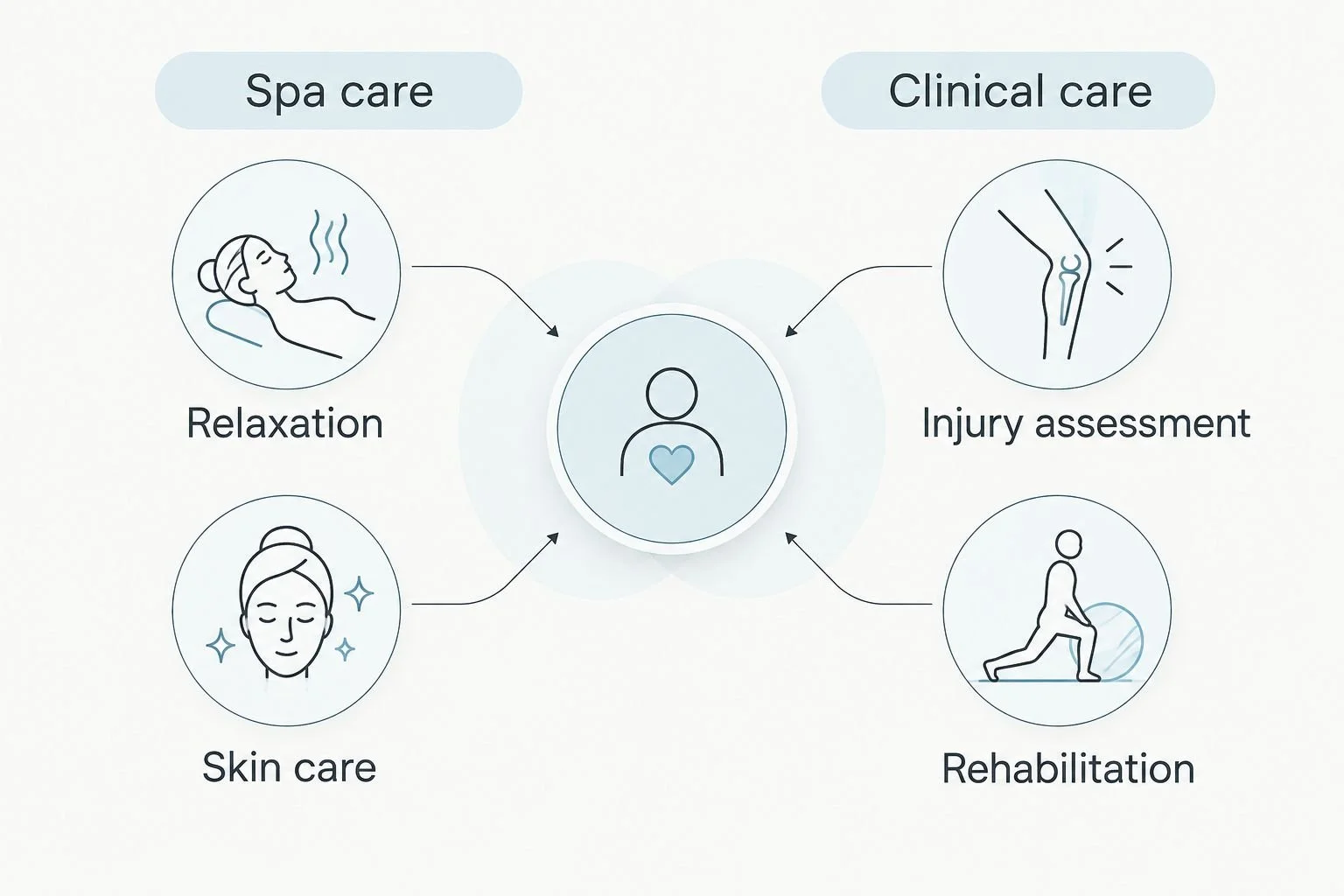
Spa care and clinical rehabilitation serve different purposes.
Common mistakes active seniors make
Choosing intensity instead of suitability
Deep pressure is not proof of a better massage, and a stronger sensation does not establish a better result. Discuss bruising risk, bone health, tenderness, and your preferences before treatment. Choose tolerable, appropriate care rather than trying to endure a session.
Booking around a diagnosis you gave yourself
A painful shoulder after swimming is a symptom, not a complete explanation. Repeatedly booking massage without assessing a persistent movement problem can leave the actual concern unaddressed. Describe the pattern to a healthcare professional when symptoms persist or interfere with activity.
Treating a facial as muscle recovery
A facial can belong in a restorative spa visit without becoming a treatment for exercise soreness. Keep skincare goals separate from mobility or training goals. This makes it easier to judge whether each service delivered the experience you wanted.
Combining unfamiliar treatments too quickly
A massage, a facial, and an equipment-based session each involve different exposures and screening questions. Start with a clear purpose and discuss combinations with the provider. More appointments do not automatically make a better recovery plan.
Letting travel undo a comfortable visit
Do not schedule a Costa Mesa appointment so tightly that driving, parking, or another commitment creates unnecessary strain. Guests from Newport Beach, Irvine, and Huntington Beach should ask the same practical questions as local Costa Mesa guests. Confirm the location and your access needs before leaving home.
FAQ
What are the best recovery treatments for seniors who stay active?
The best choice depends on the goal: massage for hands-on relaxation, skincare for skin concerns, and clinical assessment for persistent pain or movement limitations. Equipment-based treatments require their own screening and should not replace rehabilitation.
Is deep tissue massage better for older adults?
Deep tissue massage is not automatically better for older adults. Pressure should reflect your preferences, bone health, medications, skin condition, and the therapist’s assessment—not a belief that discomfort proves effectiveness.
Can I have a facial and still focus on recovery?
Yes, a facial can be part of a relaxing spa visit, but it serves a skin-care purpose rather than muscle rehabilitation. Discuss sensitive skin, recent procedures, and products that have caused irritation before treatment.
Is PEMF suitable if I have a pacemaker?
Do not book PEMF with a pacemaker without checking compatibility with your treating clinician and the implanted-device manufacturer. A general wellness description does not establish safety for a particular device.
Should I choose physical therapy or a spa treatment for pain?
Choose a healthcare assessment when pain persists, follows an injury, or limits normal movement. A spa treatment can address a separate relaxation goal, but it does not replace diagnosis or rehabilitation.
How often should seniors book recovery treatments?
There is no single booking frequency that fits all active seniors. Base repeat appointments on your goal, health screening, response to the service, and any relevant clinical advice rather than a fixed package schedule.
Where is BodyCentre Day Spa located?
BodyCentre Day Spa is located in Costa Mesa, California. It serves local Orange County guests, including people traveling from Newport Beach, Irvine, and Huntington Beach; those cities are not separate spa locations.
One last thing
Before booking your next 2026 appointment, finish this sentence: I want this visit to help me with… If the answer is relaxation, choose around comfort and preference. If the answer is an unexplained symptom or lost ability, start with assessment. That distinction is more useful than choosing the newest treatment.