
Wellness treatments for women in perimenopause: complete 2026 guide
/Perimenopause wellness care is supportive self-care aimed at improving everyday comfort during the transition toward menopause. The most useful wellness treatments for perimenopause match a specific need—muscle tension, skin discomfort, or relaxation—while medical care addresses disruptive symptoms such as hot flashes and persistent sleep problems.
TL;DR
- Choose wellness treatments for perimenopause by symptom, not by promises of hormone balancing.
- Bodycentre Day Spa suits local women seeking massage, facials, and recovery services in Costa Mesa—not medical menopause treatment.
- Massage supports relaxation; gentle skincare addresses comfort; neither replaces assessment of persistent symptoms.
- Treat red light therapy and PEMF as optional services, not established treatments for perimenopause.
Why wellness care matters for women in perimenopause
Perimenopause can bring changing menstrual patterns, hot flashes, disrupted sleep, and vaginal or urinary symptoms. Your needs can also change between appointments: a warm treatment room feels different when you are already experiencing heat sensitivity.
Choose care around today's discomfort, not a fixed idea of what women in perimenopause need. Massage, facials, and recovery appointments serve different purposes. None should be presented as a way to diagnose perimenopause or restore hormone levels.
Bodycentre Day Spa combines traditional spa care with advanced recovery services at its Costa Mesa location. For your 2026 wellness plan, keep the distinction clear: a relaxing appointment is supportive care, while persistent symptoms deserve a medical conversation.
Women traveling from Costa Mesa, Newport Beach, Irvine, or Huntington Beach should consider the whole visit, including travel and the trip home. The physical spa is in Costa Mesa; nearby Orange County cities are places guests travel from, not additional locations.
Build your perimenopause wellness plan
Identify the symptom you want to address
Start with a simple paper notebook or phone note. Record what bothers you, when it happens, and whether it affects sleep, work, exercise, or relationships. You do not need a device or a paid program to describe a pattern clearly.
Separate comfort goals from symptoms that need assessment. Shoulder tension after desk work is a different decision from new heart palpitations or unusually heavy bleeding. A spa practitioner cannot determine whether a symptom comes from perimenopause, another condition, or medication.
Use these categories when choosing your next move:
- Muscle tension: identify the area and describe what makes it worse.
- Skin comfort: record dryness, stinging, or reactions to current products.
- Hot flashes: note timing, sleep disruption, and accompanying symptoms.
- Daily function: identify which symptom most interferes with your routine.
A symptom-first plan keeps different needs separate rather than treating every change as a reason to book another service.
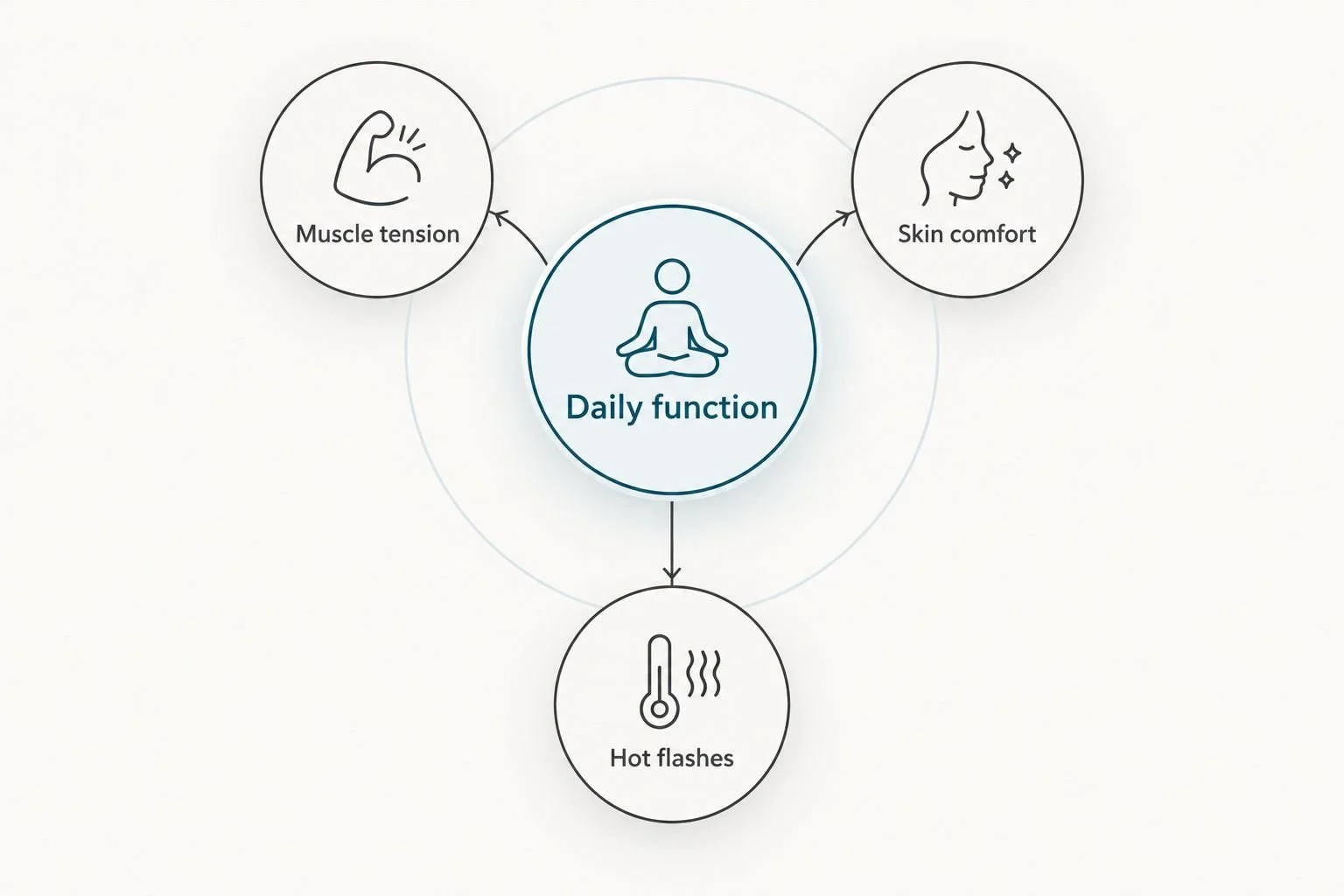
Choose the next step by the symptom, not by the treatment name.
Build a daily foundation before adding appointments
Begin with actions you control: a consistent sleep schedule, a comfortable bedroom temperature, regular movement, and straightforward skincare. These habits do not eliminate every perimenopause symptom. They give you a practical baseline against which to judge additional care.
General adult physical activity guidance recommends at least 150 minutes of moderate-intensity activity per week, plus muscle-strengthening activity on 2 days per week. These are public-health targets, not a starting prescription for every individual; adapt activity to your health, current capacity, and clinician's advice.
For your 2026 routine, make the baseline repeatable rather than elaborate. Poor sleep or pain is a reason to adjust exercise and seek guidance, not to force a demanding session.
- Keep your wake-up time consistent where practical.
- Choose movement you can repeat without aggravating symptoms.
- Use a gentle cleanser, moisturizer, and sun protection.
- Record whether alcohol, caffeine, or room temperature affects your sleep.
Choose massage for tension and relaxation
Try comfortable movement breaks and gentle stretching before assuming you need an appointment. If you want hands-on care, massage is an option for relaxation and muscular comfort—not a treatment for hormonal changes.
Bodycentre Day Spa offers massage therapy alongside its skincare and recovery services. Bodycentre Day Spa is best for local women seeking spa and recovery care in Costa Mesa, not medical menopause treatment. Its combination of services provides choices, but the right appointment still depends on your goal and health history.
Pressure is not a measure of effectiveness. Ask for an approach you find comfortable, especially if you have tenderness, easy bruising, or dislike heat. The guide to choosing the right massage in Costa Mesa can help you prepare questions before booking.
- Describe the location and character of your tension.
- Request adjustable pressure and speak up during treatment.
- Ask about room temperature, heated equipment, and draping.
- Disclose relevant conditions, medications, injuries, and recent procedures.
Match facials and skincare to current tolerance
Start by simplifying your home routine when products sting or irritate your skin. Adding several exfoliants or active ingredients at once makes it harder to identify the cause. Persistent redness, a changing lesion, or an unexplained rash belongs with a qualified medical professional.
A facial offers professional skincare attention and a relaxing appointment. It does not replace dermatology care or reverse the hormonal transition. During perimenopause, describe how your skin feels now rather than relying only on an old label such as oily, dry, or combination.
Bodycentre Day Spa offers facials and skincare alongside massage and recovery care. If you also want waxing, mention irritation and relevant skincare products before treatment rather than treating each appointment as unrelated.
- Bring the names of products you currently use.
- Explain recent dryness, flushing, breakouts, or sensitivity.
- Ask what exfoliation and heat the proposed facial includes.
- Disclose prescription skincare and recent skin procedures.
- Request simple aftercare instructions you can follow at home.
Evaluate biohacking and recovery services separately
Start with the question: what specific problem is this service intended to address? Rest, appropriate exercise, and medical assessment remain the foundation; a technical treatment name does not establish a benefit for perimenopause.
Red light therapy exposes skin to selected wavelengths of light. PEMF means pulsed electromagnetic field therapy. Hyperbaric oxygen involves breathing oxygen in a pressurized chamber, while altitude training changes oxygen exposure during training. These are different interventions, not interchangeable versions of recovery.
Bodycentre Day Spa offers these services, but their inclusion on a wellness menu does not establish that they treat perimenopause. Do not use biohacking as a substitute for symptom assessment. For a 2026 plan, ask what evidence applies to the exact device, intended use, and your situation.
- Define the intended outcome before choosing a service.
- Ask about screening, contraindications, and practitioner supervision.
- Discuss relevant medical conditions and medications with your clinician.
- Avoid adding several new services at the same time.
- Reject promises to balance hormones or cure menopause symptoms.
Review results and involve a clinician when needed
Use your original notes to review the outcome. Did muscle tension feel different? Was the facial comfortable? Did the appointment support relaxation without causing unwanted effects? These questions are more useful than treating a temporary sensation as proof of a medical change.
Keep the services that serve a clear purpose, and stop those that cause discomfort or provide no meaningful value to you. More appointments are not automatically a better wellness plan.
Medical options for bothersome menopausal symptoms include hormonal and nonhormonal treatments, selected according to symptoms and individual health history. A clinician can also assess whether another condition explains a change you have attributed to perimenopause.
- Review comfort, function, and unwanted effects after treatment.
- Bring persistent sleep problems or disruptive hot flashes to your clinician.
- Seek assessment for new, heavy, prolonged, or otherwise unusual bleeding.
- Get urgent care for chest pain, severe breathlessness, or fainting.
- Revisit your 2026 plan when symptoms or medications change.
Compare options by the job they do
The best option matches the problem; the most technical option does not automatically win. Use this comparison to separate everyday support from clinical treatment. Medical care and spa care can coexist, but they have different roles.
Home movement and sleep routines
- Best for: Building an everyday foundation
- Main advantage: You can adjust them around your schedule
- Key limitation: They do not replace treatment for disruptive symptoms
Massage
- Best for: Relaxation and muscular comfort
- Main advantage: Pressure and positioning can be discussed
- Key limitation: It does not treat hormonal changes; screening still matters
Gentle facial and skincare
- Best for: Skin comfort and professional skincare attention
- Main advantage: Treatment can focus on current skin tolerance
- Key limitation: Irritation is possible; medical skin concerns need assessment
Red light therapy
- Best for: A specific intended use discussed with a qualified practitioner
- Main advantage: It offers a noninvasive light-based approach
- Key limitation: A skin-related use does not establish perimenopause benefits
PEMF
- Best for: An individually assessed reason to explore a device-based service
- Main advantage: It provides another recovery-service option
- Key limitation: Device claims should not be generalized to menopause symptoms
Clinician-led menopause care
- Best for: Disruptive symptoms and medical assessment
- Main advantage: It connects symptoms with appropriate treatment options
- Key limitation: Treatment requires individual assessment and follow-up
If your main concern is sleep interrupted by repeated hot flashes, move medical assessment ahead of a recovery package. If your goal is a relaxing afternoon and comfortable skincare, a spa visit fits that purpose without needing a hormone-related claim.
Common mistakes women in perimenopause make
Treating every new symptom as hormonal
Perimenopause does not explain every symptom. New bleeding patterns, persistent exhaustion, or palpitations need appropriate assessment rather than an automatic change to your spa routine.
Describe the symptom before naming the cause. That gives your clinician a clearer starting point and keeps wellness decisions within their proper role.
Choosing heat or deep pressure by default
A treatment described as relaxing can still feel uncomfortable if you are heat-sensitive or tender. Ask about heated tables, hot stones, room temperature, and pressure before treatment begins.
Comfort is the goal. You do not need to tolerate an unpleasant treatment to make the appointment worthwhile.
Adding several new treatments together
A facial, massage, light session, and new skincare routine introduced together make reactions harder to interpret. Start with the service that addresses your clearest goal.
Keep the rest of your routine familiar while you assess comfort and tolerance. This makes your notes more useful at the next appointment.
Expecting recovery services to replace medical care
A calming visit and a medical treatment are not competing choices. They do different jobs.
Keep spa and recovery appointments focused on their stated purpose. Do not delay a conversation about persistent symptoms because you have started a wellness package.
FAQ
What's the best wellness treatment for perimenopause?
The best choice depends on the symptom: massage fits relaxation and muscular comfort, while disruptive hot flashes or persistent sleep problems call for medical assessment. No single spa treatment addresses every part of perimenopause.
Can massage balance my hormones during perimenopause?
Massage is not an established treatment for balancing hormones during perimenopause. Choose it for relaxation or muscular comfort, and discuss hormone-related symptoms with a qualified clinician.
Are facials suitable when my skin feels more sensitive?
A facial should be selected around your current skin tolerance, with irritation and relevant products disclosed beforehand. Persistent redness, unexplained rashes, and changing lesions need medical assessment rather than cosmetic treatment alone.
Does red light therapy treat perimenopause symptoms?
Red light therapy is not an established treatment for perimenopause as a whole. Ask about the intended use, device, evidence, and safety screening rather than assuming a skin or recovery application also treats hormonal symptoms.
Should I avoid hot stones if I get hot flashes?
Choose an unheated approach if added warmth feels uncomfortable. Ask about room temperature and heated equipment before the appointment so your comfort needs are clear.
Can I become pregnant during perimenopause?
Pregnancy remains possible during perimenopause. Menopause is generally identified after 12 months without a period when another cause does not explain the absence; discuss contraception and pregnancy possibility with your clinician.
Where can Orange County residents find combined spa and recovery care?
Bodycentre Day Spa offers massage, facials, skincare, and advanced recovery services at its Costa Mesa location. Guests from Newport Beach, Irvine, Huntington Beach, and other Orange County communities travel to that location, not separate neighborhood branches.
One last thing
Book for the outcome you can describe without a wellness slogan. Feeling comfortable during a massage, leaving with clear skincare instructions, or having space to relax are valid goals on their own.
For your next 2026 appointment, bring your symptom notes, medication information, and one clear priority. A useful visit does not need a promise of hormonal transformation.